


An Irish lighthouse, a famous shipwreck and a centuries-old signal tower connect the history of the Atlantic with the maritime traditions of the Great Lakes.
By Rob Alway
In January 2006, my brother Tom and I traveled to Ireland. Among the places we visited was the Old Head of Kinsale, a rugged peninsula extending into the Atlantic Ocean along the southern coast of County Cork.
There, beneath the gray skies of an Irish winter, we visited three places connected to the region’s maritime history: the Old Head of Kinsale Lighthouse, a memorial to the 1,198 people who died aboard the RMS Lusitania in 1915, and the ruins of an early 19th-century coastal signal tower.
Ireland has a rich maritime culture. In many ways, it reminds me of the Great Lakes. Its coastal communities are shaped by the ships that have sailed their waters, the lighthouses that have guided mariners and the shipwrecks that have become part of their history. The sea, like the Great Lakes, has provided livelihoods while also claiming lives.
Though Great Lakes Boat Blog focuses primarily on the ships and people of the Great Lakes, I think it is worthwhile to occasionally venture beyond those waters to tell maritime stories from other regions. Besides, if you are reading this “boat blog,” chances are you share my interest in maritime history beyond the Great Lakes.
The sinking of the Lusitania is one that particularly interests me.
The Lusitania was one of the great passenger liners of the Edwardian age, when transatlantic steamships were becoming larger, faster and more luxurious. Like the Titanic, she is remembered today largely because of the tragedy that ended her career. For the Lusitania, that tragedy occurred just offshore from the Old Head of Kinsale.
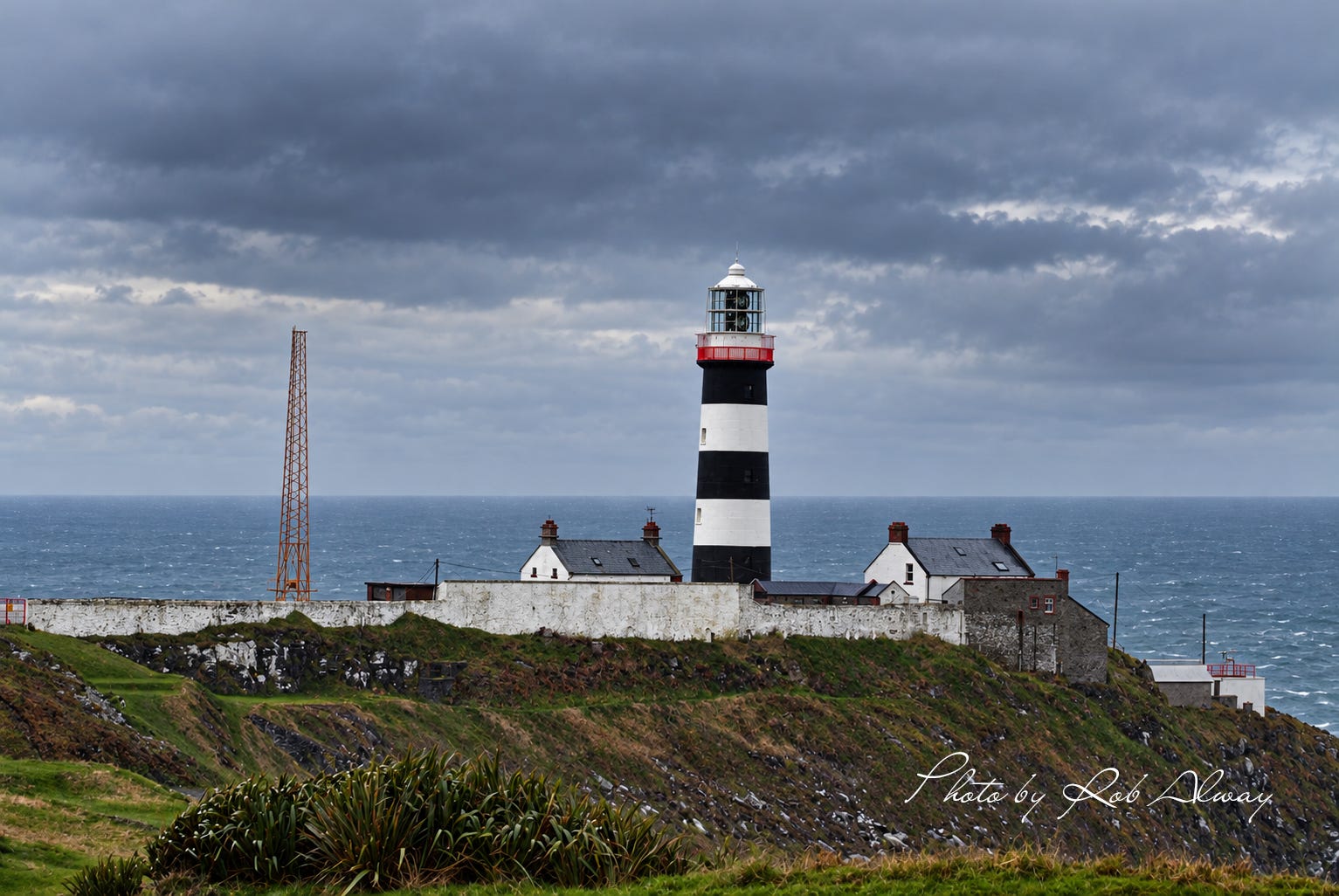
A lighthouse overlooking the Atlantic
The Old Head of Kinsale is a narrow headland extending approximately two miles into the Atlantic Ocean. Its cliffs rise hundreds of feet above the water, providing spectacular views of the surrounding sea.
For centuries, the headland has been an important navigational landmark for ships approaching Ireland’s southern coast and Kinsale Harbour.
The present lighthouse was completed in 1853, but the history of navigational lights at the Old Head extends considerably further back.
According to the Commissioners of Irish Lights, the first permanent lighthouse was established in 1665 under authority granted by King Charles II. It consisted of a small building with an open coal fire maintained on its roof.
A more modern lighthouse was established in 1814, but its elevated position created a problem. Low clouds and fog sometimes obscured its light.
The present lighthouse was constructed farther toward the end of the peninsula and at a lower elevation. Its light was first exhibited on Oct. 1, 1853.
The tower stands approximately 100 feet tall. Today, its distinctive black-and-white horizontal bands make it one of Ireland’s most recognizable lighthouses.
Interestingly, the lighthouse did not have that color scheme when the Lusitania sank. Until 1930, the tower was painted white with two red bands.
The lighthouse remains operational, displaying two white flashes every 10 seconds, with a nominal range of 20 nautical miles.
The lighthouse property is located beyond the privately operated Old Head Golf Links, which restricts ordinary public access to the southern end of the peninsula.
The great Atlantic liners
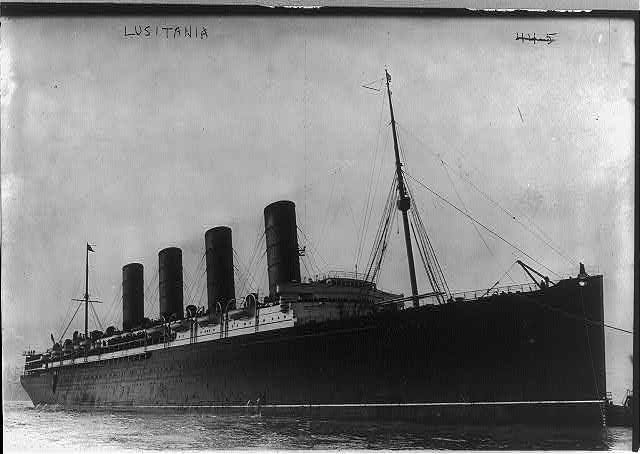
The Lusitania entered service in 1907 as one of the largest and fastest passenger ships in the world. Built by John Brown & Company at Clydebank, Scotland, she measured approximately 787 feet long, had four distinctive funnels and was powered by steam turbines driving four propellers. She could exceed 25 knots.
Her sister ship, the Mauretania, was built by Swan Hunter & Wigham Richardson in England and entered service the same year. Together, the two ships helped Cunard compete for the Blue Riband, the distinction associated with the fastest Atlantic crossings. The Mauretania held the westbound crossing record for two decades.
Cunard’s principal British rival, White Star Line, emphasized size and luxury with its three Olympic-class ships. The Olympic enjoyed a long passenger career before her retirement in 1935. The Titanic sank on her maiden voyage in April 1912. The third sister, Britannic, never entered commercial passenger service: she served as a hospital ship during World War I and sank after striking a mine in the Aegean Sea on Nov. 21, 1916.
These liners reflected the social divisions of the Edwardian era. First-class passengers traveled amid elaborate public rooms and accommodations, while second- and third-class passengers included families, immigrants and others crossing between Europe and North America. Hundreds of crew members maintained the machinery and cared for passengers.
When World War I began in August 1914, the Lusitania continued commercial service between Liverpool and New York. But the Atlantic had become increasingly dangerous.
The sinking of the Lusitania
On May 1, 1915, the Lusitania departed New York bound for Liverpool under the command of Capt. William Thomas Turner.
Germany had declared the waters surrounding the British Isles a war zone, and German submarines had begun attacking merchant shipping.
Despite the danger, passenger ships continued crossing the Atlantic.
On the afternoon of Friday, May 7, 1915, the Lusitania was approaching the Irish coast.
At approximately 2:10 p.m., German submarine U-20, commanded by Kapitänleutnant Walther Schwieger, fired a torpedo that struck the ship’s starboard side.
A second explosion followed. Although numerous theories have been offered, the precise cause of that explosion remains debated.
The Lusitania quickly developed a heavy list to starboard, making the launching of lifeboats extremely difficult.
Within approximately 18 minutes, the great ocean liner sank beneath the Atlantic.
The disaster claimed 1,198 lives, including 128 Americans. Approximately 761 passengers and crew survived, according to the widely cited figures from the original British inquiry.
The sinking took place approximately 11 miles south of the Old Head of Kinsale.
Rescue boats from Queenstown, now known as Cobh, and other coastal communities responded to the disaster. Survivors were brought ashore, while the bodies of victims were recovered from the sea.
The sinking shocked the world.
Germany maintained that the Lusitania was carrying war-related cargo, including ammunition, and that the ship was operating in a declared war zone. The vessel was indeed transporting ammunition and other military supplies, although she was also carrying civilian passengers.
The attack became an international controversy, particularly in the United States, where the deaths of American citizens intensified anti-German sentiment.
Although the sinking did not immediately bring the United States into World War I, it became an important event in the deterioration of relations between the two nations. The United States entered the war in April 1917.
Today, the wreck of the Lusitania rests approximately 300 feet beneath the Atlantic, within sight of the Irish coastline.
A memorial at the Old Head
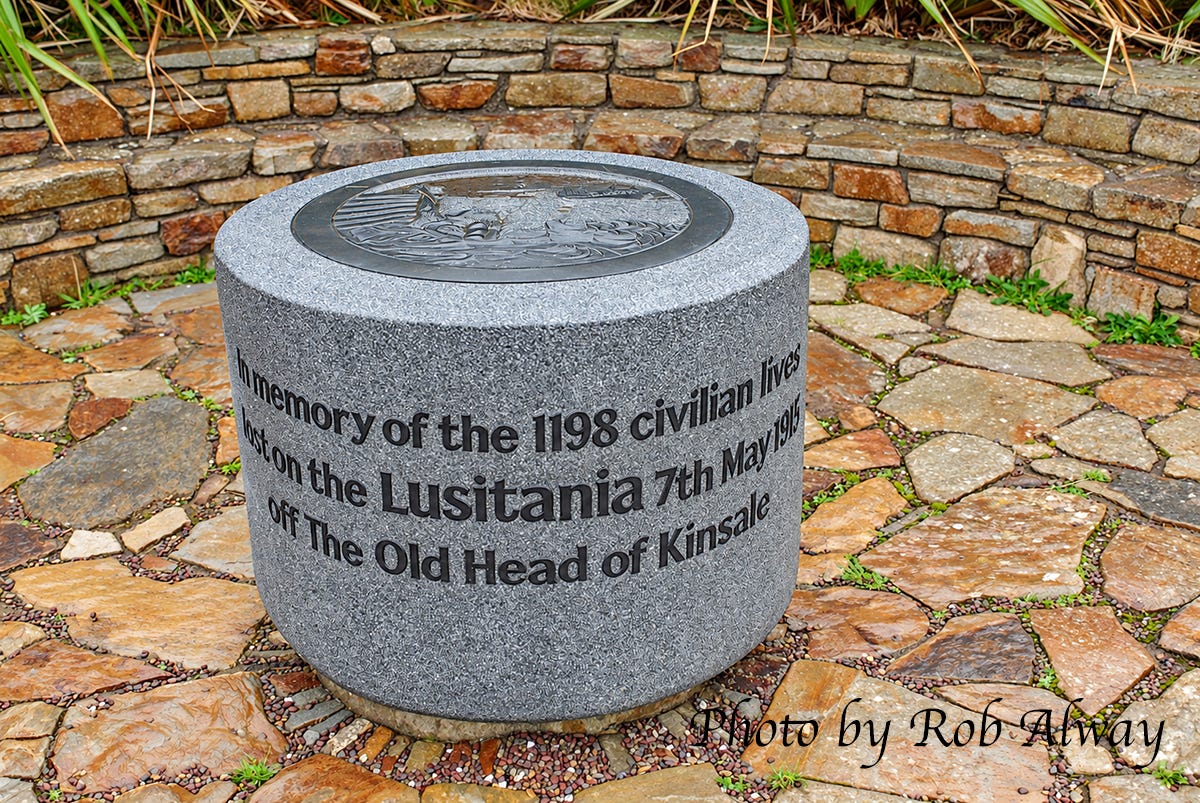
One of our stops during the January 2006 visit was the Lusitania memorial at the Old Head of Kinsale.
The circular granite monument stands in a stone-paved setting overlooking the Atlantic.
Its inscription reads:
“In memory of the 1198 civilian lives lost on the Lusitania 7th May 1915 off The Old Head of Kinsale.”
The memorial was unveiled May 7, 1995, on the 80th anniversary of the sinking. Designed by sculptor Brian Little, it was established through the efforts of the local community.
The monument is relatively simple, but its location gives it particular meaning. It stands on the headland nearest the wreck, overlooking the waters where the disaster occurred.
During our visit, I photographed the memorial and the nearby lighthouse.
Unlike many maritime memorials located in cemeteries or public parks far from the site of a tragedy, this one offers a direct geographical connection to the event it commemorates.
From the Old Head, visitors can look toward the waters where one of the most famous passenger ships in history met her end.
A watchtower from another era
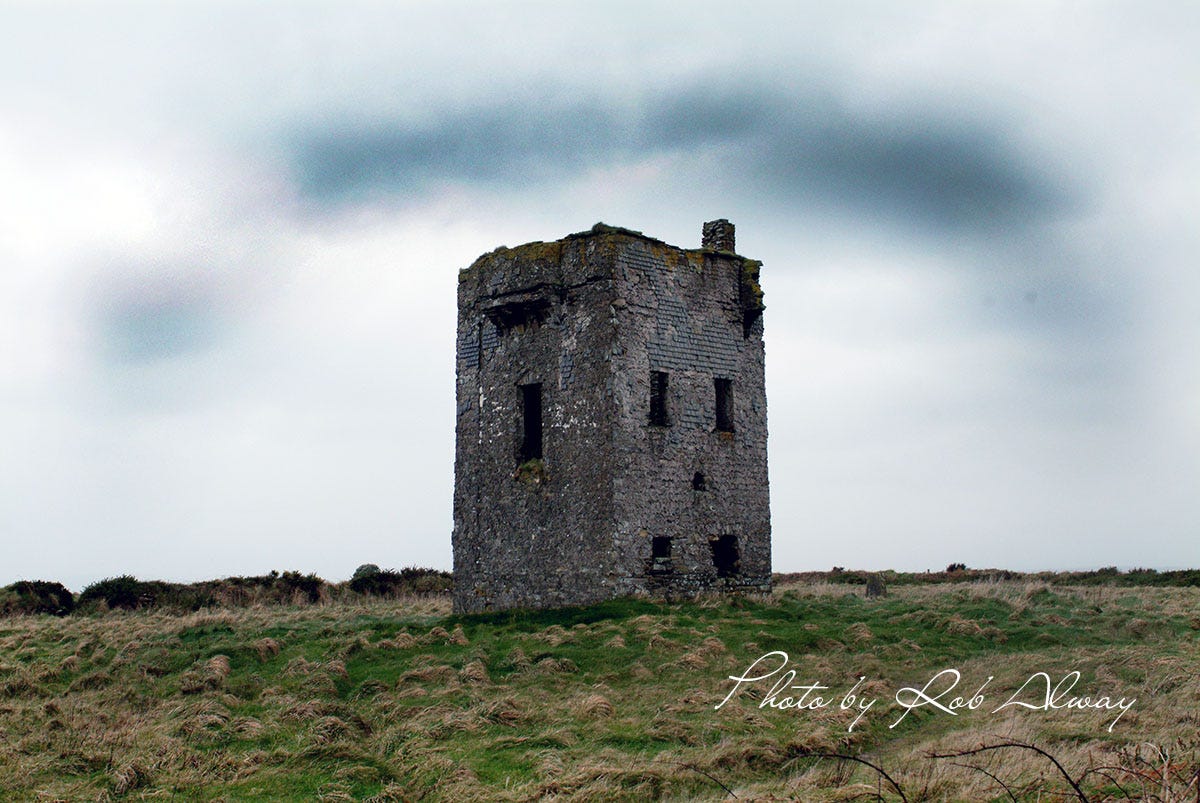
Another photograph I took in 2006 shows a small, square stone tower standing alone in an open field near the lighthouse.
Its narrow windows and heavy stone construction give it the appearance of a medieval structure.
In fact, it was built in 1804 as part of a British coastal defense system intended to warn of a possible French invasion during the Napoleonic Wars.
Following an unsuccessful French expedition to Bantry Bay in 1796, British authorities developed a network of 81 signal stations around Ireland’s coastline.
Constructed between 1804 and 1806, the stations were positioned within sight of one another so that warnings could be transmitted rapidly along the coast.
Signalmen communicated using flags, pennants and large balls raised on tall masts.
The Old Head of Kinsale tower was Station No. 25.
The system was abandoned following Napoleon’s defeat in 1815, leaving many of the towers to deteriorate over the next two centuries.
When Tom and I visited the Old Head in 2006, the signal tower was still standing, but it was clearly in poor condition.
The stone walls had weathered considerably, vegetation covered portions of the structure and the building’s windows were empty openings.
At the time, it appeared to be another abandoned historical landmark along the Irish coast.
But that would soon change.
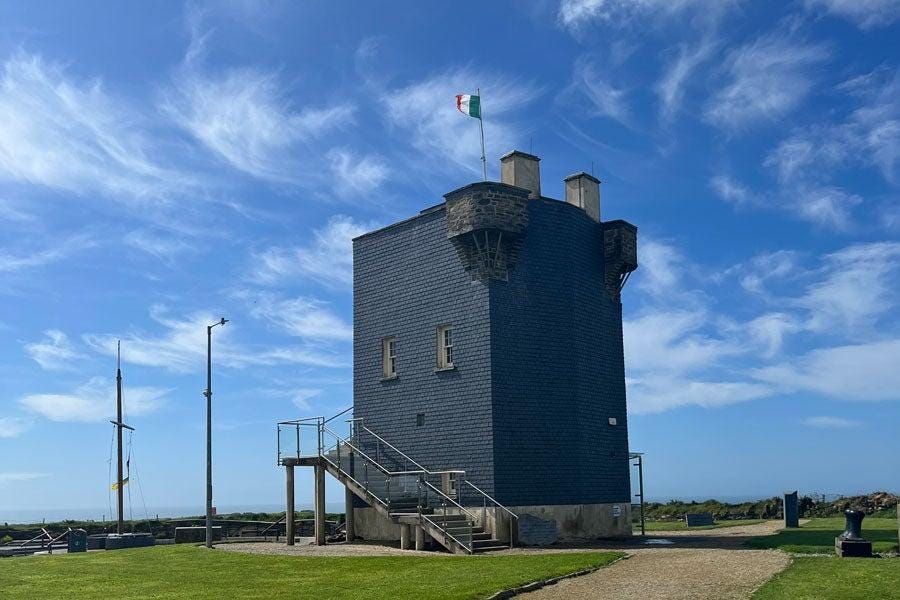
Restoring the Old Head Signal Tower
In 2010, a local community organization began exploring plans to restore the abandoned signal tower and develop a heritage attraction dedicated to the history of the Old Head and the Lusitania disaster.
The project was undertaken through Courceys Rural Integrated Development and eventually developed into a three-phase preservation and interpretation initiative.
The first phase involved restoring the signal tower itself.
Work began in September 2014 and included extensive masonry repairs, stabilization of the structure, improvements to the interior and the installation of exhibition space.
The restored tower officially opened May 7, 2015, marking the 100th anniversary of the Lusitania sinking.
According to the organization responsible for the project, the Old Head tower is the only one of Ireland’s original 81 Napoleonic signal stations to have been restored and opened to the public.
The restoration has allowed visitors to enter the building and climb to the rooftop for views of the surrounding Atlantic coastline.
The interior contains exhibits explaining the Napoleonic signal network and the maritime history of the Old Head, including the sinking of the Lusitania.
The project’s second phase involved construction of a new Lusitania Memorial Garden adjacent to the restored tower.
The garden was officially opened May 7, 2017, on the 102nd anniversary of the sinking.
Its features include a large commemorative sculpture known as The Wave, created by artists Eithne Ring and Liam Lavery. The memorial includes the names of those aboard the Lusitania on her final voyage.
Another significant artifact displayed at the site is an original lifeboat davit from the ship, donated to the project by a local government body in Northern Ireland.
The original granite memorial that my brother and I visited in 2006 remains nearby.
Building a Lusitania museum
The third phase of the preservation project involves the development of a larger, purpose-built Lusitania museum.
Although the restored signal tower already houses exhibits, its interior space is limited.
The proposed museum would provide room for additional artifacts, historical displays and educational programs.
The organization hopes to create a comprehensive interpretation of the Lusitania disaster, placing the ship’s history within the broader context of international politics, World War I, ocean travel and the lives of the passengers and crew.
The estimated cost of the project is approximately €7 million (about $7.8 million). As of October 2026, fundraising and development efforts for this phase continue.
The preservation of the tower and creation of the memorial garden demonstrate what a committed local community can accomplish.
Rather than allowing an abandoned landmark to continue deteriorating, the people involved have transformed it into a place where visitors can learn about two different periods of maritime history.
Looking back after 20 years
It has been more than 20 years since Tom and I visited the Old Head of Kinsale.
Looking through my photographs from that trip, I find it interesting to see how much has changed at this historic place.
The lighthouse still stands above the Atlantic, continuing its work as an aid to navigation.
The original Lusitania memorial remains in place, commemorating those whose lives ended in the waters offshore.
But the most noticeable change has been the restoration of the old signal tower.
In 2006, it was an abandoned structure standing in an open field. Today, it has become an important part of a maritime heritage attraction.
The Great Lakes and the Atlantic coast of Ireland are separated by thousands of miles, but their maritime histories have much in common.
Both have communities whose identities are closely connected to shipping. Both have lighthouses that have guided mariners through dangerous waters. Both have shipwrecks that continue to fascinate historians, researchers and the descendants of those who sailed aboard the vessels.
And both have people dedicated to preserving that history.
The story of the Lusitania is one of technological achievement, international conflict and tremendous human loss. The Old Head of Kinsale provides a place to remember that story while also preserving an important chapter of Ireland’s coastal history.
Sources: Historical information was obtained from the Commissioners of Irish Lights’ history of the Old Head of Kinsale Lighthouse; the Lusitania Museum & Old Head Signal Tower; Courceys Rural Integrated Development; the British Wreck Commissioner’s inquiry into the sinking of the Lusitania; the National Museum of American History; the Mariners’ Museum and Park; historical accounts of the Cunard and White Star Line fleets; and contemporary reporting on the restoration of the signal tower, development of the memorial garden and proposed museum. Personal observations and photographs are from my January 2006 visit to Ireland with my brother, Tom.
For further reading: I recommend Dead Wake: The Last Crossing of the Lusitania, by Erik Larson (Crown Publishers, 2015), and Lusitania: Triumph, Tragedy, and the End of the Edwardian Age, by Greg King and Penny Wilson (St. Martin’s Press, 2015).