


By Rob Alway
Author’s note: On Nov. 10, 1975, the steamer Edmund Fitzgerald sank on Lake Superior with all 29 men aboard. Among the vessels that joined the subsequent search was the steamship Wilfred Sykes. In October 2026, I spent five days aboard the Sykes. That voyage offered a personal connection to the ship and the sailors who answered the call more than half a century earlier.
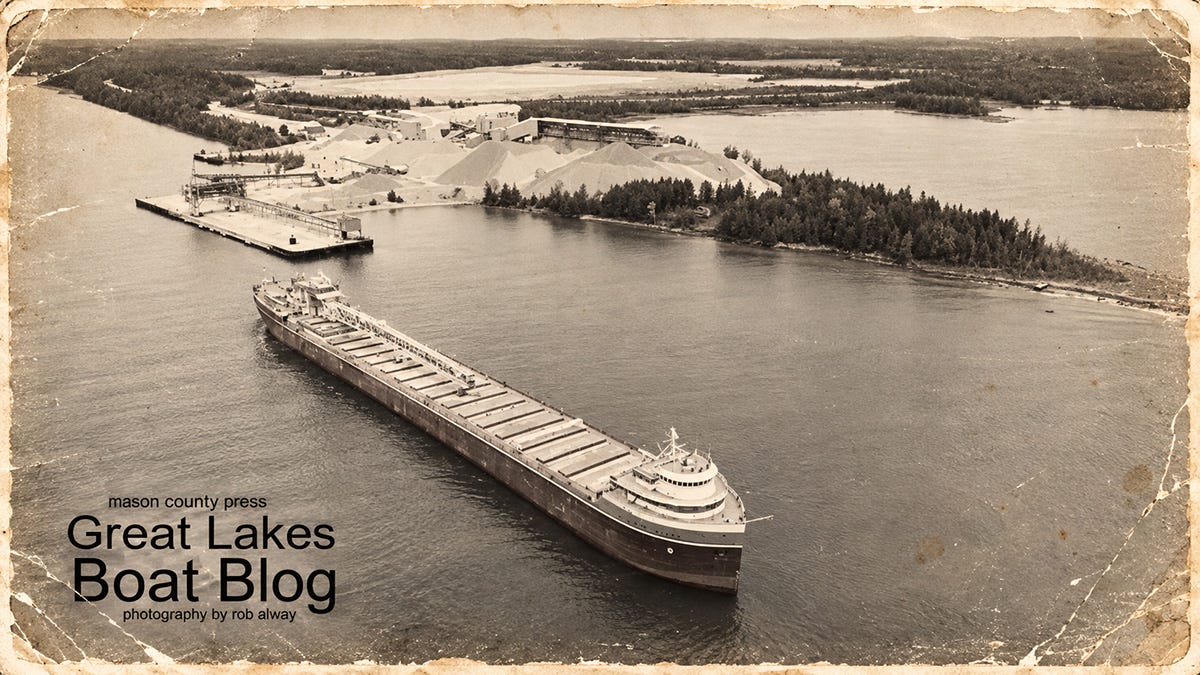
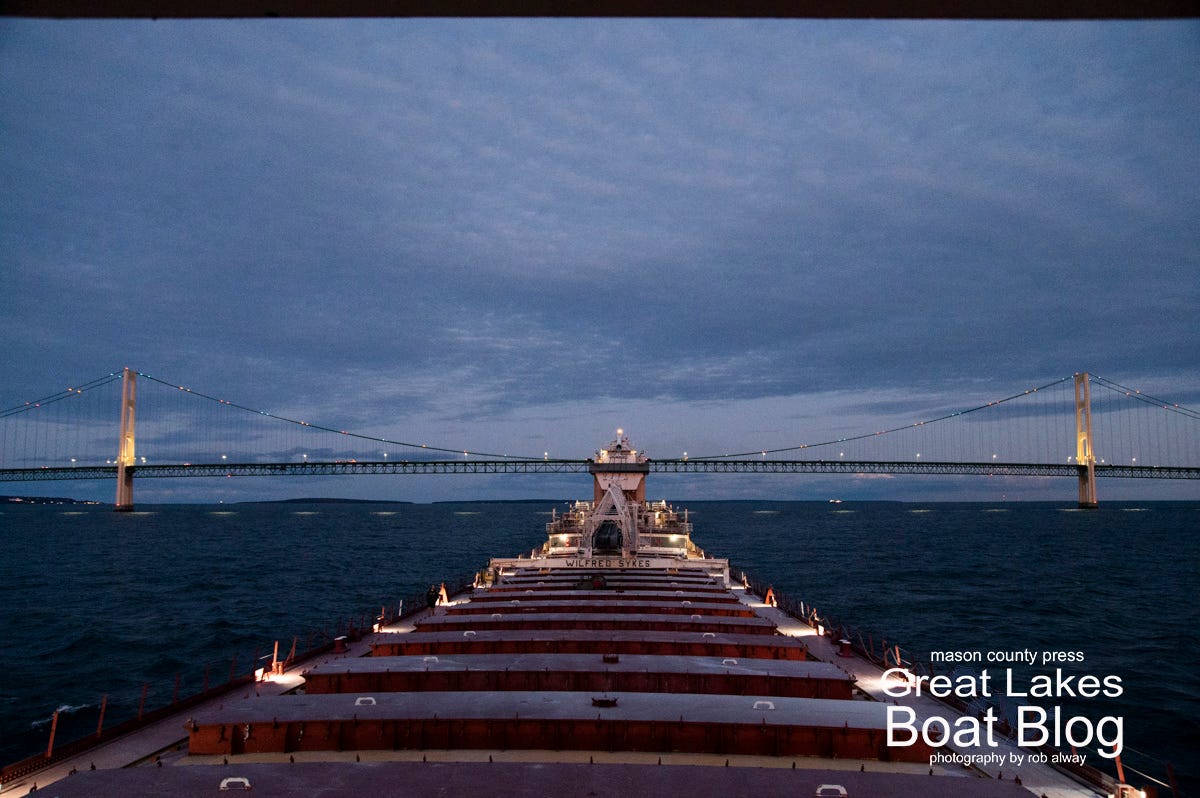
Standing in the forward pilothouse of the 678-foot SS Wilfred Sykes last month, I thought about the extraordinary history that had taken place aboard her. Built in 1949 and entering service in 1950, the freighter has outlived entire generations of Great Lakes vessels. She has carried millions of tons of cargo, endured dangerous storms and figured in two remarkable maritime emergencies.
One of those emergencies occurred 51 years ago, when the Edmund Fitzgerald disappeared during a violent Lake Superior storm. The Sykes and her crew were among the mariners who responded to the desperate search for survivors.
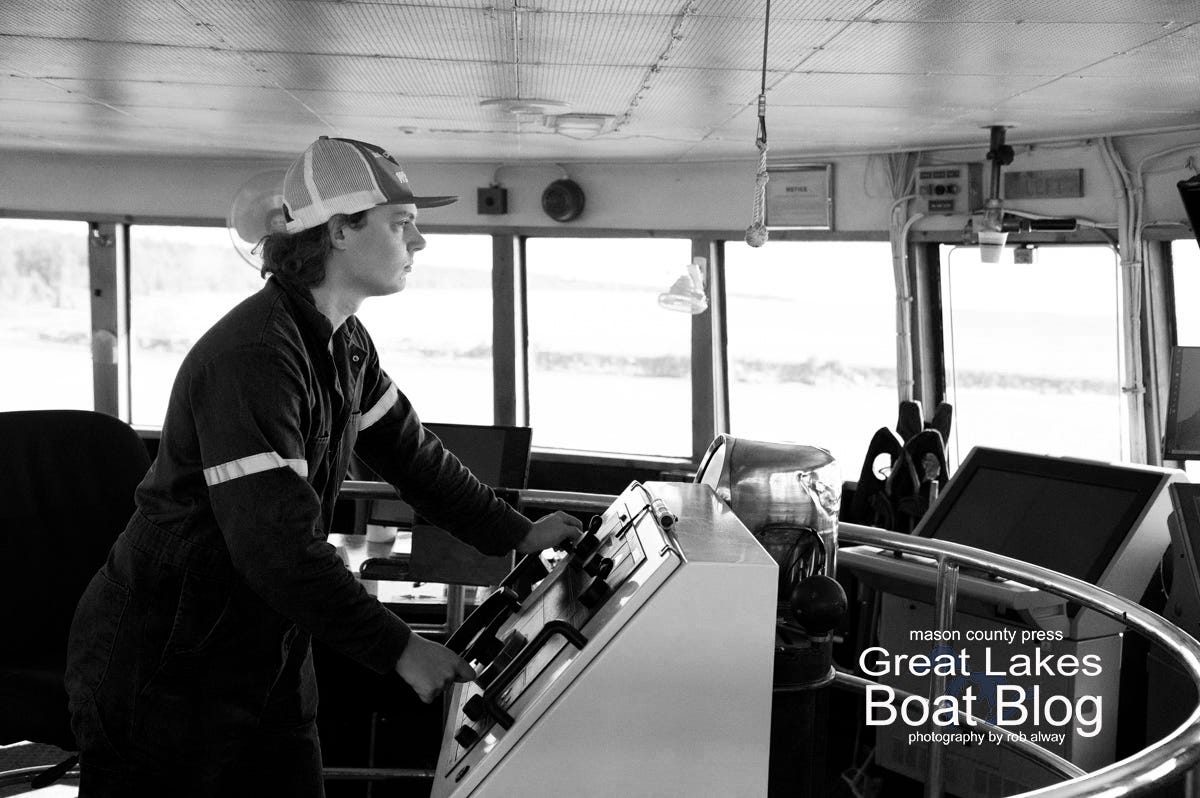
From Oct. 4 to 8, 2026, I traveled with the Sykes from Port Dolomite near Cedarville, Michigan, to Port Inland near Gulliver, Michigan, and on to Burns Harbor, Indiana, before returning north. Capt. Jason Cracraft and his crew welcomed me into the pilothouse and engine room. I was even given an opportunity to steer the ship and, under the engineers’ supervision, to operate the steam controls as we approached Burns Harbor.
Our weather was mostly pleasant. But standing at the helm of that historic freighter, looking out over the water ahead of her bow, I could not help wondering what that same pilothouse had been like during the November 1975 storm.
A different route into the storm
On Nov. 9, 1975, the Edmund Fitzgerald departed Superior, Wisconsin, with more than 26,000 tons of taconite pellets destined for the Detroit area. Capt. Ernest M. McSorley commanded the 729-foot freighter. Across the dock, the Wilfred Sykes was also loading. Under Capt. Dudley J. Paquette, she departed approximately an hour and three-quarters after the Fitzgerald.
Paquette had sailed the Great Lakes since his teenage years in Marquette, Michigan. He had served at sea during World War II and later became an officer with Inland Steel Co., the Sykes‘ owner. He also studied weather with unusual care, comparing forecasts with his own observations and barometric readings.
What began as a relatively calm departure looked increasingly ominous to him. The National Weather Service forecast was evolving, and Paquette believed a powerful storm would cross Lake Superior in a way that made the usual route particularly hazardous.
McSorley and Capt. Jesse B. Cooper of the Arthur M. Anderson, which was following the Fitzgerald, headed eastward across the lake. Paquette made a different choice. He took the Sykes toward Lake Superior’s northern shore, seeking some protection from the Canadian coastline and the waters near Isle Royale.
Years later, in interviews with Minnesota Public Radio, Paquette remembered his discomfort at departing from the judgment of two other veteran masters. He feared looking overly cautious. Nevertheless, he remained convinced the northern course gave his vessel a better chance of avoiding the worst of the storm.
Even that course offered no guarantee. By late Nov. 9, the Sykes was being battered by steep seas and snow squalls. Paquette recalled towering waves in the waters between Isle Royale and the Canadian shore. Spray and water swept high across the vessel, making the enormous bulk carrier seem vulnerable in a way that would be difficult to imagine from a calm shoreline.
The ship took temporary shelter at Thunder Bay, Ontario, on the morning of Nov. 10. When the wind shifted, Paquette moved toward Passage Island to assess whether conditions permitted an eastbound crossing. His judgment mattered not only for the ship and cargo, but also for every sailor living and working aboard.
That responsibility is easy to underestimate. A ship of the Sykes‘ size does not respond instantaneously. A master must anticipate wind, waves, course changes and the vessel’s momentum, often long before a maneuver begins. The consequences of a poor decision may not become apparent until there is little time to correct it.
The Fitzgerald disappears
Meanwhile, the Fitzgerald and Anderson were battling the storm farther east. During the afternoon of Nov. 10, McSorley reported damage to the Fitzgerald, including a downed railing and damaged vents, as well as a list and pumps operating. Trouble with the ship’s radar eventually made the Anderson‘s assistance especially valuable as they approached Whitefish Bay.
Paquette later said he heard portions of the radio traffic between the vessels. In one interview, he attributed the unusual range of the transmissions to atmospheric conditions. He remembered the troubling reports and the Fitzgerald‘s final assurance that the crew was holding its own.
Shortly after 7:10 p.m., the Fitzgerald vanished from the Anderson‘s radar. No distress call was received. All 29 sailors were lost. The wreck was later found in roughly 530 feet of water about 17 miles from the entrance to Whitefish Bay, Michigan.
The precise sequence of events that sank the Fitzgerald remains disputed. The Coast Guard concluded that the freighter lost buoyancy after massive flooding of the cargo hold, most likely through ineffective hatch closures. Other investigators and experienced mariners have proposed different mechanisms. Paquette believed structural failure played an important part, but his assessment was one interpretation rather than a settled finding.
Whatever the cause, the immediate reality was devastating: a fully loaded freighter had vanished, and no one knew whether any of her crew had survived.
The call to search
When radio calls went unanswered, the Anderson reported the disappearance. Cooper, already nearing the comparative protection of Whitefish Bay, was asked to turn back into the storm. It was an extraordinary request under dangerous conditions. He did so, and the William Clay Ford also joined the initial nighttime search.
The Coast Guard dispatched aircraft and organized a wider operation. The severe weather and distances involved made the response difficult. The cutter Naugatuck encountered mechanical problems, while the Woodrush had to travel from Duluth, Minnesota, many hours away. In the meantime, commercial freighters already on the lake were among the most immediate sources of assistance.
The official Coast Guard investigation identifies the Wilfred Sykes among the vessels that answered the urgent calls and participated in the expanded search. The Armco, Roger Blough, Reserve and William R. Roesch were among the other American ships, joined by Canadian vessels and aircraft.
The record makes an important distinction. The Anderson and William Clay Ford made the dangerous first search on the night of Nov. 10. The Sykes participated in the broader response afterward. The Coast Guard report does not specifically credit the Sykes with recovering any wreckage.
Searching for people in the open waters of Lake Superior is an enormous undertaking even in good weather. After a storm, debris can be dispersed across miles of water; floating objects may be nearly indistinguishable from breaking seas. Every vessel had to navigate safely while keeping watch for anything that might be a life raft, wreckage or, against all odds, a survivor.
For the crew of the Sykes, a commercial voyage had become a search for fellow mariners who had faced the same storm. They understood what it meant to be aboard an enormous ship in heavy weather. They understood, too, the dread that comes when another vessel stops answering the radio.
The search continued through Nov. 13. Lifeboat material, life preservers and other debris were recovered, but no survivors or bodies were found. Aircraft and vessels had done what they could. The loss remained total.
A tradition of helping fellow sailors
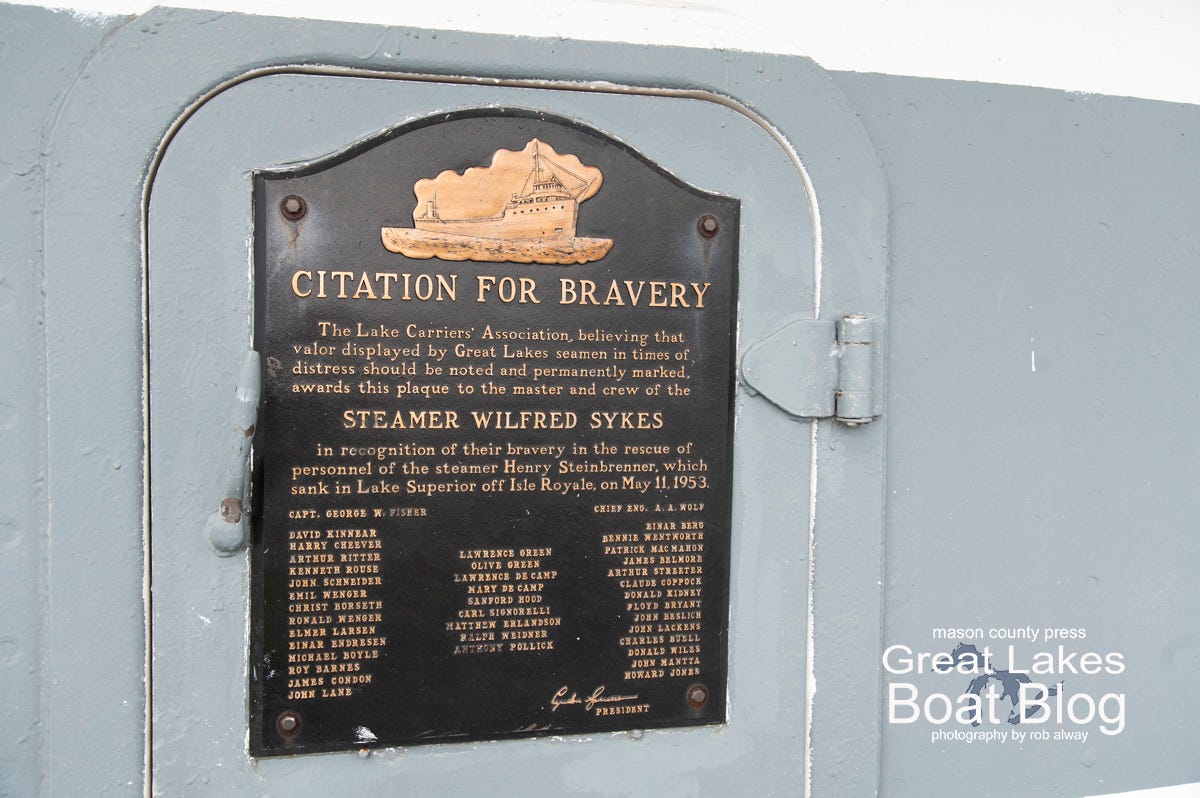
The Fitzgerald search was not the first maritime emergency in the Sykes‘ history. In May 1953, after the steamer Henry Steinbrenner sank in Lake Superior, members of the Sykes‘ crew launched a lifeboat in heavy seas and rescued two men.
A plaque recognizing that act of bravery is displayed aboard the Sykes. I saw it during my visit. It is a small physical object when compared with the size of the vessel around it, but its significance is considerable. It records not only an event, but the willingness of sailors to risk themselves for other sailors.
The 1953 rescue ended with lives saved. The 1975 search did not. Both belong to the same tradition. When a vessel is in danger, the obligation to assist, when it can be done safely, is part of the maritime profession. It transcends competing shipping companies, cargo schedules and national borders.
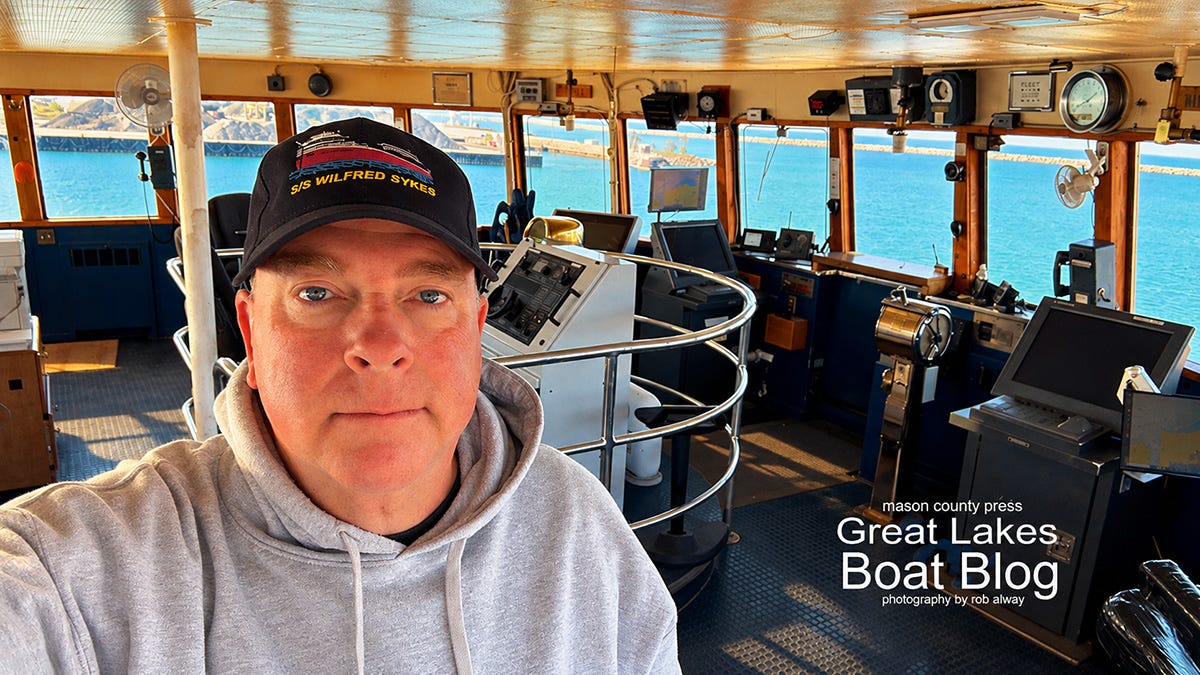
At the helm, half a century later
The Sykes was launched as one of the most advanced freighters on the lakes. Built by American Ship Building Co. at Lorain, Ohio, she was the first new American-built Great Lakes freighter after World War II, with a 70-foot beam and capacity surpassing 20,000 tons. Today she remains a working steam-powered bulk carrier operated by Central Marine Logistics.
Her forward pilothouse and aft engine room evoke a generation of Great Lakes freighters that has largely disappeared from commercial service. Oil-fired boilers provide steam for the turbines that drive a single propeller. Her crew continues to navigate, maintain and operate machinery built for an entirely different era.
My October voyage provided an unusual chance to understand some of that operation firsthand. Steering the Sykes was especially meaningful. For years I had photographed ships passing the eastern shore of Lake Michigan. Now I was at the wheel of one of those ships, responsible for the helm under the supervision of professional mariners. I was keenly aware that briefly steering a vessel in favorable conditions was very different from commanding her in a November gale.
At Burns Harbor, Chief Engineer Mark Nickerson and Third Assistant Engineer Tyler Gray-Hoehn also let me handle the steam controls under their guidance as we approached port. I could watch the machinery respond and appreciate the communication necessary between the pilothouse and the engine department.
Unlike a modern ship equipped with a controllable-pitch propeller, the Sykes must stop her propeller before reversing its rotation. Cracraft, who first came aboard as a deckhand in 2005 and became the vessel’s permanent master in April 2026, summed up the difference: “A steamer is a whole different animal.”
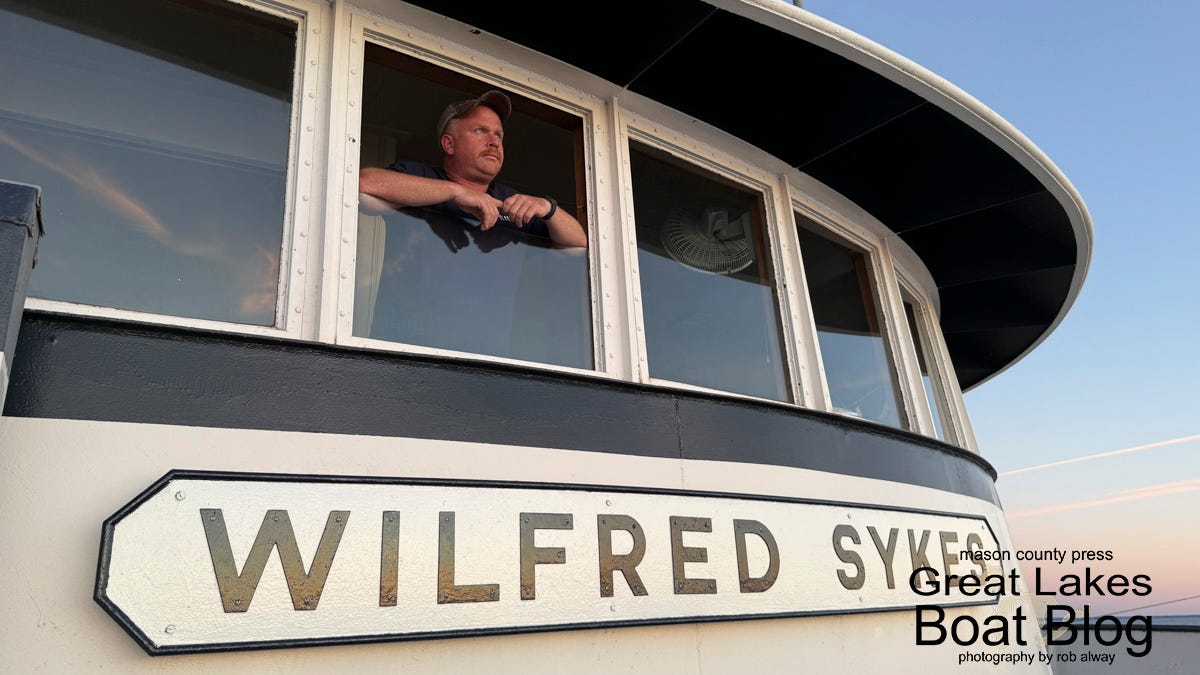
The work was continuous. Mates stood watch, engineers tended the propulsion plant, deckhands handled maintenance and cargo operations, and the steward department fed the crew. The freighter was both a workplace and a temporary home. Although our five-day trip was comfortable, I could see the discipline needed to sustain that routine through long stretches away from family.
One morning on our return north, Cracraft selected a mid-lake course on Lake Michigan to avoid higher waves forecast closer to shore. The anticipated rough seas did not materialize. Still, seeing him evaluate the forecast gave me a small insight into Paquette’s 1975 decision. The equipment and forecasts have changed dramatically; the captain’s responsibility for the vessel and her crew has not.
There was another personal connection. Cracraft is the grandson of the late Capt. Bruce Masse, a longtime Ludington, Michigan, carferry master who helped bring the SS Badger into her modern era. From the Sykes I saw familiar landmarks along the Michigan shore and, on our northbound trip, spotted the Badger crossing Lake Michigan toward Manitowoc, Wisconsin. Two historic steamships were operating within sight of one another, their crews carrying forward very different but related Great Lakes traditions.
The people behind the history
It is tempting to remember the Edmund Fitzgerald chiefly through her size, her disappearance and the song that has kept the tragedy in public memory. For people who work on the lakes, however, the loss remains first and foremost about 29 fellow sailors who never returned to their families.
The men aboard the Anderson, William Clay Ford, Wilfred Sykes and other search vessels also had families waiting at home. They understood the danger because they lived with it. Their response deserves a place in the history of the disaster, even though no rescue was possible.
The Wilfred Sykes is still at work 51 years after that storm. Captains and crews have changed, but her engines still turn and she still carries cargo across the lakes. Her story links the industrial Great Lakes of the postwar era with the sailors working on them today.
Five days aboard did not make me a sailor. They did give me a much greater appreciation for the people who keep these ships moving. To stand in the Sykes‘ pilothouse, steer her, learn from her crew and see the plaque commemorating an earlier rescue made her history far more immediate than any photograph or archive could. For me, the greatest significance of her role in the Fitzgerald search is simple: when fellow mariners needed help, the Wilfred Sykes answered.
Sources: U.S. Coast Guard, Marine Casualty Report: SS Edmund Fitzgerald (1977); National Transportation Safety Board, Marine Accident Report: SS Edmund Fitzgerald (1978); Minnesota Public Radio interviews with Capt. Dudley J. Paquette (1999 and 2000); Michigan Public, historical radio account (2015); Rob Alway, Aboard the Wilfred Sykes, Great Lakes Boat Blog and Mason County Press. (2026), including onboard observations and interviews.