


By Rob Alway
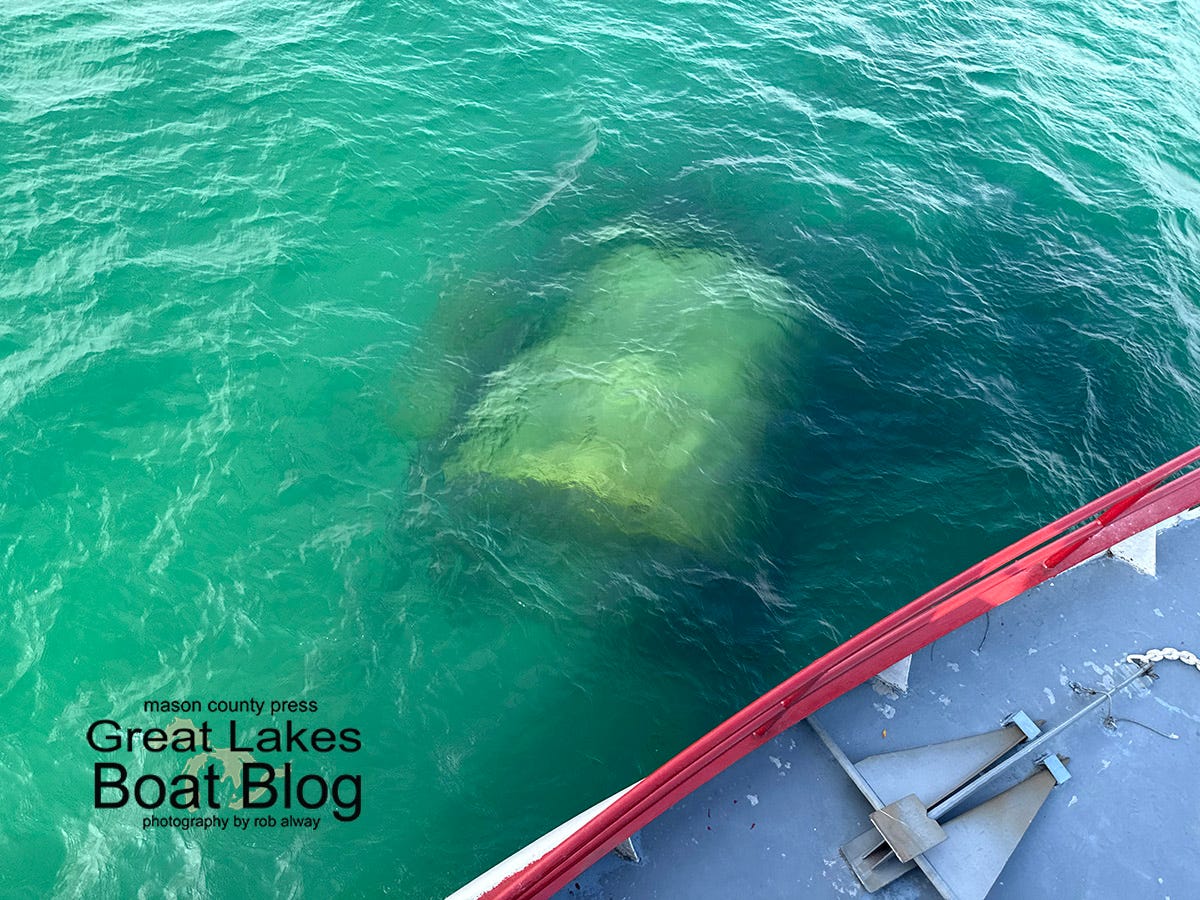
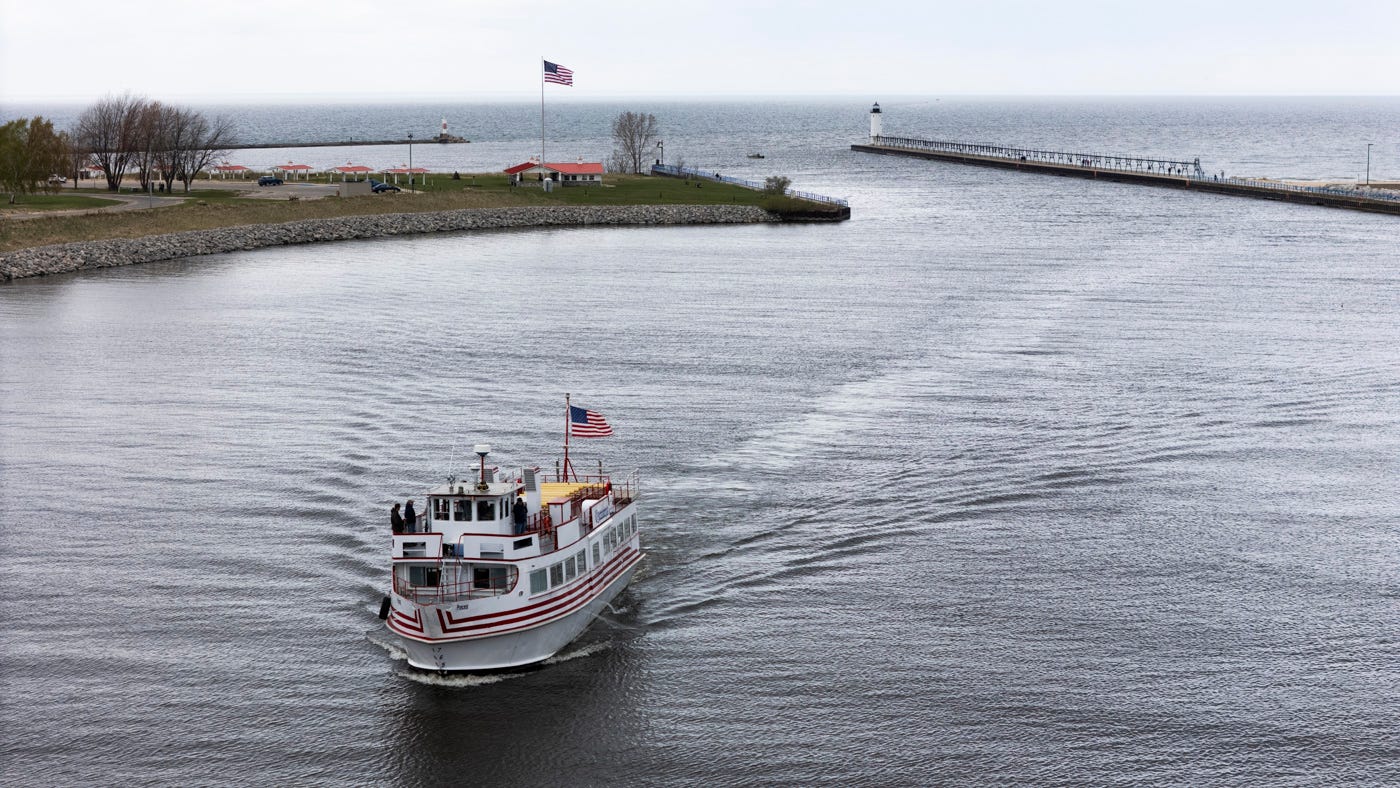
MANISTEE COUNTY, Michigan — Under the right lighting conditions, passengers aboard Manistee Harbor Tours’ Princess of Manistee can see the remains of a wooden steam freighter beneath the waters of Lake Michigan. The wreck rests in approximately 25 feet of water near the mouth of Barr Creek, about four miles north of the Manistee harbor entrance.
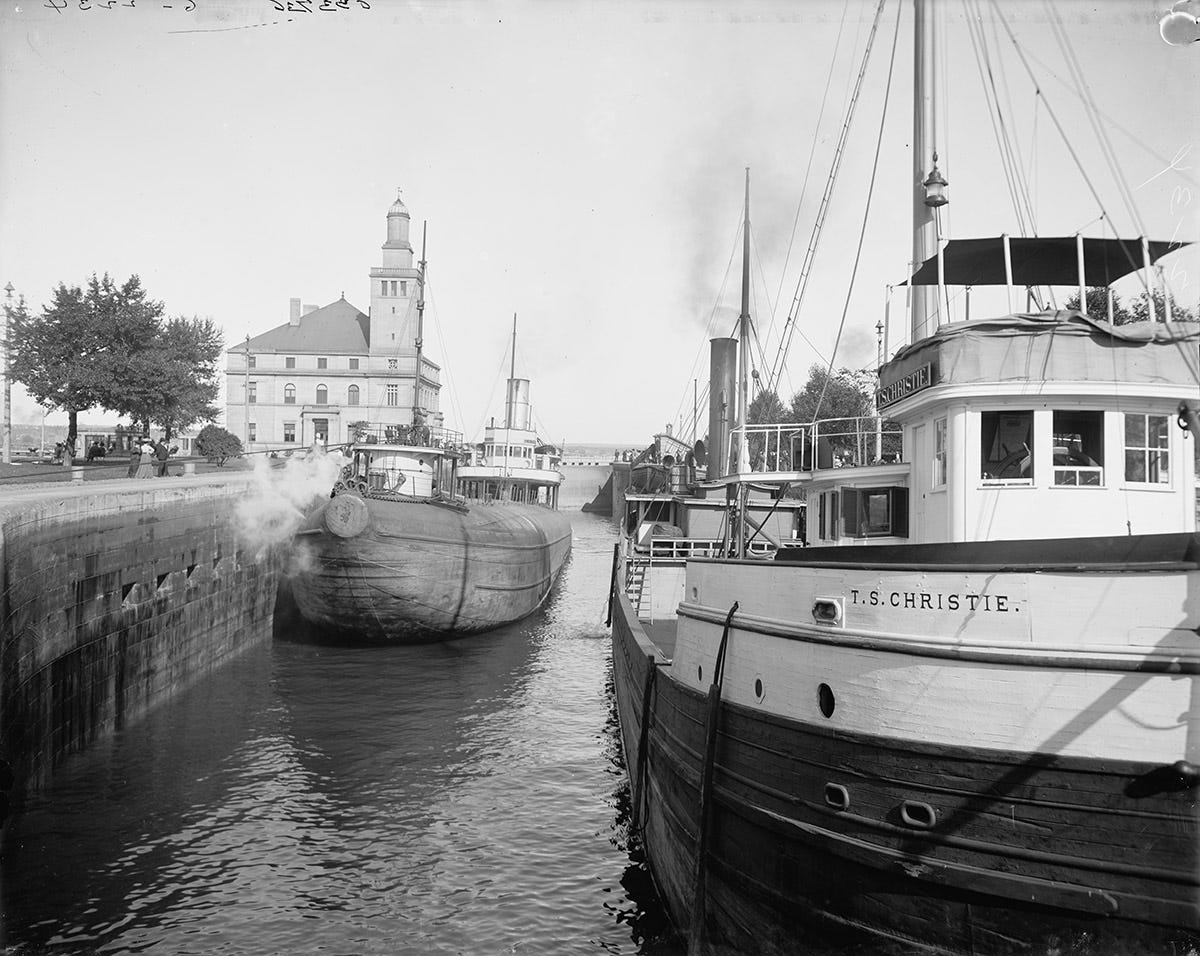
The vessel is the T.S. Christie, a 160-foot freighter that spent nearly half a century working the Great Lakes before a November 1933 snowstorm brought her career to a violent end.
On the night of Nov. 8, 1933, Capt. Louis Strahan was attempting to navigate the Christie into Manistee harbor. Blinding snow obscured the shoreline, and neither the harbor lights nor its fog signal could be detected. Despite careful soundings, the freighter ran aground approximately 1,500 feet from shore.
For the next several hours, Strahan and his crew struggled to free their vessel while waves crashed against her wooden hull. With no radio to summon assistance and rescue boats unable to reach them, the men eventually escaped in their own lifeboat.
All 12 survived. Their ship did not.
Nearly half a century on the lakes
The T.S. Christie was built in 1885 by F. W. Wheeler & Co. at West Bay City, Michigan, now part of Bay City.
According to the Father Edward J. Dowling Marine Historical Collection at the University of Detroit Mercy, the wooden freighter measured 160 feet long, had a beam of 30.3 feet and a depth of 12 feet. Her official United States registry number was 145402.
Originally constructed as a double-deck package freighter, the Christie was converted to carry bulk freight around 1902, reflecting changing demands in Great Lakes commerce.
Some of her machinery was considerably older than the vessel herself. Her original engine, built in 1867, had previously powered the steamer B. W. Jenness. The machinery was subsequently modified during the Christie‘s long career.
The freighter had several owners, including Capt. Peter Peterson of Green Bay, Wisconsin; G. Engelkins of Chicago, Illinois; the H. H. Hettler Lumber Co. of Chicago; and the Marinette Transportation Co.
Shipping notices from August 1904 placed her in the lumber trade at Midland and Penetanguishene, Ontario, illustrating how vessels such as the Christie moved between ports throughout the Great Lakes.
By November 1933, she was carrying pulpwood for the Hettler interests. Her final voyage was from Escanaba, Michigan, to Filer City, just south of Manistee.
A harbor hidden by snow
The circumstances of the Christie‘s final voyage were recounted by maritime historian James P. Barry in Wrecks and Rescues of the Great Lakes: A Photographic History, first published in 1981 by Howell-North Books of San Diego, California. A second edition was published by Thunder Bay Press in 1994.
Barry’s account was also featured in Jim Hettinger’s January 22, 2017, column, “The self-rescue of the T.S. Christie,” published in the Battle Creek Enquirer.
By the evening of Wednesday, Nov. 8, 1933, snow and fog had reduced visibility to almost nothing along the eastern shore of Lake Michigan.
At approximately 8:40 p.m., Strahan ordered the engine checked while the Christie drifted and the mate took soundings. The crew found eight fathoms of water, or approximately 48 feet, but the depth was decreasing as the freighter approached shore.
Finding the harbor in those conditions was an exercise in judgment, soundings and careful listening.
The men searched for the harbor light. They listened for its fog signal. Neither was apparent through the storm.
Shortly before 10 p.m., Strahan stopped the freighter again while he and the mate tried to establish their position. Believing they were north of the harbor entrance, Strahan began turning southwest.
Then came a slight bump.
The Christie had touched bottom.
It was a relatively gentle grounding, but her situation quickly became serious. Efforts to work the freighter free only drove her farther onto the shoal.
Although the crew eventually could see evidence of activity ashore, the harbor fog signal remained silent, according to Barry’s account. Strahan attempted to attract attention with the ship’s whistle and distress rockets.
Nobody responded.
The Christie was stranded only about 1,500 feet from land, yet the weather made that short distance extraordinarily dangerous.
The freighter carried no radio. Her crew was effectively isolated.
The crew saves itself
By Thursday, Nov. 9, conditions had deteriorated substantially.
The Ludington Daily News carried the story across its front page under the headline “Vessel Is Grounded North of Manistee.” The newspaper reported that the Christie had been driven off course during the previous night’s snowstorm and that attempts to free her had failed.
As waves struck the vessel broadside, her deck cargo began washing into the lake. The wooden hull listed heavily, and there was growing concern that the pounding seas would break her apart.
Coast Guard personnel at Manistee made two attempts to leave the harbor, first in a powered lifeboat and then aboard a tug. Heavy seas forced both efforts to turn back.
Strahan and the crew faced a difficult decision. Remaining aboard meant risking their lives if the freighter broke apart. Leaving required launching a small boat into dangerous surf.
The men chose the lifeboat.
Contemporary newspaper accounts indicate that Strahan and 11 crewmen reached shore on Nov. 9 without assistance from a rescue vessel. Barry’s later narrative places their departure at approximately 6 p.m., followed by a landing 15 minutes later. Reports published on Nov. 9, however, suggest the evacuation occurred earlier that day.
Despite this difference in timing, the accounts agree on the essential circumstances: The crew abandoned the stranded freighter, made its way through the surf and reached shore safely.
The men eventually arrived in Manistee, where they spent the night at the Hotel Northern.
When Coast Guard personnel reached the grounding site by traveling overland, the crew was already safe.
The event was unusual not because a rescue service had successfully removed men from a stranded freighter, but because the crew had managed to rescue itself.
Hopes of saving the Christie disappear
Although her crew had survived, the Christie remained exposed to the full force of Lake Michigan.
On Nov. 10, newspapers reported that she was lying broadside to the waves and had been driven farther onto the shoal.
Her entire deckload of pulpwood had washed away.
Strahan feared the ship could not withstand continued pounding. On Nov. 11, an Associated Press account quoted him as saying her condition “looks bad.”
The report stated that the Christie was listing heavily to starboard and was hard aground approximately 1,500 feet offshore.
Plans were discussed to bring in the barge Neff, operated by the same Chicago company, to remove cargo and assist with efforts to pull the freighter into deeper water.
The Coast Guard cutter Escanaba was also identified in contemporary accounts as part of the response. Reports indicated that the cutter was standing by, although subsequent coverage noted difficulties associated with her own repairs and availability.
Neither the Neff nor the Escanaba could save the stranded freighter.
By Nov. 15, the Escanaba Daily Press reported that the Christie had been battered to pieces by the storm. Salvage efforts turned toward recovering portions of the pulpwood cargo and wreckage, including material from the pilothouse, spars and timbers that had washed ashore.
The Christie‘s working life had ended.
Capt. Peter Peterson: A pioneer of Great Lakes navigation
One of the more interesting figures in the Christie‘s earlier history was Capt. Peter Peterson, a Norwegian immigrant who owned and operated the freighter from 1890 until his retirement in 1900.
Peterson was born Feb. 10, 1835, in Hardanger, Norway, where he developed an interest in maritime life while still a young man.
He immigrated to the United States in 1853 and made his first voyage on the Great Lakes the following year, traveling aboard the sloop Ebenezer from De Pere, Wisconsin, to Chicago.
Peterson subsequently worked on several vessels before entering the shipowning business.
In 1862, he joined Olson and Gunderson in purchasing the schooner Alleghany. Working with Gunderson and Lambert Nau, he later built the schooner Mary Nau, followed by the Libbie Nau.
In 1873, Peterson built the schooner Anna M. Peterson, described at the time as one of the largest schooners on the Great Lakes. He operated her from 1874 until 1884.
After the death of Nau, Peterson purchased the schooner F. A. Georger and operated her in partnership with Frederick Hurlbut.
His ownership of the T.S. Christie from 1890 to 1900 represented another chapter in a maritime career that had begun during the height of the sailing schooner era.
Peterson retired in 1900 after nearly 50 years on the Great Lakes.
He died in Green Bay on April 10, 1913, at age 78, following a prolonged illness. His obituary, published in the April 12, 1913, edition of the Escanaba Daily Press, recalled his involvement in both navigation and shipbuilding.
He was survived by his wife, three daughters and five sons and was buried in Woodlawn Cemetery in Green Bay.
Peterson’s career reflected the transition from sailing schooners to steam-powered freighters. The Christie was one of the vessels connecting those two periods of Great Lakes commerce.
Capt. Louis Strahan: The Christie‘s final master
Capt. Louis Francis Strahan Jr., who commanded the Christie during her final voyage, was himself a veteran Great Lakes mariner.
Strahan was born Jan. 1, 1871, in Manistee County, Michigan, the son of Louis Strahan Sr. and Johanna Elizabeth Quinn Strahan.
By 1880, his family was living in Door County, Wisconsin, a region with strong connections to Great Lakes shipping and shipbuilding.
Federal census records show that by 1910, Strahan was living in Marinette, Wisconsin, and working as a vessel captain. By 1920, he had moved to Escanaba, Michigan, where he was again listed as a captain.
His first wife, Fannie Estelle Machia Strahan, was born in Egg Harbor, Wisconsin, in 1872. The couple had several children, including Gladys, Marian, Harold, Doris and Helen. Fannie died in Escanaba on March 1, 1923.
Strahan was 62 years old when the Christie grounded north of Manistee.
The loss of the freighter did not end his career.
By the late 1930s, he was commanding vessels in the Michigan state ferry fleet operating across the Straits of Mackinac.
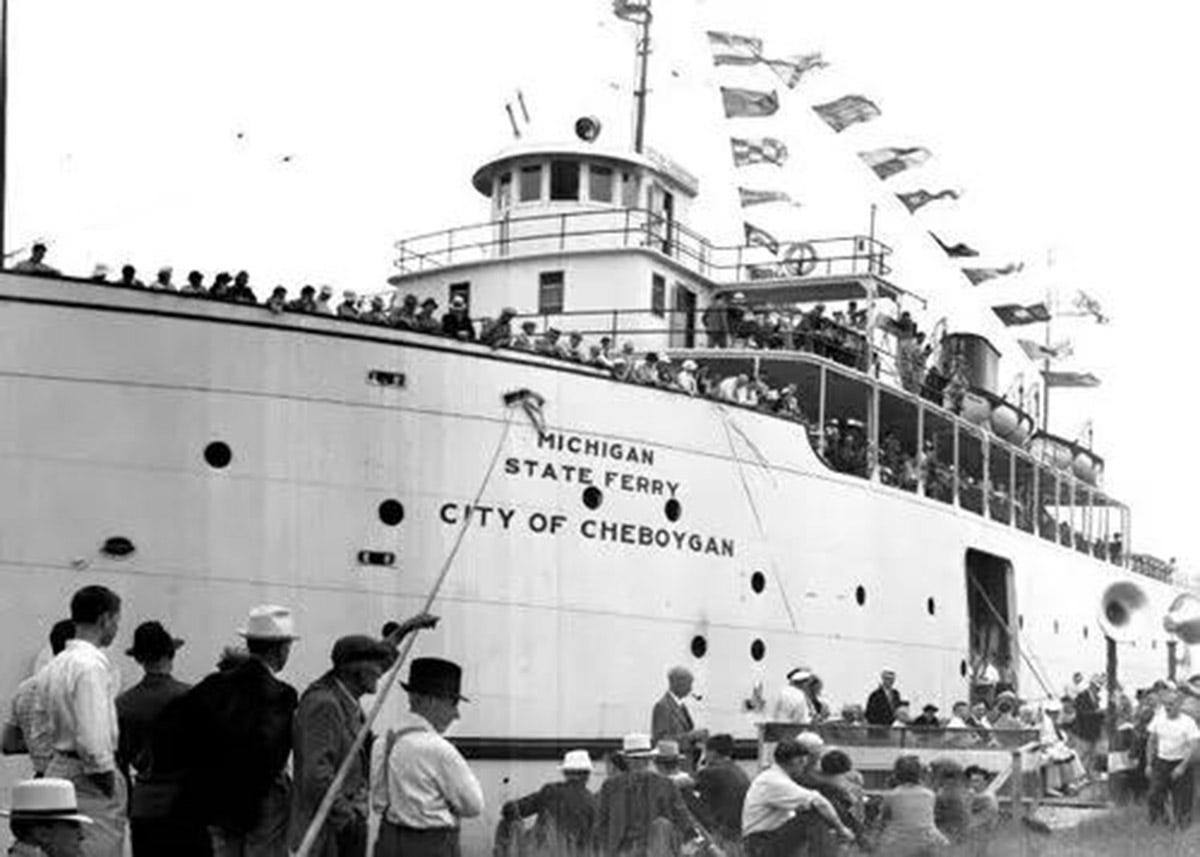
On June 8, 1939, Strahan was master of the state ferry St. Ignace when she collided with the ferry City of Cheboygan, commanded by Capt. Andrew Coleman.
The collision occurred in dense fog near the Graham Shoals, approximately five miles from Mackinaw City.
The St. Ignace was carrying passengers, automobiles and trailers. Several people aboard her suffered injuries, and the ferry sustained a large hole in her port side. The City of Cheboygan also was damaged, although no injuries were reported aboard that vessel.
Both ferries managed to reach dock under their own power.
A federal marine board subsequently investigated the collision. According to a report published June 28, 1939, the board charged both masters with failing to reduce their vessels’ speed in fog.
Strahan and Coleman pleaded not guilty during the proceedings. Capt. George Loughlin, superintendent of Michigan’s state ferry system, publicly expressed confidence in the two captains, citing their experience and the difficult conditions in the Straits.
The incident was another encounter with the navigational hazards of limited visibility, six years after the grounding of the Christie.
Strahan married Myrtle Patterson Mero on April 8, 1939, in Sault Ste. Marie, Michigan. Myrtle died in St. Ignace on Dec. 18, 1947.
Strahan died July 10, 1951, in Detroit at age 80. He was buried at Lakeview Cemetery in Escanaba.
His career had taken him from the working freighters of the Great Lakes to the state ferries of the Straits of Mackinac, with the wreck of the Christie among its most dramatic episodes.
The Christie today
More than 90 years after the November storm, what remains of the T.S. Christie lies beneath the waters north of Manistee.
The wreck is located near the mouth of Barr Creek, at approximately 44°18.366′ N, 86°18.393′ W, in about 25 feet of water.
Although the site is outside the established boundaries of the West Michigan Underwater Preserve, the Michigan Underwater Preserve Council identifies the wreck among the area’s nearby diving attractions.
Under favorable lighting and water conditions, passengers aboard the Princess of Manistee can see her remains from the surface.
The freighter’s story offers an unusual contrast to the many Great Lakes shipwrecks in which crews disappeared or perished. The Christie was destroyed, but her entire crew survived, reaching safety without a vessel coming to their rescue.
For nearly half a century, she had carried freight across the lakes, passing through changing ownership, evolving transportation markets and the transition from the schooner era to modern bulk shipping.
Her final voyage ended within sight of a shoreline that her captain could not locate through the snow.
Her men made it to land. The Christie remained behind.
Learn more about the Manistee Princess here.
Sources: Contemporary newspaper reporting from The Ludington Daily News, Nov. 9–11, 1933; South Haven Daily Tribune, Nov. 9 and 16, 1933; Jackson Citizen Patriot, Nov. 11, 1933; Escanaba Daily Press, April 12, 1913, and Nov. 15, 1933; The Sault News, June 9 and 20, 1939; The Dowagiac Daily News, June 8, 1939; and Livingston County Daily Press and Argus, June 28, 1939. Additional sources include James P. Barry, Wrecks and Rescues of the Great Lakes: A Photographic History (Howell-North Books, 1981; Thunder Bay Press, 1994); Jim Hettinger, “The self-rescue of the T.S. Christie,” Battle Creek Enquirer, Jan. 22, 2017; the Father Edward J. Dowling Marine Historical Collection, University of Detroit Mercy; Great Lakes Shipwreck Files; Michigan Underwater Preserve Council; and genealogical records concerning Capt. Louis Francis Strahan Jr. and his family.