


By Rob Alway
LUDINGTON, Michigan — On Nov. 10, 1975, the Great Lakes were gripped by one of the most infamous storms in their history. On Lake Superior, the 729-foot freighter SS Edmund Fitzgerald disappeared beneath the waves, taking all 29 crew members with her.
The sinking has become one of the defining tragedies in Great Lakes maritime history. But the storm that claimed the Fitzgerald was not confined to Lake Superior. It was a massive regional weather system, with powerful fronts sweeping across the Great Lakes. Earlier that day, violent winds and towering waves had already battered the eastern shore of Lake Michigan.
In Ludington, two young newspaper reporters were documenting the storm firsthand. Their photographs and reporting would become a lasting visual record of one of the most extraordinary weather events in the city’s history.
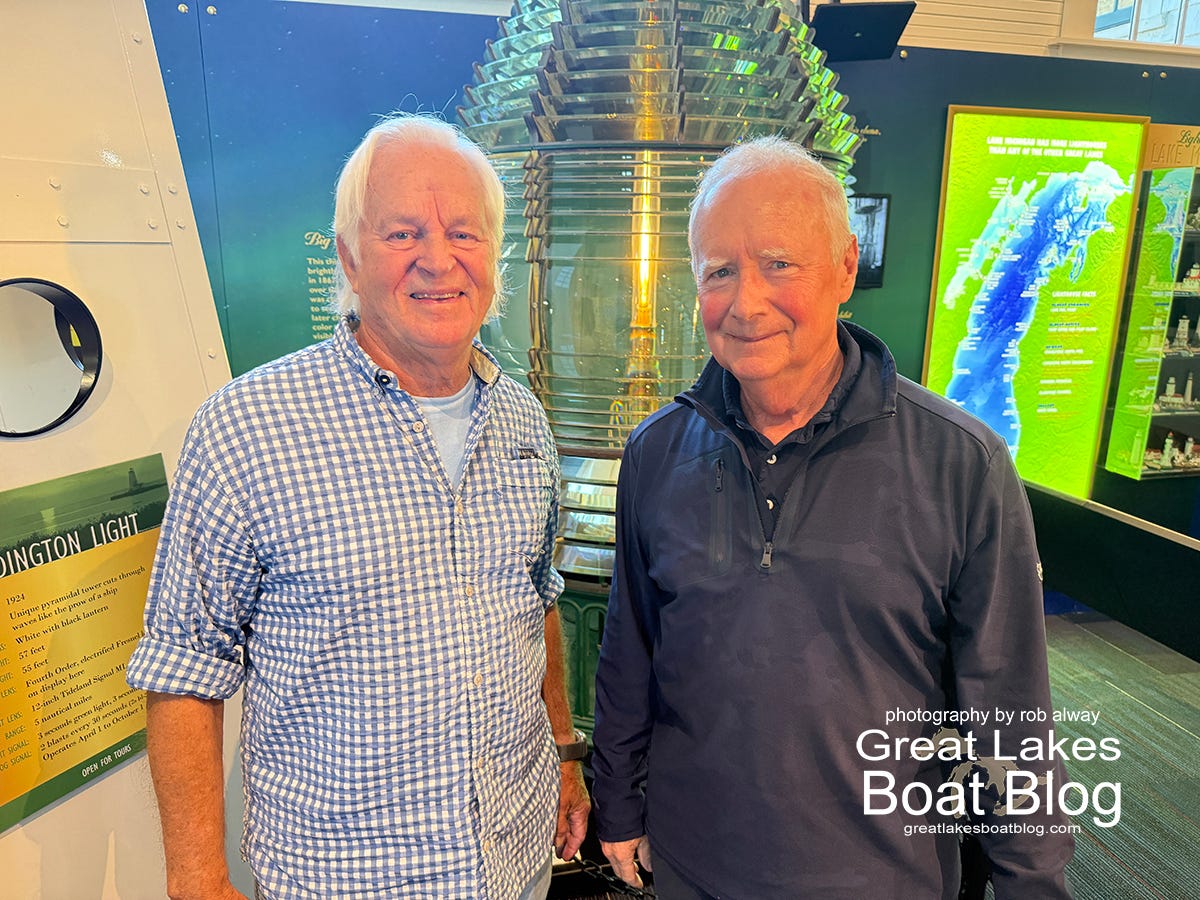
In October 2025, as the 50th anniversary of the sinking approached, I sat down with former Ludington Daily News reporters Todd Reed and Vans Stevenson at the Port of Ludington Maritime Museum to discuss their experiences on Nov. 10, 1975.
Now, on the 51st anniversary of the sinking, their recollections offer a perspective on a storm remembered primarily for what happened hundreds of miles to the north.
The museum was a fitting location for the conversation. Its recently opened Age of Steam exhibit included a detailed model of the Edmund Fitzgerald, built by Ken Jilbert of Manistee, Michigan. The building itself had served as U.S. Coast Guard Station Ludington from 1934 to 2004, a particularly meaningful connection for Reed, who spent most of his 33 years in the Coast Guard Reserve assigned to the station.
A frightening morning
For Stevenson, the storm began with an unexpected awakening.
On the morning of Monday, Nov. 10, 1975, the young reporter was sleeping in his apartment at the corner of Ludington and Washington avenues when he was awakened around 6 a.m. by a tremendous noise.
“I thought somebody was breaking into the apartment, but it was just the wind,” he recalled during the 2025 interview. “I had never heard the winds like that.”
Stevenson was relatively new to the newspaper business, having recently graduated from college with a journalism degree. But he was no stranger to Ludington.
His family had owned a cottage at Epworth Heights, a summer resort community north of the city, since the 1890s. His mother, Frances Stevenson, had worked during the 1940s as the Epworth correspondent for the Ludington Daily News. While Stevenson was still in high school, she encouraged him to seek summer employment at the newspaper.
By November 1975, Ludington was his permanent home.
A Monday morning tradition among the newspaper’s editorial staff was to gather at Bach’s Bakery on Foster Street before heading to the newspaper office on North Rath Avenue. Managing Editor Paul S. Peterson often joined the informal gathering.
That morning, however, simply driving through the city proved hazardous.
“I started west down Ludington Avenue and was driving downtown when I witnessed the door blow off of a gentleman’s car. The door just continued to tumble down the street,” Stevenson recalled. “At that point, I wondered what the conditions were like out at Epworth.”
He drove north to the resort, which had closed for the season, and made his way to South Beach.
What he found was remarkable.
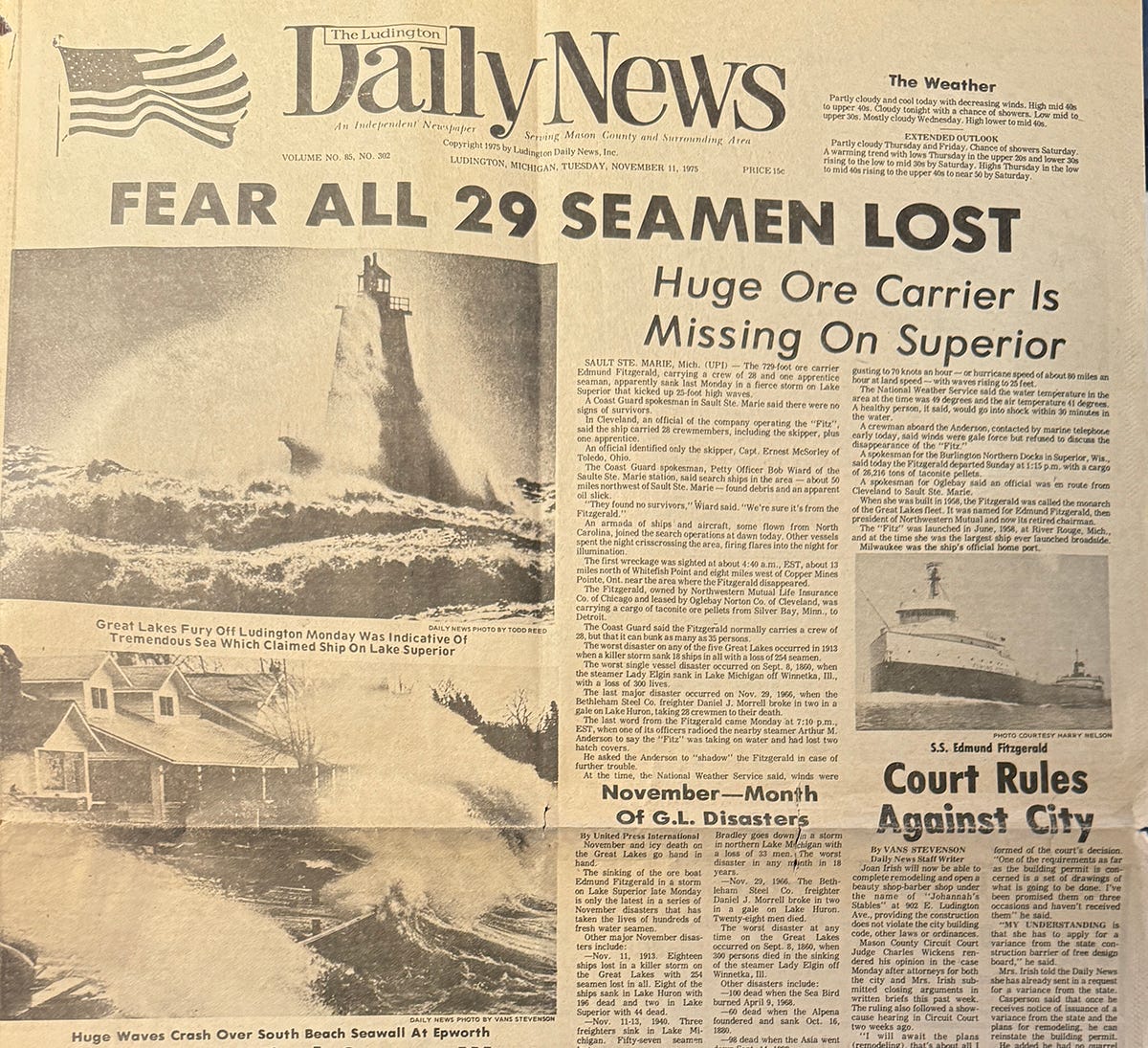
Enormous waves were crashing over the seawall and sweeping over the tops of the lakeside cottages. Stevenson braced himself against a building and began photographing the violent scene.
One of those photographs appeared on the front page of the following day’s newspaper.
The photograph of a lifetime
Todd Reed, a Ludington native and Michigan State University graduate, was in his fifth year at the Ludington Daily News. Already developing a reputation for his photographic abilities, Reed worked closely with the newspaper’s chief photographer, Russ Miller.
But on Nov. 10, 1975, Reed was initially focused on an entirely different assignment.
He had traveled approximately 60 miles east to Chase, in eastern Lake County, to investigate a farmer whose cattle herd had been contaminated by chemicals in its feed.
The contamination had caused serious concerns for the farmer and his family. Frustrated by what they regarded as an inadequate government response, the farmer and his neighbors had dug a trench and shot all 108 cows rather than risk sending contaminated meat into the food supply.
The incident had attracted national attention.
Reed spent several hours reporting the story and returned to Ludington convinced that his work would dominate the next day’s front page.
During the approximately 45-minute drive home, he mentally organized the story he planned to write.
But another story was developing.
As Reed entered downtown Ludington, he glanced westward toward Lake Michigan.
Even from the center of the city, he could see the extraordinary waves rising from the lake. Instead of heading directly to the newspaper office, Reed made his way toward the waterfront.
There, he began photographing the storm.
“I could hardly stand up,” he recalled.
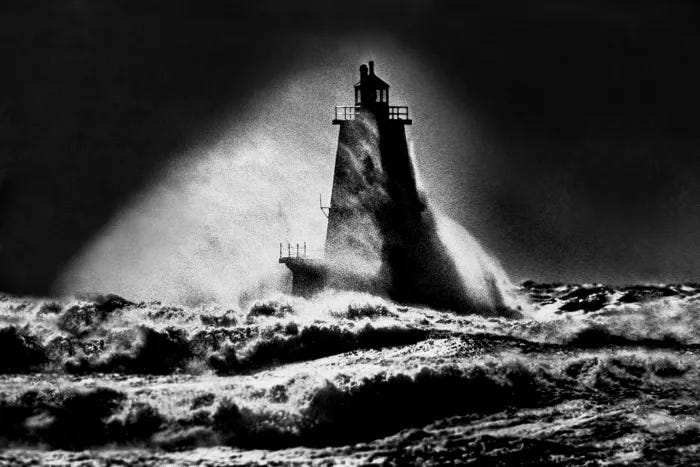
One photograph captured a scene that would become iconic in Ludington’s history.
Towering waves crashed over the city’s 57-foot-high North Breakwater Lighthouse. The north breakwater itself was completely obscured by water, and enormous seas surged through the harbor.
The image illustrated the staggering power of the storm.
During our October 2025 conversation, Reed said the photograph remained his favorite storm image, even after a lifetime spent photographing Lake Michigan and its often unpredictable moods.
His carefully researched story about the contaminated cattle herd, meanwhile, was relegated to page two.
The storm had taken over the front page.
Carferries in the storm
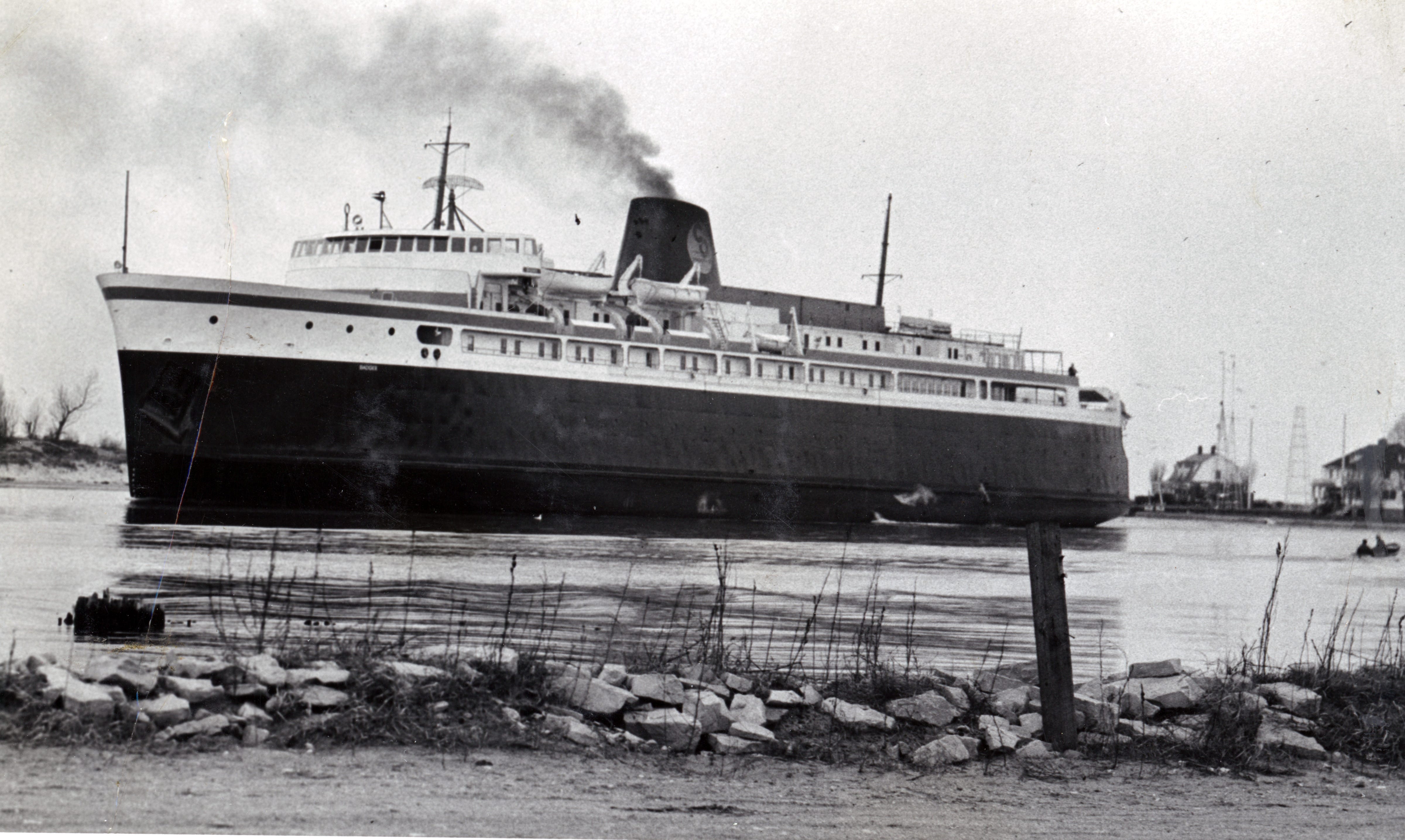
Ludington’s harbor was home to the Chesapeake & Ohio Railway’s fleet of Lake Michigan carferries, which connected the Michigan port with railroad terminals across the lake in Wisconsin.
Those vessels were accustomed to operating in difficult weather. Their captains and crews had extensive experience navigating Lake Michigan’s storms, sometimes under conditions that would keep most other vessels in port.
But Nov. 10, 1975, was no ordinary day.
Stevenson recalled watching the SS Spartan, one of the railroad’s carferries, arrive at Ludington shortly before conditions reached their worst.
“I remember watching the Spartan come in a little earlier,” Stevenson said. “It came in just before the storm got really bad, but she couldn’t dock. Instead she beached at Buttersville for the next 12 to 15 hours.”
In 1975, the Buttersville Peninsula, on the south side of Ludington’s inner harbor, was considerably different from its present appearance. The Crosswinds condominium development had not yet been constructed, and much of the peninsula remained open land.
It was common practice for carferry captains to temporarily beach their vessels along the eastern shore of Buttersville during severe weather or while waiting for a railroad slip to become available.
Carferry crews would call the maneuver “Parking at the island.”
Reed knew those operations particularly well.
As a member of the Coast Guard Reserve assigned to Station Ludington, he had witnessed carferry captains maneuver their large vessels through the harbor under difficult conditions.
“The channel was half the width as it is today,” Reed said. “I remember being on watch at the Coast Guard station and watching the boats come in during a storm, running nearly full speed, threading this needle, then making the turn so they could navigate to beach the boat. It was incredible to see. Those captains and the crews were masters at what they did.”
On that November day, the storm brought the railroad’s carferry operations to a halt. The three C&O carferries would not resume their regular crossings that day.
Meanwhile, far to the north, events were unfolding that would forever define the storm.
Tragedy on Lake Superior
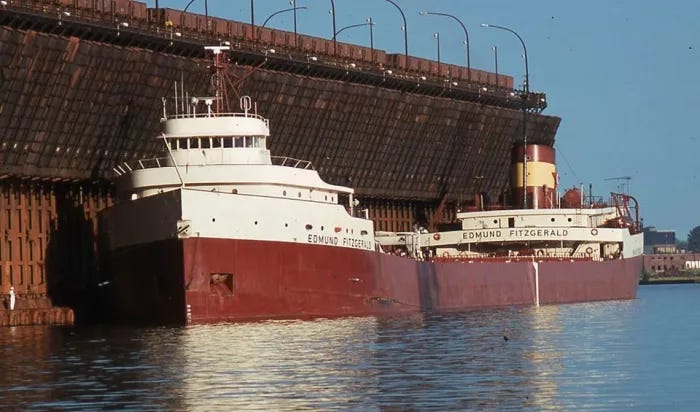
The Edmund Fitzgerald was among the best-known freighters on the Great Lakes.
The 729-foot vessel entered service on Sept. 24, 1958, becoming the longest ship operating on the Great Lakes at the time. Owned by Northwestern Mutual Life Insurance Co., she was operated by the Columbia Transportation Division of Oglebay Norton Co. of Cleveland, Ohio.
On Sunday, Nov. 9, 1975, the Fitzgerald departed Superior, Wisconsin, at approximately 2:15 p.m., carrying a full cargo of taconite iron ore pellets destined for Zug Island in Detroit.
Her master was Capt. Ernest M. McSorley (1912–1975), a veteran Great Lakes mariner who was reportedly planning to retire following the voyage.
Early November weather had been unusually mild, with temperatures reaching into the 70s in some areas.
By late afternoon on Nov. 9, the Fitzgerald was traveling in company with the freighter Arthur M. Anderson, commanded by Capt. Jesse B. Cooper. The Anderson was carrying cargo destined for Gary, Indiana.
As the National Weather Service began issuing gale warnings, the two masters elected to follow a more northerly route, remaining closer to the Canadian shore in an effort to find some protection from the worsening weather.
But conditions deteriorated dramatically on Nov. 10.
The massive storm produced ferocious winds and enormous waves across Lake Superior. The Fitzgerald struggled through the increasingly dangerous conditions while the Anderson followed behind.
Shortly after 7 p.m. on Nov. 10, the Edmund Fitzgerald disappeared from radar and radio contact.
She was never heard from again.
All 29 men aboard were lost.
The sinking became one of the most extensively studied maritime disasters in Great Lakes history, and the Edmund Fitzgerald has remained a symbol of the risks faced by the men and women who work aboard the lakes’ commercial vessels.
Three storm fronts
Reed continued to study the weather event for decades after photographing its impact at Ludington.
During our 2025 interview, he explained his understanding of the unusual meteorological conditions that produced the storm.
“This storm was the accumulation of three fronts that all met over Whitefish Bay,” Reed said. “It was for all practical purposes the ‘perfect storm.’”
The same weather system that ultimately overwhelmed the Fitzgerald had been responsible for the extraordinary conditions Reed and Stevenson witnessed along Lake Michigan earlier that day.
While much of the public’s attention understandably centered on the tragedy on Lake Superior, the storm’s impact was felt throughout the region.
For Stevenson and his colleagues at the Ludington Daily News, learning of the Fitzgerald‘s disappearance was a moment of shock.
The newspaper carried the national Associated Press coverage of the sinking but also sought to place the disaster into a local historical context.
Managing Editor Paul S. Peterson, a history enthusiast whose father had worked aboard a carferry, recognized that the storm had parallels with another catastrophic November weather event.
Remembering the Armistice Day Storm
Peterson’s reporting compared the Nov. 10, 1975, storm with the Armistice Day Storm of Nov. 11, 1940, which had struck the Great Lakes 35 years earlier.
That storm was particularly devastating along the eastern shore of Lake Michigan.
Three vessels sank in the waters between Ludington and Little Point Sable, while the Pere Marquette Railway carferry City of Flint 32 was forced to beach along the shoreline.
The storm became one of the most deadly weather events in Lake Michigan maritime history.
The similarities between the two November storms were striking, not only because of their severity but because they occurred almost exactly 35 years apart.
Reed noted that the historical weather records at Ludington reflected the extraordinary intensity of both events.
“The storm on Nov. 10, 1975 had the second-lowest barometer reading recorded at Ludington,” he said. “The lowest was on Nov. 11, 1940.”
For the young reporters who had witnessed the 1975 storm, the experience became an unforgettable part of their careers.
Stevenson remembered the wind that awakened him, the car door tumbling down Ludington Avenue and the massive waves crashing over the cottages at Epworth Heights.
Reed remembered seeing Lake Michigan’s towering waves from downtown Ludington, struggling to remain standing along the waterfront and capturing the photograph of the North Breakwater Lighthouse almost swallowed by the lake.
Their memories illustrate something easily overlooked in the decades of attention devoted to the Edmund Fitzgerald: the storm of Nov. 10, 1975, was a Great Lakes-wide event.
On Lake Superior, it claimed 29 lives and one of the lakes’ most famous freighters.
On Lake Michigan, it produced scenes of extraordinary violence, challenged experienced carferry crews and left a photographic record that continues to resonate more than half a century later.
For Reed and Stevenson, the events of that November day remained vivid when we spoke in October 2025, 50 years after they had documented the storm for the Ludington Daily News.
And for the maritime communities of the Great Lakes, Nov. 10 remains a reminder of both the power of the inland seas and the people whose lives have been shaped by them.
Beautifully told.