


By Rob Alway
The final four months of 1929 were especially deadly for shipping on Lake Michigan. At least four shipwrecks resulted in the deaths of more than 100 people. This series examines those disasters and compares the circumstances that contributed to the complete loss of some crews while others survived.
The vessels lost included the SS Andaste (Sept. 9), SS Milwaukee (Oct. 22), SS Wisconsin (Oct. 29) and SS Senator (Oct. 31). Two of those wrecks claimed everyone aboard. Neither the Andaste nor the Milwaukee, the two vessels lost with all hands, carried wireless radio equipment.
Of those four wrecks, two resulted in the loss of everyone aboard. Neither of those ships, the Andaste and the Milwaukee, was equipped with wireless radio.
This is the first of a four part series. Part 2 will examine the sinking of the SS Andaste. Part 3 will look at the sinking of the SS Wisconsin and Part 4 will examine the sinking of the SS Senator.
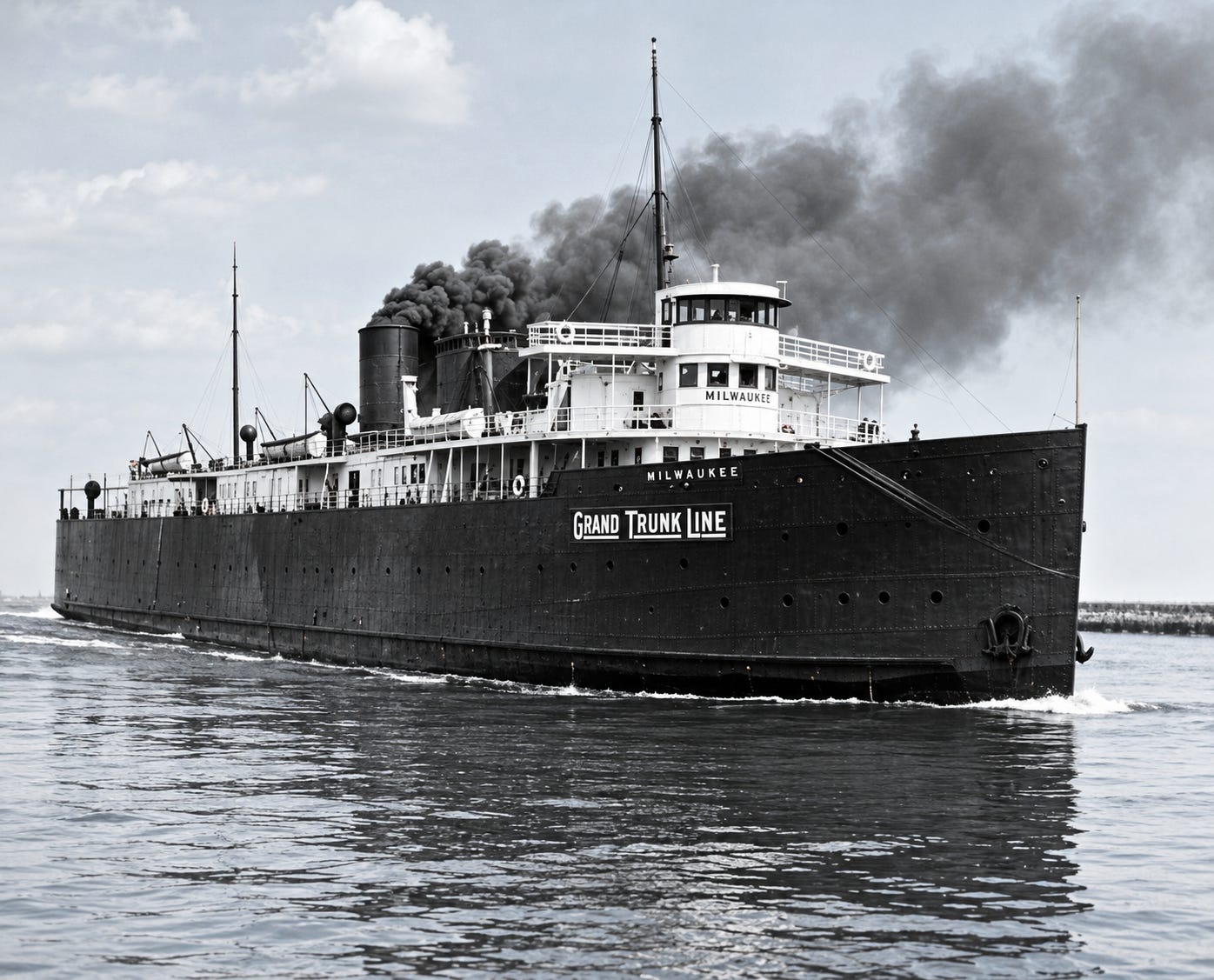
October 2026 marks the 97th anniversary of the sinking of the SS Milwaukee, which disappeared during a severe Lake Michigan storm on Oct. 22, 1929. Her loss remains the deadliest railroad car ferry disaster in Great Lakes history.
All aboard, estimated at between 43 and 56 people, were lost.
The Milwaukee was the third and last of three railroad car ferries lost in major Great Lakes disasters. Interestingly, all three vessels were of the same design, built by the same shipyard within three years of one another.
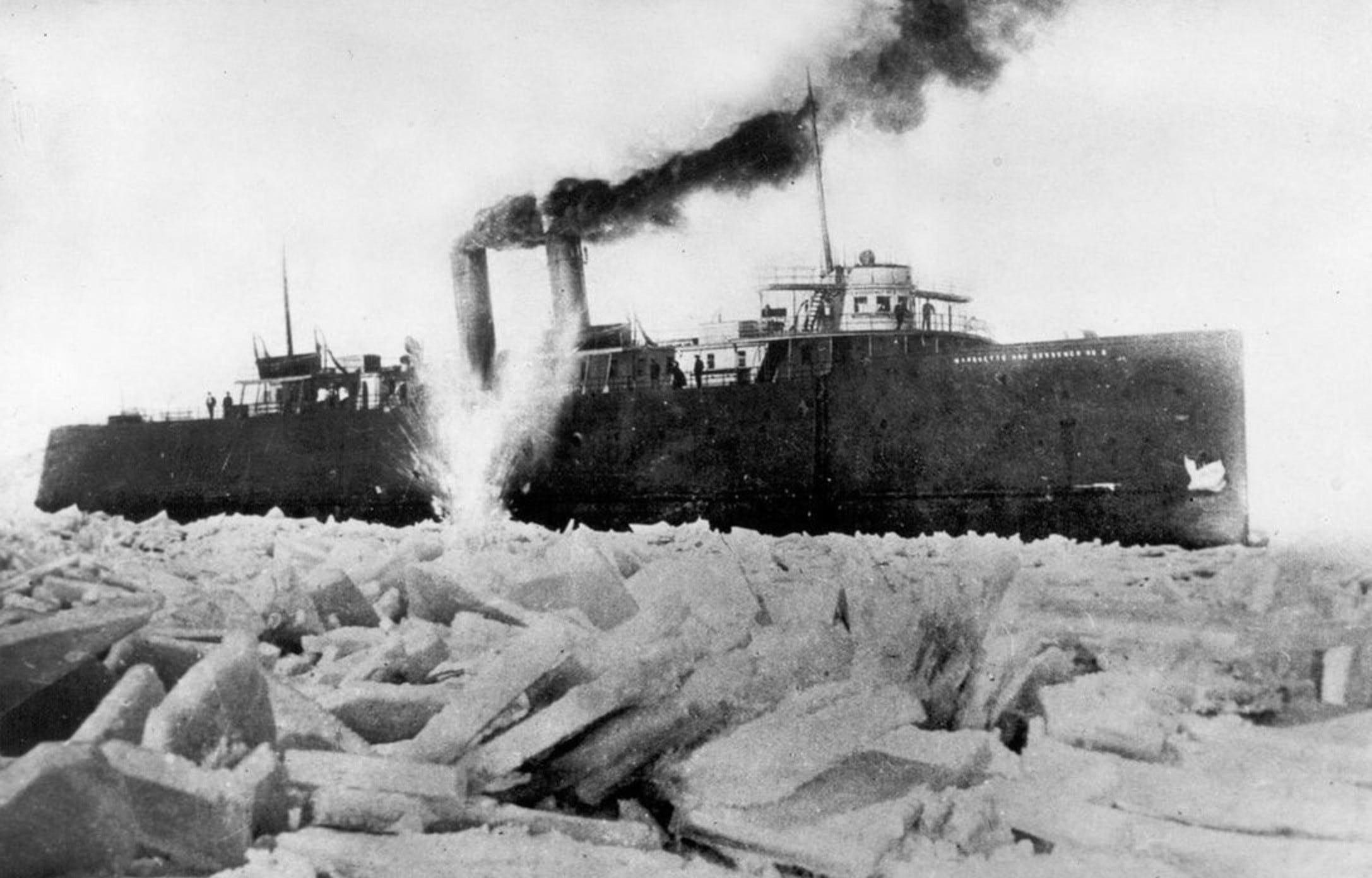
The first was the Marquette & Bessemer No. 2, which disappeared on Lake Erie on Dec. 7, 1909, taking all 30 to 32 crew members with her.
The second was the Pere Marquette 18, which sank on Lake Michigan on Sept. 9, 1910. Twenty-nine people lost their lives, while 33 survived.
All three vessels were designed by naval architect Robert Logan and built by American Shipbuilding Co. in Cleveland, Ohio.
The Pere Marquette 18, Hull No. 412, was built in 1902. The Milwaukee, originally named Manistique Marquette and Northern 1, was built in 1903 as Hull No. 413. The Marquette & Bessemer No. 2, Hull No. 428, followed in 1905.
All three were 338 feet long.
The Manistique years
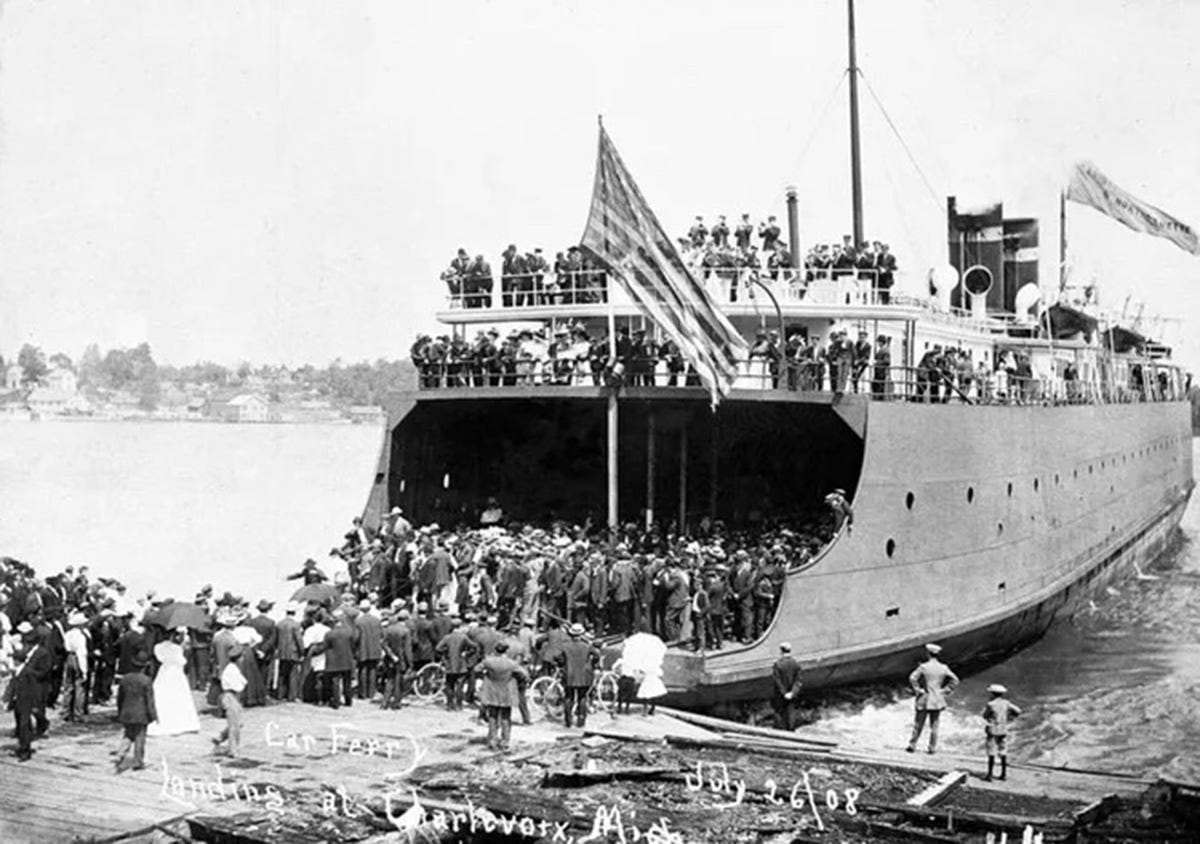
The Manistique Marquette and Northern 1 was built for the Manistique Marquette and Northern Railroad and operated between Northport, Mich. and Manistique, Mich. She was commonly called the Manistique.
In 1904, the railroad defaulted on an interest payment and went bankrupt. It subsequently came under the control of the Pere Marquette Railway, which closed the Northport dock and moved the vessel to Ludington.
From there, the Manistique operated between Ludington and Manistique, a 138-mile voyage that took approximately 11 hours.
She departed Ludington, Mich. on Tuesdays, Thursdays and Saturdays for two years.
Following the Pere Marquette’s bankruptcy in 1905, the ship returned to her original Northport-Manistique route in 1906.
In 1908, the Manistique Marquette and Northern Railroad was succeeded by the Manistique and Northern Railroad, which was partially owned by the Ann Arbor Railroad.
The Ann Arbor had operated its Frankfort, Mich.-based car ferries to Manistique since 1898 and no longer needed the Northport dock.
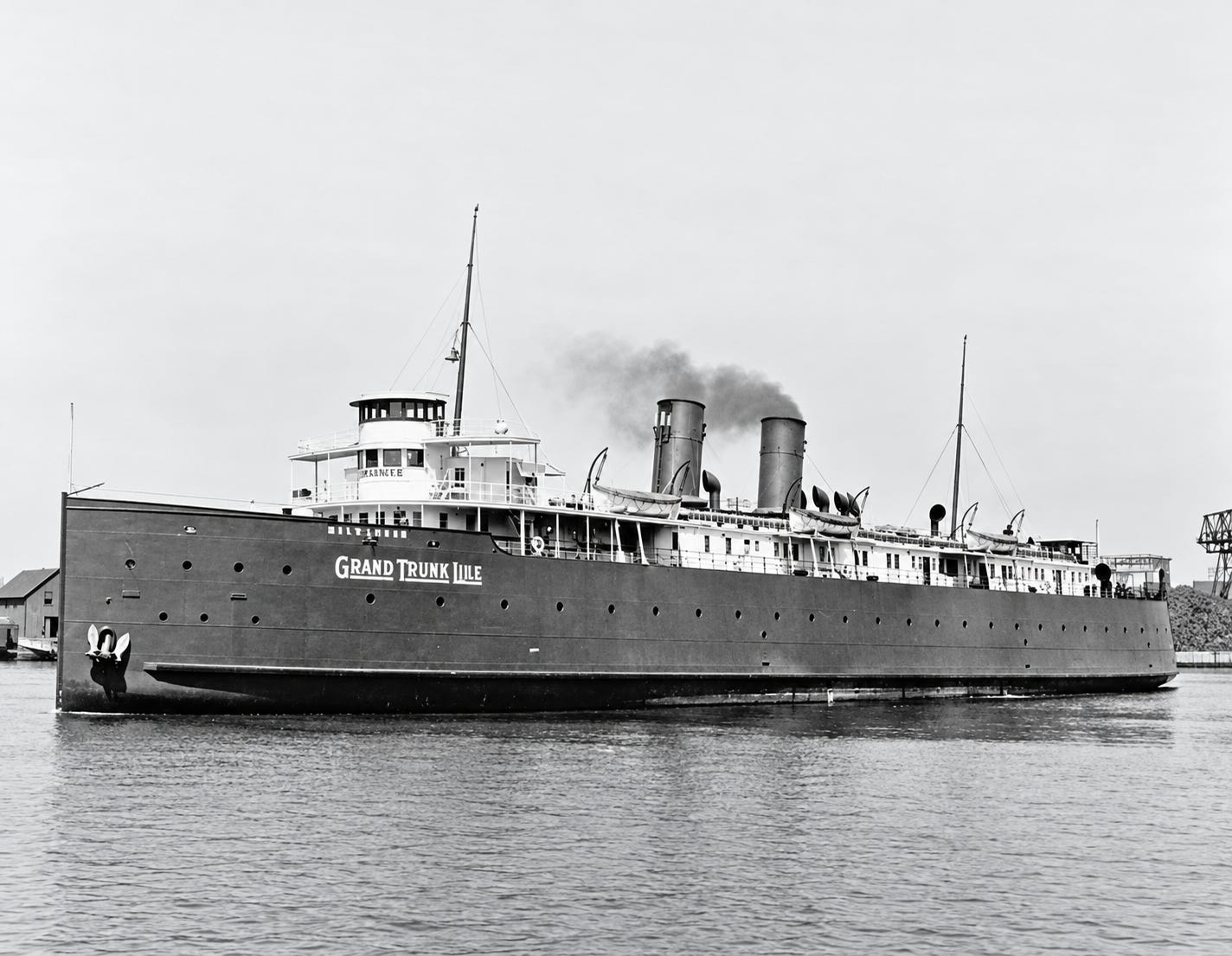
The Manistique was sold to the Grand Trunk in 1908 and renamed Milwaukee.
Grand Trunk’s early Lake Michigan operations
Passenger and break-bulk freight service between Grand Haven, Mich. and Milwaukee, Wis. began in 1849 with the small paddle steamer Champion, owned by Eber Brock Ward.
Nine years later, the Detroit & Milwaukee Railway reached Grand Rapids, Mich. resulting in freight being transported down the Grand River by river steamer to Grand Haven.
The paddle steamer Forester was the first to transport railroad freight across Lake Michigan from Grand Haven to Milwaukee, beginning May 27, 1858.
The railroad operated the service using a variety of side-wheelers and propellers until 1869, when it contracted with Nathaniel Engelmann, owner of Engelmann Transportation Co. of Milwaukee, to operate the vessels.
That service was replaced by Northwestern Transportation Co. in 1875 and Goodrich Transportation Co. of Chicago in 1881.
On April 28, 1883, the Detroit, Grand Haven & Milwaukee Railway, which operated the Grand Trunk Railway’s Detroit-to-Grand Haven rail line, began operating its own break-bulk steamers.
Break-bulk service involved removing freight from railroad cars at the docks, loading it aboard ships and transporting it across Lake Michigan.
The railroad purchased three vessels from Goodrich: the side-wheeler City of Milwaukee and the propellers Michigan and Wisconsin.
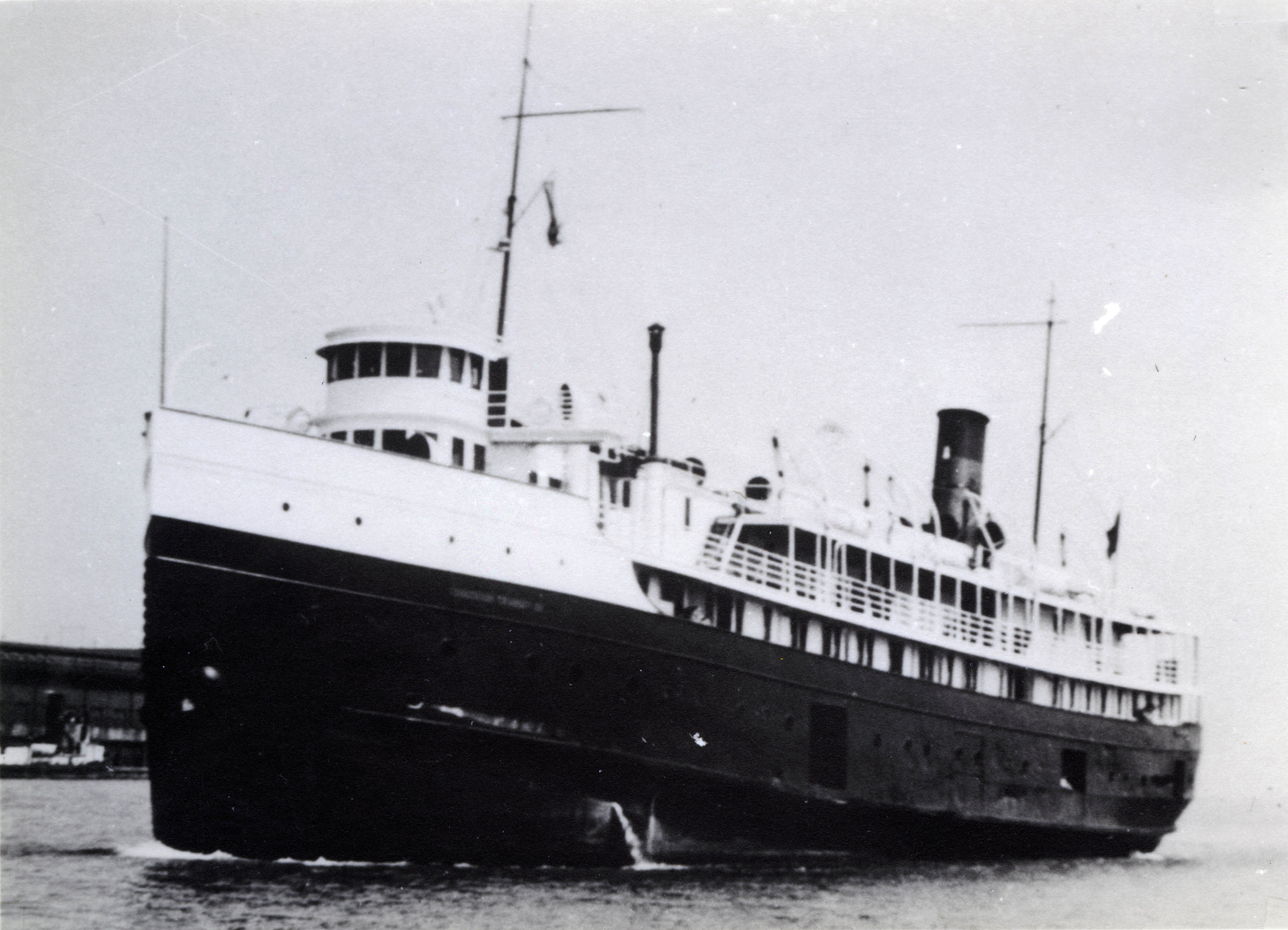
The three ships had originally been ordered by Goodrich in 1881 to serve the Flint & Pere Marquette Railway, which had begun operating break-bulk service from Ludington in 1875, a year after the railroad reached the city.
They were designed by naval architect Frank Kirby and constructed by Detroit Dry Dock Co. in Wyandotte, Michigan.
The first completed was the side-wheeler City of Milwaukee, launched Feb. 11, 1881, at a cost of $179,000.
This vessel should not be confused with the railroad car ferry SS City of Milwaukee, built for the Grand Trunk Western Railroad following the 1929 loss of the Milwaukee.
The Michigan was launched Aug. 20, 1881, followed by the Wisconsin on Oct. 11, 1881.
Both vessels were taken to Milwaukee for fitting out and completion. They entered regular service before the end of the year.
The Michigan and Wisconsin were rated at 1,183 tons and measured 215 feet in length, with beams of 34 feet and depths of 14 feet. Each cost $159,212.
Both vessels were specifically designed for winter service across Lake Michigan, incorporating heavy ice-breaking features into their construction.
Each had a rounded forefoot and full entrance similar to those later used on railroad car ferries. This design allowed the ship to rise onto the ice and crush it beneath her weight.
The vessels also featured double iron bottoms and iron main decks.
The end of Goodrich’s Ludington service
The three new ships operated for Goodrich for only about two years.
In 1882, the first two vessels owned by the Flint & Pere Marquette Railway, F&PM No. 1 and F&PM No. 2, arrived in Ludington.
With the acquisition of these vessels, it became apparent that the railway intended to enter the lake transportation business itself.
Gradually, business shifted away from the Goodrich steamers.
On April 1, 1883, the Flint & Pere Marquette canceled its contract with Goodrich, ending the company’s Ludington-Milwaukee service.
The cancellation was a serious financial blow to Goodrich Transportation Co.
A substantial portion of the company’s capital, along with borrowed funds, had been invested in the new steamers and the development of the service. Less than two years of earnings had not provided sufficient time to recover that investment.
To avoid a financial crisis, Capt. Goodrich decided to sell the three vessels and use the proceeds to satisfy the company’s creditors and other financial obligations.
On May 1, 1883, the ships were sold to the Detroit, Grand Haven & Milwaukee Railway Co.
The railroad paid $180,000 for the City of Milwaukee and $160,000 each for the Michigan and Wisconsin.
The operation became a forerunner of the Grand Trunk Car Ferry Line, operated by the Grand Trunk Western Railway.
Less than two years after her purchase, the Michigan was lost in the ice during the winter of 1885. The same storm severely damaged the Wisconsin, although she was repaired.
The City of Milwaukee and Wisconsin continued regular Grand Trunk service until 1896.
That year, the City of Milwaukee was sold to the Graham & Morton Line, while the Wisconsin was sold to Crosby Transportation Co.
The Wisconsin was renamed Naomi in 1898 and operated alongside the wooden propeller Nyack, a former Erie Railroad steamship, providing nighttime service for the Grand Trunk between Grand Haven, Muskegon and Milwaukee.
The break-bulk operation continued under the Grand Trunk Line name even after the railroad entered the car ferry business.
The service later continued as Wisconsin & Michigan Transportation Co., which was owned by Sand Products Inc. of Muskegon.
That company subsequently operated the Milwaukee Clipper and became associated with other Great Lakes maritime businesses, including Lake Service Shipping, Port City Marine Services and Aquastar Cruises.
The Wisconsin is examined further in Part 3 of this series.
The Grand Trunk Car Ferry Line
The Grand Trunk entered the railroad car ferry business in 1903 by continuing its relationship with Crosby and establishing the Grand Trunk Car Ferry Line.
E.G. Crosby served as president and general manager.
The line’s first ferry was the Grand Haven, a 306-foot steel vessel built in 1903 by Craig Shipbuilding Co. in Toledo, Ohio.
She was powered by two triple-expansion engines and had four railroad tracks with the capacity to carry 26 railcars.
Under Crosby’s leadership, the Grand Trunk Car Ferry Line defaulted on its bonds in 1905.
The Grand Haven was offered at a receiver’s auction Nov. 7, 1905, and purchased by the Grand Trunk Milwaukee Car Ferry Co., a newly formed subsidiary of the Grand Trunk Railroad.
The new company continued operating the Grand Haven but needed a second vessel.
In 1908, it purchased the Manistique Marquette and Northern 1 and renamed her Milwaukee.
The Grand Trunk continued as a two-ship operation into the mid-1920s, occasionally chartering ferries from the Pere Marquette Railway and Ann Arbor Railroad during busy periods.
In 1926, the Grand Trunk expanded its fleet with two new ferries, the Grand Rapids and Madison.
The Grand Rapids entered service Oct. 23, 1926, followed by the Madison on Jan. 19, 1927.
The ships were among five new railroad car ferries built by Manitowoc Shipbuilding Co. in Manitowoc, Wisconsin.
Each measured 347.9 feet in length and 56.2 feet in width.
The five vessels were:
• Pere Marquette 21, Hull No. 209, built in 1924.
• Pere Marquette 22, Hull No. 210, built in 1924.
• Ann Arbor No. 7, Hull No. 214, built in 1925.
• Grand Rapids, Hull No. 226, built in 1926.
• Madison, Hull No. 227, built in 1927.
A sixth vessel, the City of Milwaukee, Hull No. 261, was built in 1931 to replace the lost Milwaukee.
Together, these vessels became known as the “Manitowoc Six.”
Capt. Robert McKay
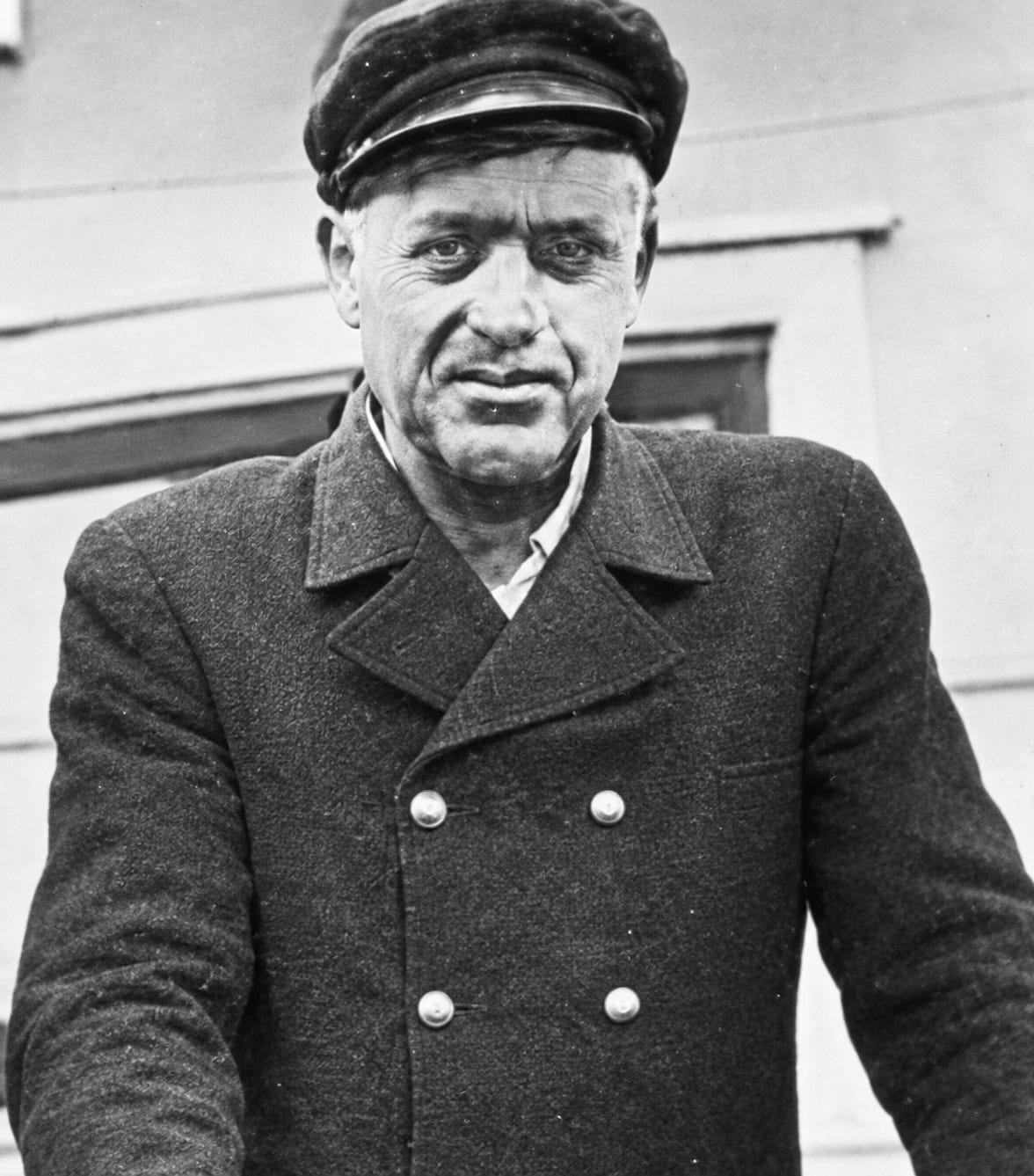
The Milwaukee was under the command of Capt. Robert McKay Jr., an experienced Great Lakes mariner.
McKay was born Aug. 15, 1862, in Burray, Orkney Islands, Scotland, the son of Robert McKay Sr. (1835-1920) and Jane (Budge) McKay (1834-1927).
He was the oldest of seven children.
His father was a fisherman who sailed from the Orkney Islands.
McKay immigrated to the United States in 1881 with his younger brothers, John and James.
On Jan. 4, 1893, he married Henrietta Donker (1869-1901) in Grand Haven.
The couple had three children: Robert Budge McKay (1894-1967), Henry William McKay (1895-1982) and Janet Euphemia McKay (1898-1985).
Following Henrietta’s death, McKay married Cornelia Van Weelden (1869-1961) on Dec. 31, 1912.
At the time of his death, the McKays lived at 113 Franklin St. in Grand Haven.
McKay began his sailing career after arriving in the United States with assistance from his uncle, Capt. John Budge, his mother’s brother.
A Nov. 7, 1929, article in the Grand Haven Tribune described McKay’s love of the water and his reluctance to see his sons follow the same occupation because of the separation from family that came with a life at sea.
The newspaper described him as one of the best seamen on the Great Lakes.
According to an Oct. 24, 1929, article in the Grand Haven Tribune, McKay had served as captain of the Milwaukee for two years.
He previously commanded the freighter Pentland and had served as a mate aboard the Goodrich Transit Co. steamer Alabama. He also served as first mate aboard railroad car ferries.
McKay was no stranger to maritime emergencies.
The Grand Haven Tribune reported that he was first mate aboard the Naomi when she caught fire on Lake Michigan. He was credited with helping save the lives of those aboard as passengers and crew were forced to abandon the vessel in small boats.
The newspaper also reported that McKay had been aboard the ill-fated James B. Moran, which sank in February 1899.
The Naomi, as mentioned earlier, had previously sailed as the Wisconsin and would later return to that name.
At approximately 1 a.m. on May 21, 1907, the Naomi caught fire 28 miles west of Grand Haven.
Her passengers and crew were rescued by the SS Curry.
The Naomi was subsequently rebuilt in Manitowoc and returned to service.
Her eventual sinking is the subject of Part 3 of this series.
The sinking of the Milwaukee
On Oct. 22, 1929, a powerful northeast gale swept across Lake Michigan, producing winds of 34 to 37 mph.
Storm warnings began at 8:30 a.m.
The Pere Marquette ferries remained in port, but the Grand Trunk Milwaukee Car Ferry Co. sent all four of its ferries onto the lake.
The Grand Haven departed Milwaukee at 2 a.m. and arrived in her namesake port at 5 p.m., 15 hours later. The crossing normally took about six hours.
The Milwaukee arrived in Milwaukee from Grand Haven around noon.
Capt. McKay described the westbound crossing as fairly good.
The Milwaukee then loaded 25 railroad cars and departed for Grand Haven shortly after 3 p.m.
At 3:45 p.m., she passed approximately three miles east of Lightship 95.
Witnesses observed the ferry rolling and pitching heavily in the rough seas.
It was the last reported sighting of the Milwaukee.
Unlike the Pere Marquette ferries, the Grand Trunk vessels were not equipped with wireless radio.
Five days later, on Oct. 27, a Coast Guard patrol near South Haven recovered the ship’s message case.
Inside was a handwritten note signed by A.R. Sadon, the Milwaukee‘s purser:
The ship is taking water fast. We have turned around and headed for Milwaukee. Pumps are working but sea gate is bent in and can’t keep the water out. Flicker is flooded. Seas are tremendous. Things look bad.
The message provided a grim account of the ferry’s final hours.
The Milwaukee had apparently attempted to return to her Wisconsin port after encountering the heavy seas.
Her sea gate had been damaged, allowing water to enter the vessel.
Without wireless radio, the crew had no means of transmitting a distress call.
Historical accounts differ on the number of crew members aboard, with estimates generally ranging from 45 to 53. Other accounts have placed the number of victims between 43 and 56.
The Grand Trunk ferries did not carry passengers.
The Milwaukee was lost with all hands, and her wreck has never been located.
Questions about the Milwaukee’s seaworthiness
In his 1962 book, “The Great Lakes Car Ferries,” maritime historian George W. Hilton discussed criticism of McKay’s decision to leave Milwaukee in such severe weather.
Hilton wrote that the Coast Guard had criticized the tendency of some railroad car ferry captains to sail in nearly all weather conditions, apparently seeking to establish reputations for maintaining dependable schedules.
While the other three Grand Trunk ferries survived the storm, the Milwaukee, the oldest vessel in the fleet, did not.
Hilton noted that the Milwaukee‘s sea gate, installed after Grand Trunk acquired her, was approximately four feet lower than those aboard newer ferries.
She also had less engine power than the newer vessels.
Even early in her career, the Milwaukee had been regarded as a well-built ship but one that lacked sufficient power.
The total financial loss was estimated at $720,000, including approximately $600,000 for the vessel and the remainder for the railroad cars and their cargo.
According to Hilton, the disaster prompted Lake Michigan railroad car ferry operators to establish a minimum sea gate height of 8 feet, 6 inches.
The recovery of Capt. McKay
The body of Capt. McKay was recovered Nov. 6, 1929, approximately two weeks after the sinking.
He was among three bodies found along a beach in Allegan County.
A Nov. 7, 1929, article in the Grand Haven Tribune reported that McKay’s son Henry, who lived in Long Beach, California, identified his father by a thin Gruen watch, a diamond ring and his glasses.
McKay was found some distance from the other bodies, fully dressed and without a life preserver.
The newspaper speculated that the captain had remained on the bridge as his vessel went down, following the maritime tradition of a captain remaining with his ship.
McKay’s body was taken to the family home on Franklin Street in Grand Haven, where funeral services were held later that week.
The Grand Haven Tribune remembered the captain as a beloved and respected figure among his fellow mariners and the men who served under his command.
He was described as one of the courageous Scottish seamen who had immigrated to the United States and helped establish the maritime traditions of the Great Lakes.
Capt. Robert McKay is buried in Lake Forest Cemetery in Grand Haven.
The City of Milwaukee
Following the sinking, Grand Trunk ordered a replacement ferry from Manitowoc Shipbuilding Co.
Construction took place in 1930, and the new SS City of Milwaukee entered service in 1931.
She served the Grand Trunk until 1978.
Following her Grand Trunk career, the City of Milwaukee was purchased by the State of Michigan and placed on loan to the Ann Arbor Railroad at Frankfort.
She continued in service with the Ann Arbor into the early 1980s.
Today, the City of Milwaukee is preserved as a museum ship in Manistee, Michigan.
She is the last surviving example of the six early 20th-century railroad car ferries constructed by Manitowoc Shipbuilding Co. that became known as the Manitowoc Six.
Her preservation provides a tangible connection to the railroad car ferry era and the maritime industry that developed around the transportation of railroad freight across Lake Michigan.
Crew of the Milwaukee
According to a roster published in the Oct. 24, 1929, edition of the Grand Haven Tribune, the Milwaukee had a crew of 58, with 50 aboard when she sank.
The following is the crew roster as published in that newspaper, with names and spellings retained from the original account.
Captain: Robert McKay, Grand Haven
First mate: William Vaxter, Grand Haven
Third mate: James Pett, Grand Haven
Chief engineer: Ray Dickey, Manistee
Chief assistant engineer: Harry Owens, Grand Haven
Third engineer: K. Martin, Grand Haven
Wheelsmen: A. Moran, M. Iverson, A. Kiss
Lookouts: O.E. Jackson, Grand Haven; J. O’Brien; C. Smith
Watchmen: J. Murphy, A.W. Widinz, E. Melson, F. Walters, Ray Girard
Deckhands: F. Jarcis, J. Schoblock
Oilers: E. Krouse, McMetto, C. Johnson
Water tenders: H. Morse, Thomas Gannon, W. Laskey, J. Nickless, C. McCarthy, A. Hunt
Firemen: J. Trimm, J. Mercia, G. Robert, J. Johnson, M. Leahy, J. O’Shea, I. Donnigon, J. Gorrorski, S. O’Neal
Coal passers: J. Lyon (not aboard the ship), C. Lawrence, Z. Tyron, Peter Mello, J. Rodzy, C. Hassenger, W. Powell
Chef: Thomas Lotta, Grand Haven
Cook: Stanley Scarasta, Grand Haven
Head porter: S. Fox
Second porter: Carl Barnes
Porters: S. Berkovich, Joseph O’Leary
Head waiter: Arthur Gilbert
Waiter: J. Ross
Second watch: Tony Malusky
Cabin watchers: Ole Berg, Otto Elssesser
Deckhands: B. Engalki, Gus Bidstrub
Help support this Substack page and check out our merchandise store.
This story is copyrighted 2026 by Sable Points Media.