


By Rob Alway
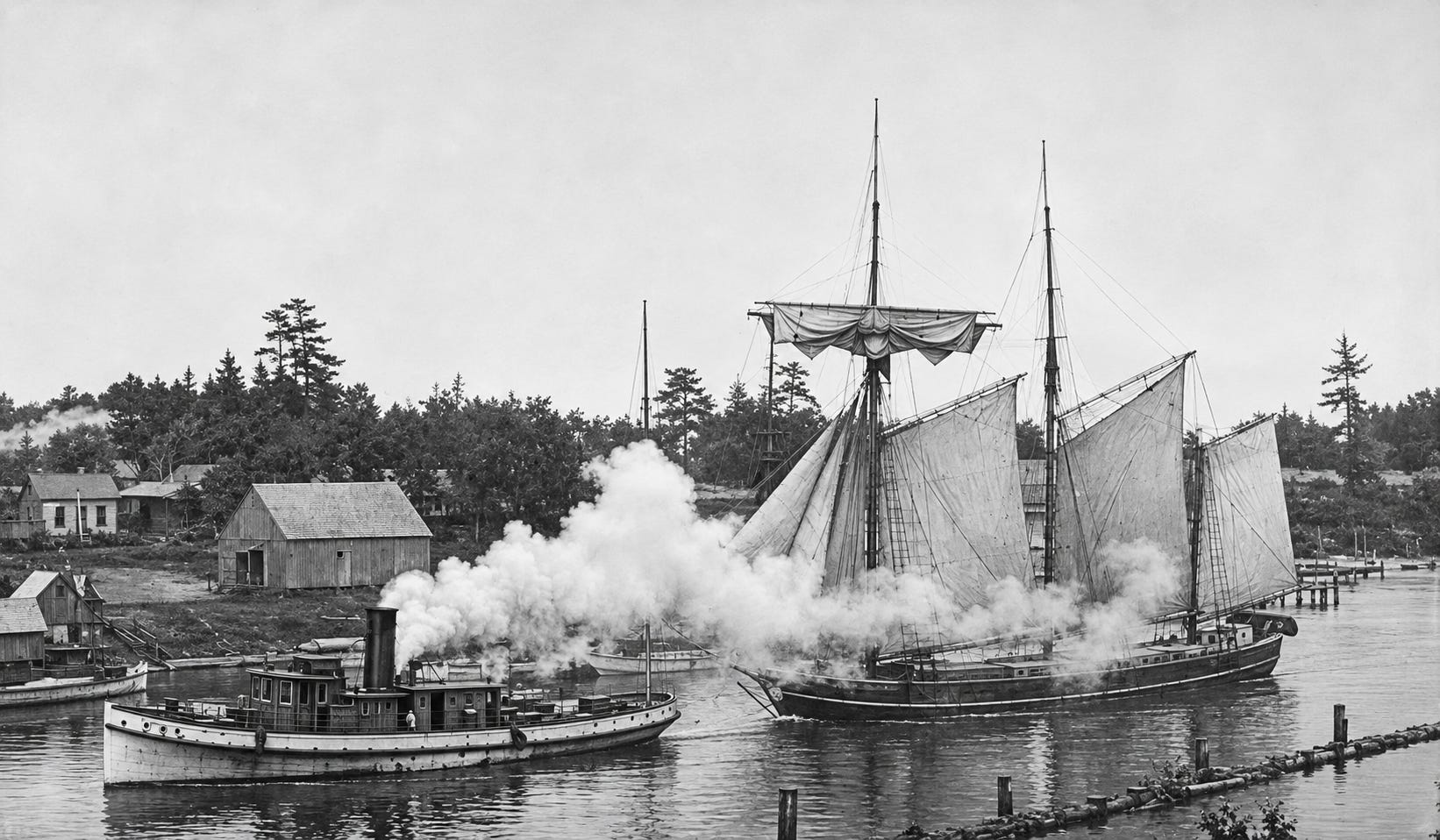
The warning flags were flying over the Manistee, Michigan harbor when Capt. John McMillan prepared to take the schooner City of Toledo onto Lake Michigan on Tuesday, Aug. 30, 1892.
A strong southwest wind was blowing, and heavy seas were building beyond the harbor entrance. The schooner was carrying approximately 300,000 board feet of green lumber, much of it piled high on her deck. She sat so low in the water that her deck planking was reportedly only four or five inches above the surface.
The captain of the tug preparing to take her out warned McMillan that the weather was dangerous. He recommended remaining inside the harbor until conditions improved.
Two other schooners, Isabella Sands and Lucia A. Simpson, had already ventured onto the lake.
According to a newspaper account published the following week, McMillan reasoned that if those vessels could withstand the conditions, so could his schooner.
It was a decision that would cost nine people their lives, including McMillan and one or two of his daughters.
Within hours, the City of Toledo would be overturned in Lake Michigan, her heavily laden hull drifting toward the shoreline near Pierport, approximately 16 miles north of Manistee, Michigan.
For decades afterward, sailors who witnessed her final voyage would question why she had sailed and whether anything could have been done to save those aboard.
A Scottish-born mariner
John McMillan was born in Scotland around 1845, the son of Alexander McMillan and Elizabeth (Smith) McMillan.
On Aug. 15, 1867, McMillan married Ann McGown in Tradeston, Lanarkshire, Scotland. Ann, born around 1846 in Airdrie, was the daughter of John McGown and Mary Currie.
Their daughter Elizabeth, known as Lizzie, was born in Scotland around 1872.
The precise date of the family’s immigration to the United States in unknown, but by the 1880s they had settled in Manistee, one of Lake Michigan’s busiest lumber ports.
Manistee’s sawmills produced enormous quantities of lumber destined for Chicago, Illinois, and other growing cities. Much of that material traveled aboard wooden schooners, whose crews faced a demanding schedule dictated by cargo availability, freight rates and the unpredictable weather of the Great Lakes.
By 1892, McMillan was an experienced lake mariner. One contemporary account described him as having sailed from Manistee for more than 20 years. Although his earlier commands remain to be documented, his years in the merchant service suggest a long familiarity with the demands of sailing vessels.
His final command, however, was an aging vessel with an unusual history.
A schooner with a past
The City of Toledo was originally built in 1865 by Squires & Keating at Toledo, Ohio, as a wooden sidewheel steamer.
She measured approximately 161 feet in length, with a beam of 25 feet and a depth of 9 feet. Her later registry listed her at approximately 245 gross tons.
After suffering a fire at Manistee in 1874, she was rebuilt as a three-masted schooner-barge. The conversion gave the former steamer an entirely different working life.
By 1882, the City of Toledo was listed among the vessels belonging to the Dempsey, Cartier & Co. fleet of Manistee. By 1892, she was owned by the Manistee Lumber Company.
The schooner had experienced trouble before her fatal voyage.
On Sept. 21, 1889, while being towed up the Chicago River by the tug Satisfaction, she collided with the Clark Street bridge. The bridge tender had indicated that the draw would open, but a defective locking mechanism prevented it from moving.
The tug managed to release her tow and pass beneath the bridge. The City of Toledo struck the structure, breaking her foremast and damaging her mainmast and standing rigging.
The incident became the subject of a federal admiralty case, Manistee Lumber Co. v. City of Chicago, decided Nov. 3, 1890. The court held the city responsible because the bridge tender had failed to provide a timely warning that the bridge could not open.
The City of Toledo survived that collision and returned to service.
Three years later, however, she would encounter a danger from which her crew could not escape.
Into the gale
Shortly before noon on Aug. 30, 1892, the lumber-laden City of Toledo was towed down the Manistee River and through the harbor entrance.
Her cargo consisted of approximately 300,000 board feet of green lumber, nearly two-thirds of it reportedly carried on deck.
The weather station had recorded a southwest wind of approximately 16 mph, but the cautionary signal flying over the harbor warned mariners of deteriorating conditions.
The tug captain advised McMillan against leaving.
The warning went unheeded.
As the schooner emerged from the shelter of the harbor, she immediately encountered heavy seas. Contemporary accounts stated that the waves were running so high that crew members were forced to hold onto the rigging until the vessel cleared the most turbulent water.
The schooner proceeded into Lake Michigan, where she remained visible from the Manistee Life-Saving Station for several hours.
For a time, she appeared to be making reasonable progress.
Then the wind strengthened.
By approximately 4 p.m., the Manistee weather station reported winds increasing to 21 mph. Offshore, the sea was growing more dangerous.
Those on shore watched the schooner turn toward the Michigan shoreline. A lookout at the lifesaving station believed she might be attempting to reach Frankfort, Michigan, farther north.
Other accounts described the vessel displaying a distress signal.
But the City of Toledo was no longer making the voyage McMillan had planned.
She was struggling to survive.
An eyewitness remembers
Nearly four decades after the disaster, Capt. Nels Palmer recalled the schooner’s final hours in his serialized newspaper column, “Tales of Adventure,” published in the Ludington Daily News in November 1930.
Palmer had been on Lake Michigan that afternoon.
He remembered six large schooners departing Manistee with lumber cargoes, the City of Toledo being the last to leave.
Palmer’s vessel was working westward in the strong southwest wind, and her crew had reduced sail by taking in double reefs.
He recalled passing three schooners, including the City of Toledo, which were standing out into the lake on their port tack.
After traveling approximately six or seven miles westward, the vessels attempted to come about onto the opposite tack.
The other schooners completed the maneuver.
The City of Toledo did not.
According to Palmer, she was unable to come about. Instead, she squared away and ran before the wind.
It was an ominous development.
A sailing vessel that could not turn through the wind might lose the ability to hold her intended course. For a heavily laden schooner, such a problem could become especially dangerous as wind and seas increased.
Palmer recalled that a distress flag had appeared at the schooner’s mainmast around 1 p.m., signaling for assistance from a tug.
He believed the vessel was already in serious trouble and should never have been permitted to continue without an investigation of her condition.
His recollection, written nearly 38 years after the event, differs in some details from the reports published immediately after the disaster. Nevertheless, it provides a valuable account from a mariner who witnessed the schooner’s movements that afternoon.
Palmer remembered that the City of Toledo capsized around 6 p.m., approximately 15 miles north of Manistee.
There were no survivors.
Nine lives lost
The schooner reportedly overturned approximately two miles offshore and drifted toward the beach near Pierport.
When her overturned hull was discovered the following morning, she was lying bottom up in shallow water. Contemporary reports placed her approximately half a mile offshore, although some accounts described her considerably closer to the beach.
Personal belongings and wreckage washed ashore, including sailors’ hats, a woman’s hat, a bureau and the schooner’s yawl.
Early newspaper reports disagreed about the number of people aboard. Some reported seven or eight deaths. Others, including the Sept. 1 Jackson Citizen Patriot, reported nine.
Nine is the figure generally accepted in later vessel histories.
The most complete contemporary casualty lists identify the following people:
Capt. John McMillan, master, of Manistee.
Lizzie McMillan, the captain’s daughter and the schooner’s cook.
George McKinzie, mate, approximately 30, of Grand Haven, Michigan.
William “Billy” McCarthy, seaman, of Chicago.
John Larsen, seaman, approximately 30, of Chicago.
Angus McNeil, seaman, of Chicago.
Peter Peterson, seaman, identified as being from Manitoba, Canada.
Two additional people were listed as unidentified in some accounts. Other newspapers named John O’Neil of Chicago among the victims.
The reports also disagree about the number of McMillan’s daughters aboard.
The Jackson Citizen Patriot reported that his two eldest daughters accompanied him, while other newspapers mentioned only Lizzie. A September 1892 account stated that McMillan, his two daughters and six crewmen perished.
Lizzie’s presence is firmly established. The identity of a possible second daughter has not been confirmed from the available records. A family tree published on Ancestry.com only lists Lizzie as daughter of John and Ann McMillan.
According to that same information, Elizabeth McMillan was born around 1872, making her approximately 20 years old when the schooner went down.
She had accompanied her father on what would become their final voyage.
The fate of Lizzie McMillan
The circumstances surrounding Lizzie’s death became one of the most haunting elements of the tragedy.
Early reports stated that no bodies had been recovered and suggested that the victims remained trapped inside the overturned vessel.
Later recollections presented a different account.
In 1930, Capt. Palmer wrote that the captain’s daughter had been found on the beach the following day, reportedly attached to a mattress.
Palmer believed she might have been saved had someone reached her when she came ashore. That was his retrospective judgment, not evidence that she was still alive when she reached the beach.
In a May 23, 1976, historical feature published in The Grand Rapids Press, writer Don Farrant also described the recovery of Lizzie’s body.
Farrant identified her as Eliza McMillan and wrote that she was found near Bar Creek, just north of the wreck, wearing nightclothes with a mattress nearby.
He suggested she had retired for the night before the schooner capsized and had been caught without time to dress.
That interpretation cannot be established from the earliest accounts, and the later stories differ in important details.
What is certain is that Lizzie was serving as the vessel’s cook and died alongside her father.
Could they have been saved?
The loss of the City of Toledo provoked considerable criticism in Manistee.
Newspapers reported that residents were angry with the lifesaving crews and tug operators for failing to reach the distressed schooner.
According to contemporary accounts, the vessel had remained visible from shore for several hours. Her distress signal and apparent difficulty maneuvering raised questions about whether assistance could have been attempted sooner.
The Manistee and Frankfort lifesaving crews subsequently patrolled the shoreline and recovered wreckage.
But the weather and sea conditions that prevented assistance were also significant.
The same heavy seas that threatened the schooner would have endangered any tug or lifesaving boat attempting to approach her.
In his 1930 account, Palmer remained critical of the response. He believed that a lifeboat operating under sail might have reached the vessel.
“I do not believe such a thing would happen now,” he wrote.
His criticism reflected the convictions of an experienced sailor who had witnessed the disaster. It did not, however, establish that a rescue would have succeeded.
The available newspaper accounts do not provide a definitive official finding concerning the rescue response.
Why did the schooner capsize?
The exact sequence of events aboard the City of Toledo remains unknown.
There were no survivors to describe her final moments or explain why she failed to recover.
Contemporary reporting suggested that McMillan might have attempted to anchor offshore and ride out the storm. One theory held that the anchor caught or failed to release properly as the vessel rolled in the heavy seas.
That explanation was speculative.
The schooner’s heavy deck cargo was another concern.
Nearly two-thirds of her load reportedly consisted of green lumber carried above deck. The additional weight and its elevated position could have affected the vessel’s stability, especially in breaking seas.
The City of Toledo also had an unusual construction history. She had been designed as a steamer and subsequently converted to a sailing vessel.
Palmer described her as an “old crank,” a sailor’s expression for a vessel that was easily rolled or required particular care in managing sail.
He believed that her conversion from a steam barge had made her less suited to carrying sail in strong winds.
Whether that characteristic, her cargo, an anchoring maneuver or some combination of circumstances caused the capsizing cannot be established conclusively.
The weather was severe, but the captain had also received a warning before leaving harbor.
It was a tragedy that left many questions unanswered.
A vessel that survived her crew
Although the nine people aboard the City of Toledo perished, the schooner’s hull was not permanently lost.
After the disaster, wrecking crews attempted to right the overturned vessel.
Palmer recalled that the schooner was towed, bottom up, to an area outside Manistee harbor, where a fleet of tugs and steamers attempted to turn her upright.
He also remembered hearing accounts that she had been taken to Ludington, Michigan, for additional salvage work, although he did not personally verify that story.
The initial attempts apparently failed.
Eventually, however, the City of Toledo was recovered and returned to service.
Her history continued for nearly 14 years after McMillan’s fatal voyage.
On July 21, 1906, while carrying coal on the Detroit River, the City of Toledo was involved in another collision. According to Great Lakes Shipwreck Files, she broke her towline, went out of control and struck a bridge support near Belle Isle in Detroit, Michigan.
She sank, although all seven people aboard survived.
Her hull was subsequently raised for use as a lighter.
It was an extraordinary final chapter for a wooden vessel that had already survived a fire, a major bridge collision and a fatal capsizing.
For her crew in August 1892, there had been no second chance.

A family’s loss
The tragedy devastated the McMillan family in Manistee.
Contemporary accounts stated that the captain left behind his wife and several children.
His widow, Ann McMillan, survived him by approximately five and a half years.
A Michigan death certificate records the death of Annie M. McMillan in Manistee on Feb. 15, 1898. She was 52 years old, a widow, and was buried at Oak Grove Cemetery in the family plot, as was John and Elizabeth.
It also records that she had borne seven children, five of whom were still living at the time of her death.
The record provides additional evidence of the family’s losses, although it does not identify the two deceased children or establish that both were aboard the schooner.
The schooner’s name remained in maritime records long after the wreck. Her hull was salvaged, repaired and sent back into commerce. Eventually, she would meet her own end in the Detroit River.
But for the McMillan family and the other families who lost loved ones, the disaster of Aug. 30, 1892, could never be undone.
The City of Toledo had sailed out of Manistee at noon, loaded with the lumber that helped build America’s growing cities.
By evening, she lay overturned off the Michigan shoreline.
Nine people were dead.
And the questions surrounding her final voyage would linger in the memories of Great Lakes sailors for generations.
Sources: Contemporary newspaper accounts from the Grand Rapids Eagle, Aug. 31, 1892; Jackson Citizen Patriot, Sept. 1, 1892; The Times Herald, Sept. 1, 1892; Benton Harbor Weekly Palladium, Sept. 2, 1892; Albion Recorder, Sept. 3, 1892; South Haven Sentinel, Sept. 3, 1892; and Clinton Independent, Sept. 8, 1892. Additional sources include Capt. Nels Palmer’s “Tales of Adventure,” Ludington Daily News, Nov. 16, 1930; Don Farrant, “Schooner days—and the bones left on the beach,” The Grand Rapids Press, May 23, 1976; History of Manistee County, Michigan (1882); Manistee Lumber Co. v. City of Chicago, 44 F. 87 (1890); Great Lakes Shipwreck Files; Schooners in Peril by James L. Donahue; genealogical records concerning John McMillan and Ann McGown; and the Michigan death certificate of Annie M. McMillan, Feb. 15, 1898.