


By Rob Alway
The Flint & Pere Marquette’s greatest cross-lake problem was no longer the size of its steamers. The problem was the transfer of freight. Hundreds of workers unloaded railroad cars at Ludington, moved the cargo aboard package freighters and repeated the process in Wisconsin. Railroad officials increasingly believed the answer was to carry the loaded railroad cars across Lake Michigan without unloading them.
The idea had been discussed inside the railroad for years. A 1904 Ludington Record Appeal history credited railroad superintendent Sanford Keeler with predicting that loaded cars could someday be carried across the lake. Marine men reportedly greeted the suggestion with ‘scorn and ridicule,’ arguing that the weight would make such a vessel unstable and that railroad cars could not be secured safely on deck.
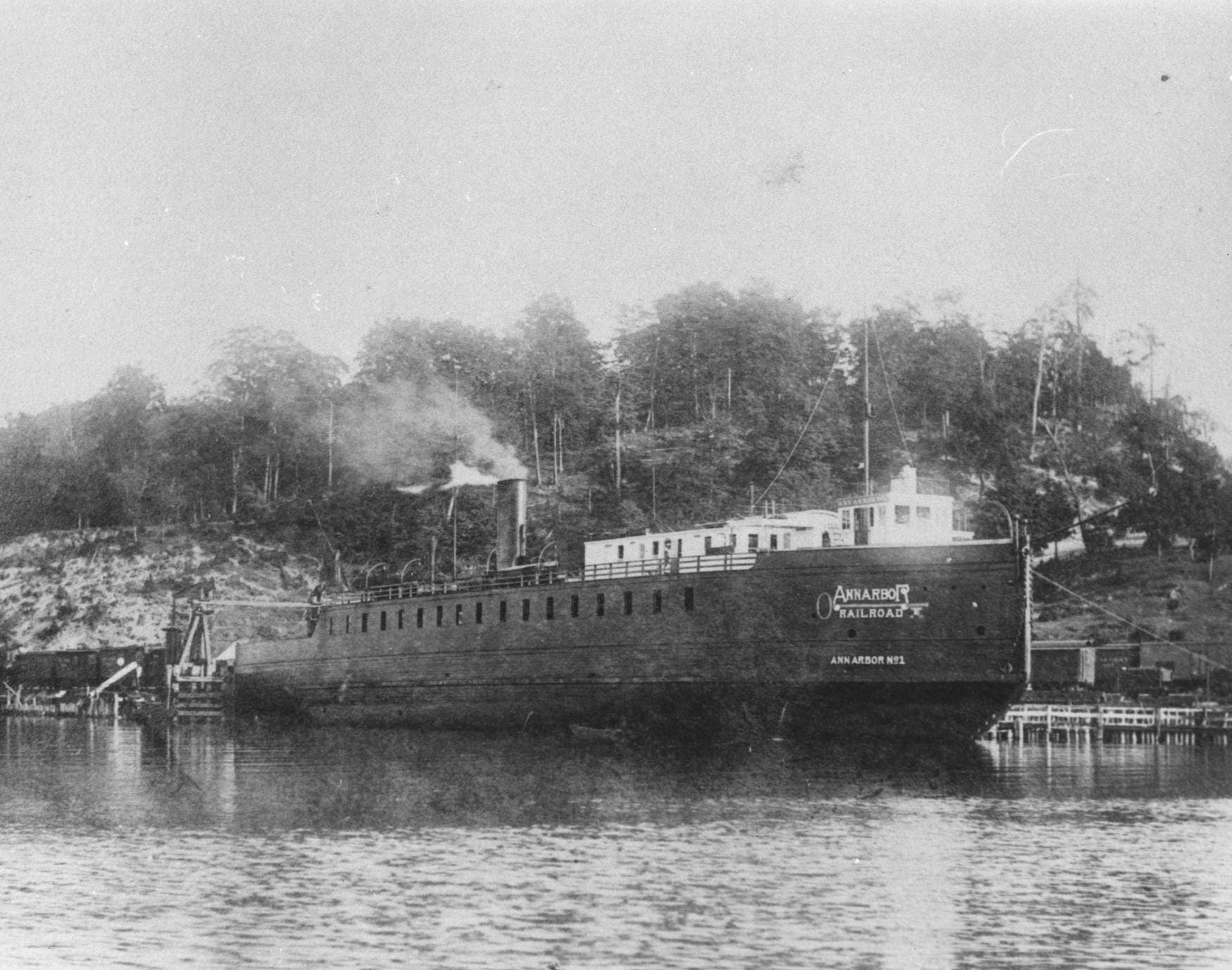
The Ann Arbor Railroad eventually demonstrated that the concept could work. Beginning in 1892, wooden railroad carferries carried cars between Frankfort and Wisconsin. The Flint & Pere Marquette now had proof that an entire train could be transferred across the lake without breaking bulk.
Capt. James W. Martin became the driving force behind the Flint & Pere Marquette’s own carferry project after becoming superintendent in the mid-1890s. The Record Appeal later credited Martin with conceiving and building the first steel railroad carferry on the Great Lakes. He presented his plans to railroad management, and the directors eventually authorized the investment.
The railroad let a contract in 1896 for a $300,000 steel vessel at F.W. Wheeler & Co. in West Bay City. Cleveland naval architect Robert Logan prepared the design with Martin’s close involvement. Instead of cargo holds requiring hand loading, the new ship would have four railroad tracks running nearly the length of the main deck.
The project also threatened the livelihood of the men who had made the break-bulk system possible. The Record Appeal estimated that 400 to 500 freight handlers worked the Ludington docks. The newspaper described the new vessel as a ‘great labor saving machine’ and reported that displaced workers responded with strikes, boycotts and other labor actions.
The confrontation escalated beyond an ordinary employment dispute. The 1904 account stated that opponents threatened to dynamite what they called the ‘infernal carferry.’ The source does not describe a riot, but it clearly documents serious labor unrest and threats of violence as workers confronted a technology that could eliminate much of the work that supported their families.
The newspaper later attributed Martin’s declining health to the strain surrounding the first freight-handlers’ strike. He died in a Milwaukee hospital March 21, 1897, only weeks after the new vessel entered service. The paper’s account linked his illness to the stress of the dispute, though that attribution should be understood as the newspaper’s explanation rather than a medical finding.
Despite the unrest, the railroad did not turn back. The new carferry would fundamentally change freight transportation at Ludington. Instead of moving cargo between a train and a ship, the railroad would move the train itself across Lake Michigan.
Coming in Part 7: Pere Marquette begins a new era.