


By Rob Alway
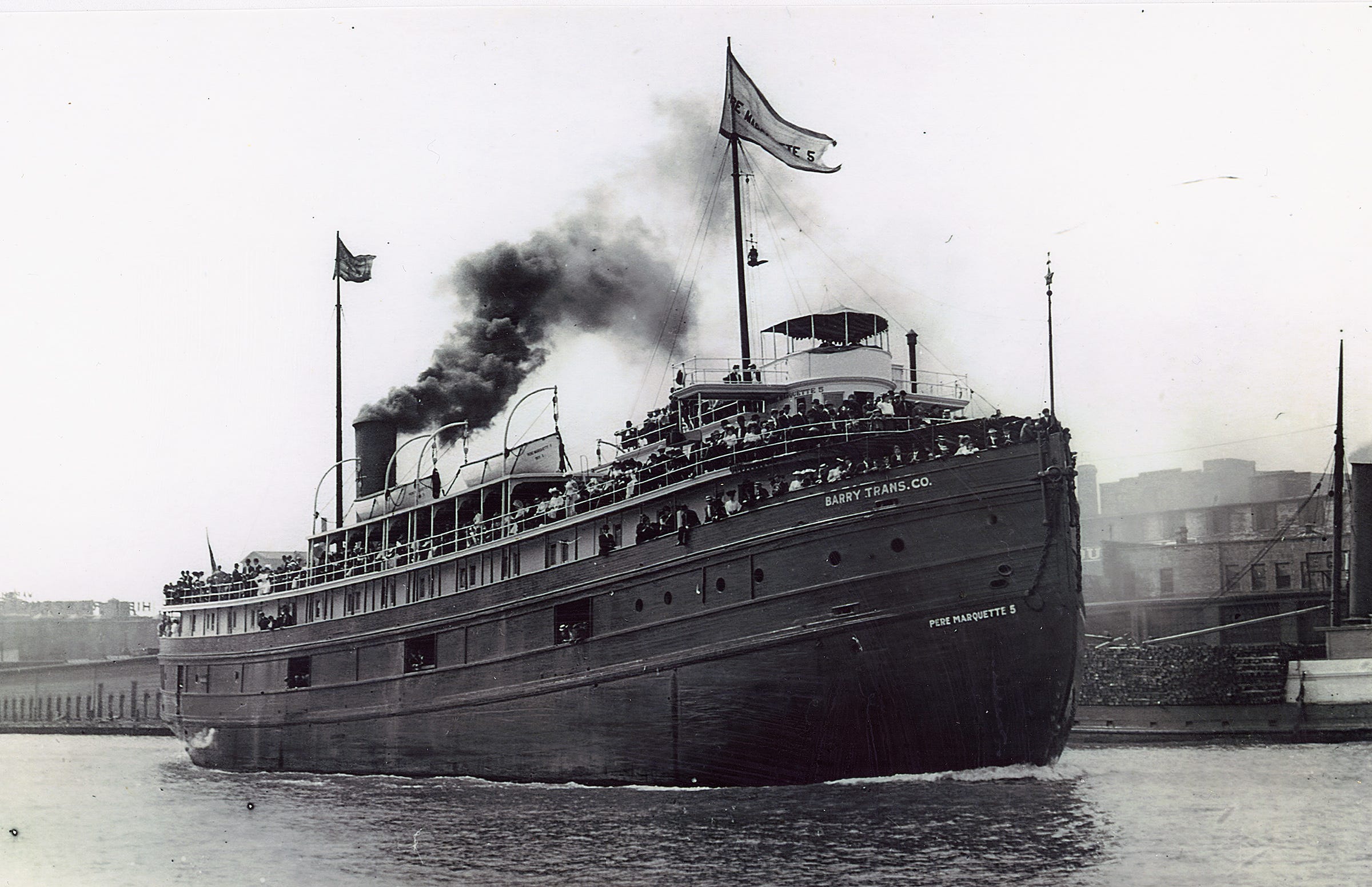
The Flint & Pere Marquette Railway pushed the Black Boat concept to its limit with F&PM No. 5. Built by F.W. Wheeler & Co. at West Bay City, the wooden steamer was launched Nov. 10, 1890 and dwarfed the earlier vessels in the fleet.
No. 5 measured about 226 feet between perpendiculars and more than 240 feet overall, with a beam of approximately 38 feet. She registered about 1,723 gross tons and was powered by a triple-expansion steam engine developing roughly 1,350 indicated horsepower.
The vessel was initially built as a straight package freighter without regular passenger accommodations. Her enormous cargo capacity was intended in part to move flour and other products during winter months when navigation through the Straits of Mackinac was restricted and the Ludington route offered an important east-west alternative.
The scale of the break-bulk operation can be seen in traffic figures from the winter of 1892-93. Five steamers moved the equivalent of about 4,000 railroad carloads eastbound. Roughly 1,400 carloads were grain, totaling about 1.2 million bushels, while flour and other mill products made up much of the balance. Westbound cargo included merchandise and thousands of barrels of salt.
Moving that freight required an enormous labor force. Approximately 300 men could be employed around the clock on the Ludington docks during winter rushes, unloading railroad cars, moving cargo through warehouses and loading the steamers. The system generated work, but it also exposed the central weakness of the operation.
The railroad had reached the practical limits of break-bulk shipping. A larger boat could carry more freight, but every additional ton still had to be handled by people at both ends of the lake crossing. The problem was not simply vessel capacity. It was the process itself.
No. 5 was rebuilt in 1898 with passenger cabins and became Pere Marquette 5 after the formation of the Pere Marquette Railway. She later worked under charter and then passed through several owners, including the Pere Marquette Line Steamers.
The vessel left the Great Lakes after being sold in 1916 to the Nova Scotia Steamship Co. Renamed Anzac, she entered Atlantic service. On March 11, 1917, the former Black Boat foundered off Nantucket while carrying lumber to New York. The crew survived.
The Black Boats had transformed Ludington into a major cross-lake freight terminal, but the railroad needed a way to eliminate the costly hand transfer that defined the entire system. The idea that would solve the problem had already been tried elsewhere on Lake Michigan: put the railroad cars aboard the ship themselves.
Coming in Part 6: The carferry idea - and the labor crisis that followed.