


By Rob Alway
The Flint & Pere Marquette Railway expanded its company-owned steamship fleet again in the late 1880s with F&PM No. 3 and F&PM No. 4. The new vessels retained the wooden-hulled package-freight design of the first Black Boats but were larger and offered substantially better passenger accommodations.
Frank E. Kirby again designed the ships. Construction of F&PM No. 3 began in 1886 under a Detroit Dry Dock contract, with Linn & Craig building the wooden hull at Gibraltar, Mich. She was launched April 1, 1887. The vessel measured about 187 feet long, 34.5 feet wide and registered roughly 924 gross tons.
No. 3 could accommodate about 200 passengers. Walnut woodwork, plush furnishings and oil lamps gave the ship a level of comfort far beyond the modest passenger quarters aboard Nos. 1 and 2. The railroad was increasingly competing not only for freight but also for overnight travelers between Michigan and Wisconsin.
Capt. John W. Duddleson supervised construction and became No. 3’s first master. When F&PM No. 4 joined the fleet in 1888, Duddleson moved to the new vessel and Capt. John W. Stewart took command of No. 3.
F&PM No. 4 was built by Detroit Dry Dock at Wyandotte. She was also about 187 feet long and was powered by a compound engine supplied with steam by two Scotch boilers. Like No. 3, she carried passengers and package freight rather than railroad cars.
The larger Black Boats generally worked the Ludington-Manistee-Milwaukee trade, while the earlier vessels were increasingly assigned to other routes such as Ludington-Manitowoc. Salt moved west while grain, flour and other products came east. Hundreds of men worked the Ludington docks transferring cargo between trains, warehouses and vessels.
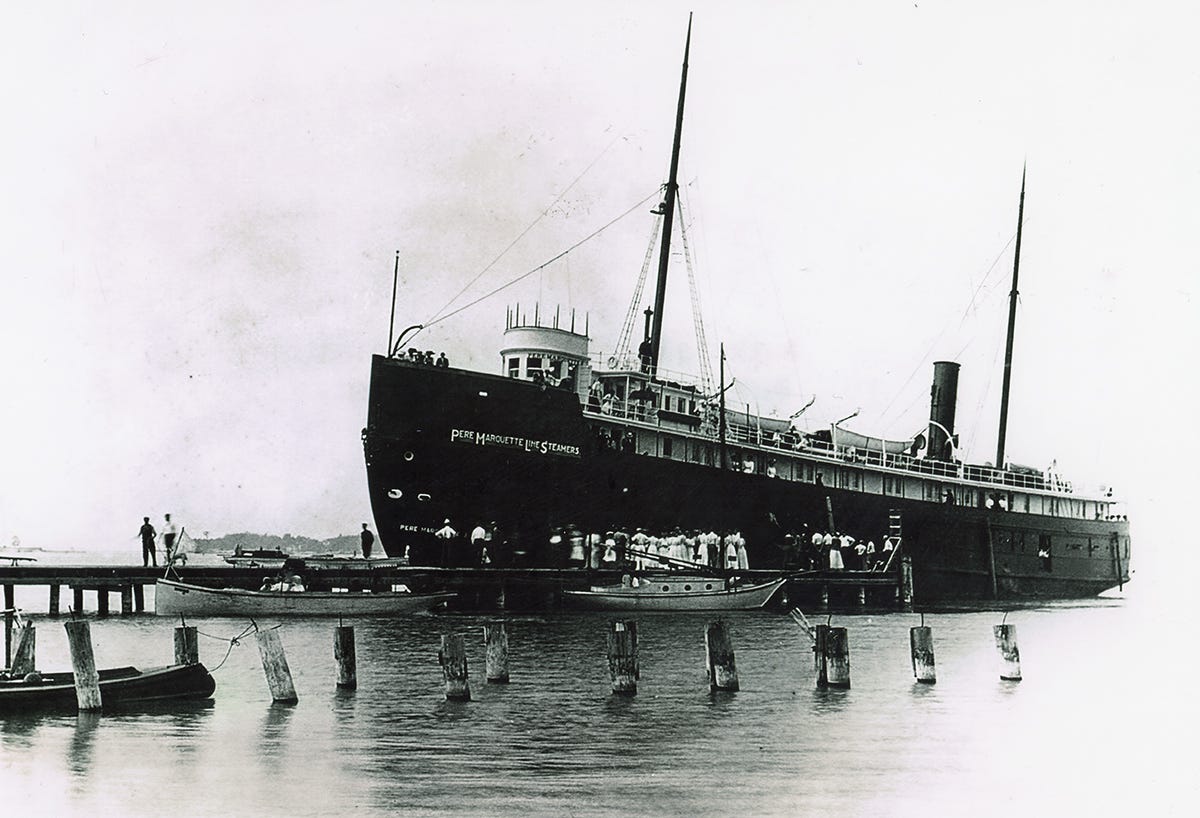
The creation of the Pere Marquette Railway in 1900 brought new names. F&PM No. 3 and F&PM No. 4 became Pere Marquette 3 and Pere Marquette 4. In 1903 both were sold, along with Pere Marquette 2, to Gus Kitzinger’s Manistee, Ludington & Milwaukee Transportation Co., which became associated with the Pere Marquette Line Steamers.
No. 3’s career ended after she became caught in ice off Ludington in March 1920. The wooden hull was badly damaged and settled by the stern. She was later raised and taken to Manitowoc, but rebuilding was judged impractical. The remains were eventually burned.
No. 4 survived longer. She collided with the steel carferry Pere Marquette 17 outside Milwaukee in dense fog in May 1923. The old wooden steamer later became a clubhouse for the Columbia Yacht Club in Chicago and was finally condemned and destroyed in the 1930s.
The railroad’s next Black Boat would be much larger than any of her predecessors - and would become the last major package-freight steamer built for the Flint & Pere Marquette before the railroad began searching for a radically different solution.
Coming in Part 5: F&PM No. 5 - the largest of the Black Boats.