

By Rob Alway
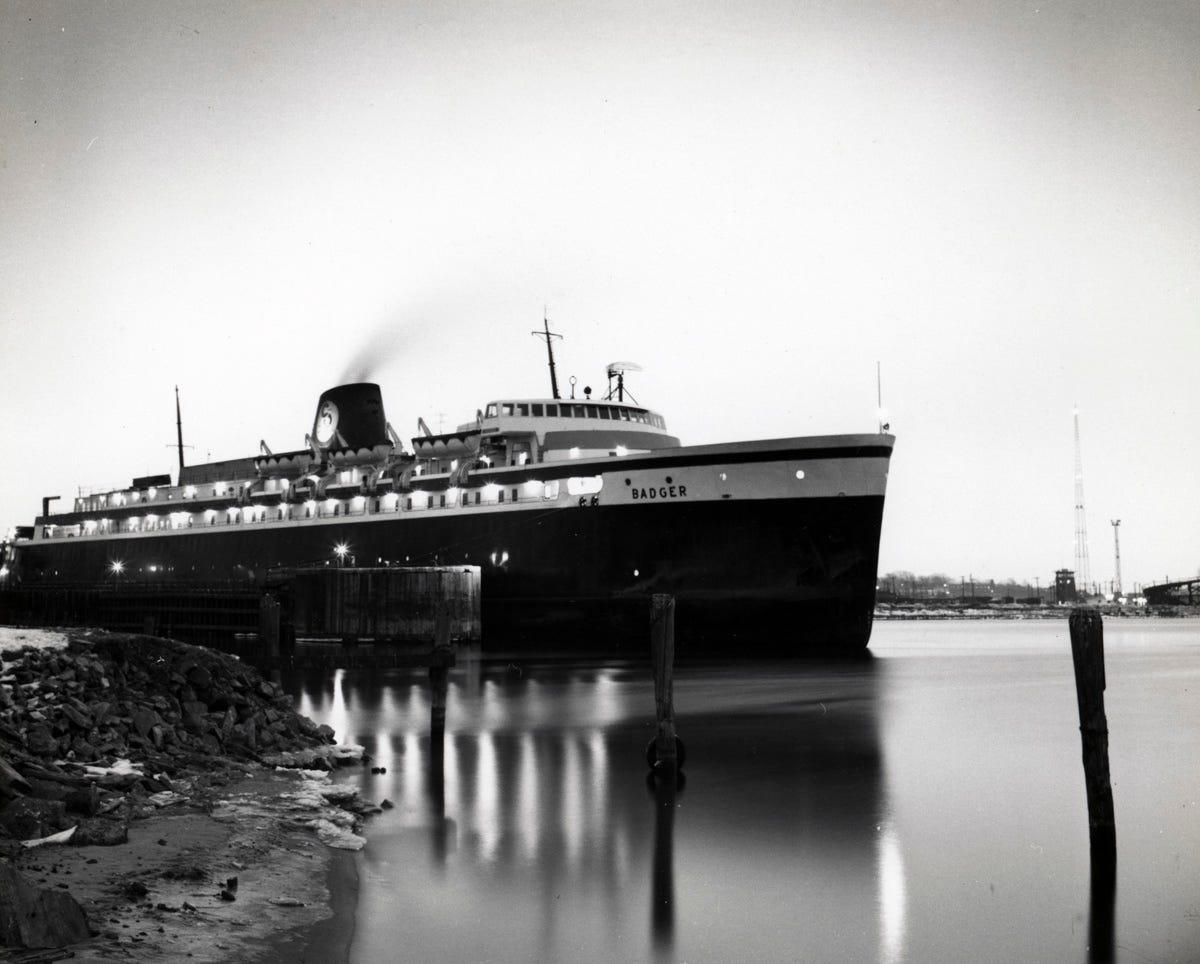
SS Badger entered service as the final vessel in a line of Ludington railroad steamers stretching back more than three-quarters of a century. She was the second of two massive sister ships ordered by the Chesapeake & Ohio Railway to expand and modernize the cross-lake operation. Her older sister, Spartan, had already reached Ludington in 1952. When Badger followed in 1953, the C&O had completed what would become the final generation of railroad carferries ever built for Lake Michigan.
Christy Corp. constructed Badger at Sturgeon Bay, Wis., using essentially the same plans as Spartan. She was launched Sept. 6, 1952, during a ceremony that also formally recognized her sister, which had been launched earlier that year. Badger began regular service from Ludington on March 21, 1953. The ship was named for the University of Wisconsin’s Badgers, complementing Spartan, named for Michigan State College, now Michigan State University.
The two ships were the largest railroad carferries built for the Ludington fleet. Badger measures 410 feet, 6 inches long and 59 feet, 6 inches wide. Her four-track car deck was originally designed to handle 34 standard railroad cars, while configurations for automobile service could accommodate about 150 vehicles. Contemporary accounts emphasized the scale of the new sisters and the quality of their passenger accommodations.
Deep inside the ship were two Skinner Unaflow reciprocating steam engines. Four Foster-Wheeler coal-fired boilers supplied steam to the engines, which turned two enormous four-bladed propellers. The machinery represented the culmination of reciprocating marine steam technology at a time when diesel power was rapidly replacing steam elsewhere. The American Society of Mechanical Engineers designated Badger’s propulsion system a Historic Mechanical Engineering Landmark in 1996.
The C&O had ended the official numbering tradition with City of Midland 41. Neither Spartan nor Badger ever carried an official number as part of her name. The tradition nevertheless survived among carferry crews and enthusiasts. Spartan became affectionately known as ‘42,’ while Badger became ‘43,’ continuing the sequence that officially ended with No. 41.
Badger joined the fleet during the height of Ludington’s railroad carferry operation. Seven vessels were operating from the harbor during the 1950s, connecting Ludington with Milwaukee, Manitowoc and Kewaunee. Railroad freight remained the primary business, but passenger and automobile traffic had become increasingly important. The C&O operated what amounted to a waterborne extension of its railroad across Lake Michigan.
For decades, Badger performed exactly the work for which she had been built. Railroad cars were switched onto her four tracks at Ludington, secured for the crossing and unloaded onto connecting railroads in Wisconsin. Passengers and automobiles traveled above them. During her railroad years, the ship operated in all seasons, including the heavy ice and severe winter weather that had shaped the design of Ludington carferries since the 1890s.
The business that created her was already beginning to change, however. Improved railroad routing around the southern end of Lake Michigan reduced the advantage of carrying freight cars across the lake. The C&O gradually reduced its Lake Michigan operation, and the once-large Ludington fleet dwindled. By the early 1980s, City of Midland 41, Spartan and Badger were the three remaining ships.
The railroad left the Lake Michigan carferry business in 1983. The three vessels were sold to a group of Ludington businessmen who formed Michigan-Wisconsin Transportation Co. The new company continued the cross-lake operation, initially relying primarily on City of Midland 41 for railroad service to Kewaunee.
Badger was used briefly for seasonal passenger and automobile service before being laid up. Her future changed after a Coast Guard inspection revealed costly problems with No. 41’s boiler mounts. Rather than make the necessary repairs to the older vessel, Michigan-Wisconsin Transportation refurbished Badger. She returned to service in November 1988, replacing City of Midland 41 as the company’s operating railroad carferry.
That decision placed Badger at the center of the final chapter of Lake Michigan railroad carferry service. For the next two years she carried railroad cars between Ludington and Kewaunee, the last surviving rail-ferry route on the lake.
The railroad-car era ended in November 1990. Badger made her final railroad-car crossing from Kewaunee to Ludington, bringing an end to more than nine decades of railroad carferry service from Ludington. Railcars would never again cross Lake Michigan aboard a carferry.
For a time, it appeared Badger might follow so many earlier carferries into the scrapyard. Michigan-Wisconsin Transportation ceased operations, and the three surviving ships sat idle at Ludington. Ludington native Charles Conrad purchased Badger, Spartan and City of Midland 41 in 1991 and organized Lake Michigan Carferry.
Conrad envisioned a completely different purpose for Badger. The railroad cars would not return. Instead, the ship was renovated to concentrate on passengers, automobiles, commercial vehicles and tourism. Lounges, food service and other passenger spaces were improved, while the machinery that had powered the ship during her railroad career remained largely intact. In 1992, Badger returned to service between Ludington and Manitowoc.
The gamble worked. The former railroad carferry developed into a successful seasonal passenger and vehicle operation. Lake Michigan Carferry continued refining the service while preserving a vessel that otherwise might have disappeared with the railroad business that created her.
Preserving a coal-fired steamship also created challenges. For decades, Badger’s boilers produced coal ash that was discharged into Lake Michigan, a practice that eventually became the subject of federal environmental regulation. The company installed an ash-retention system that collects the material aboard the vessel for disposal ashore, permanently ending coal-ash discharge into the lake in 2015.
The following year brought one of the greatest recognitions in the ship’s history. In 2016, SS Badger was designated a National Historic Landmark, the nation’s highest level of federal recognition for a historic property. Her significance rests not merely on her age but on what survives aboard her: the hull form, railroad-car deck and coal-fired Skinner steam machinery that document the final stage of American railroad carferry development.
Another ownership transition came in 2020. Interlake Maritime Services acquired Lake Michigan Carferry and SS Badger, along with Spartan and the assets of Pere Marquette Shipping Co., operator of the Undaunted/Pere Marquette 41 tug-barge combination. The purchase reunited Ludington’s three surviving railroad carferry hulls - Badger, Spartan and the former City of Midland 41 - under common ownership.
SS Badger continues to sail today from her home port of Ludington. Her modern mission bears little resemblance to the one for which the C&O built her. Instead of railroad cars, she carries passengers, automobiles, motorcycles, recreational vehicles, buses and commercial trucks across Lake Michigan between Ludington and Manitowoc. The crossing remains a waterborne segment of U.S. 10 between Michigan and Wisconsin.
More than seven decades after entering service, Badger remains powered by coal-fired boilers and Skinner Unaflow steam engines. She is the only surviving Ludington railroad carferry still sailing under her own power.
Her survival completes a remarkable circle in Ludington’s maritime history. The Flint & Pere Marquette Railway began cross-lake service in 1875 with the chartered sidewheel steamer John Sherman. Freight had to be unloaded from railroad cars at Ludington, carried aboard the vessel and then transferred back to the railroad after reaching Wisconsin.
The railroad soon developed its own fleet of wooden ‘Black Boats,’ followed in 1897 by the revolutionary steel carferry Pere Marquette. Loaded railroad cars could now roll directly aboard a ship at Ludington and continue their journey after crossing Lake Michigan. What had begun as a steamship connection had become, quite literally, a railroad across the lake.
Successive generations of carferries followed. Pere Marquette 17, 18, 19 and 20 expanded the fleet. Nos. 21 and 22 introduced a new generation in the 1920s. City of Saginaw 31 and City of Flint 32 brought greater speed and an increased emphasis on passenger travel. City of Midland 41 became the final new steamer built for the Pere Marquette Railway. Then came the Chesapeake & Ohio twins, Spartan and Badger, the culmination of more than half a century of railroad carferry development.
The railroad-car era finally ended in 1990, but the story did not. The hull of City of Midland 41 survives as the working barge Pere Marquette 41. Spartan remains in Ludington harbor. And SS Badger continues to sail from Ludington to Manitowoc, preserving a direct physical connection to the fleet that once carried entire trains across Lake Michigan.
More than 150 years have passed since the John Sherman began the railroad’s first cross-lake service from Ludington. The vessels changed. The railroads changed. The technology changed. Yet Ludington harbor remains home to surviving pieces of that extraordinary transportation system.
The railroad cars are gone, but the steamship remains.
Each time SS Badger passes through the Ludington pier heads, she carries with her the legacy of the captains, engineers, deck crews, railroaders, shipbuilders and thousands of others who built and operated Ludington’s railroad across Lake Michigan.