

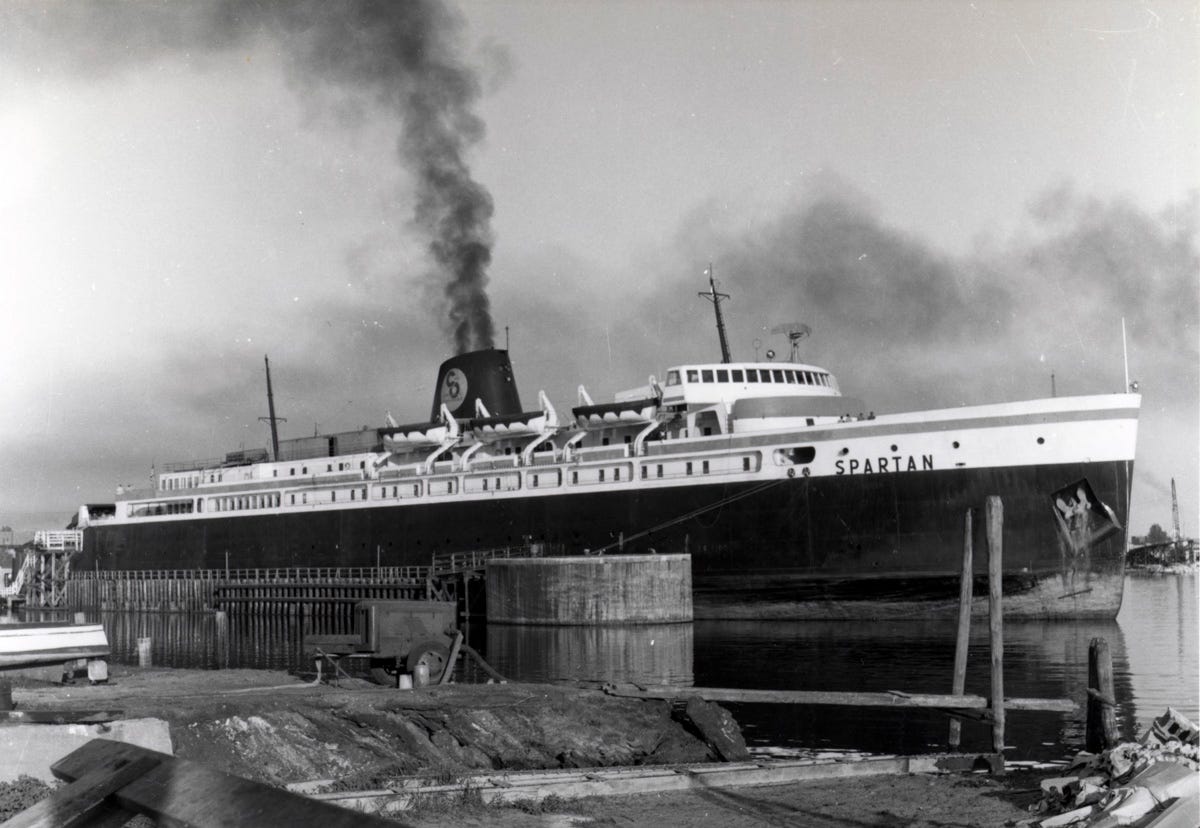
The Chesapeake & Ohio Railway signaled its commitment to Ludington’s cross-lake operation only a few years after absorbing the Pere Marquette Railway. Rather than simply continue operating the inherited fleet, the C&O ordered two enormous new railroad carferries in 1951. The first would be Spartan, a 410-foot coal-fired steamer that introduced the final generation of railroad carferries built for Ludington. The second would be her nearly identical sister, Badger.
Christy Corp. of Sturgeon Bay, Wis., built Spartan. Construction began in 1950, and the vessel was launched in January 1952. Unlike previous Ludington carferries carrying Pere Marquette numbers or the names of Michigan cities, the new vessel was named for the athletic teams of Michigan State College, now Michigan State University. Her sister would be named Badger for the University of Wisconsin.
The sister ships represented the culmination of more than half a century of railroad carferry development. Spartan measured approximately 410 feet long with a beam of nearly 60 feet. Four tracks crossed her car deck, which was designed for 34 standard railroad cars. She also offered substantially improved accommodations for the traveling public, including 60 staterooms, lounges and dining facilities.
Automobiles had also become an important part of the business. The twins could carry about 150 automobiles when used primarily for vehicle traffic, while their normal railroad configuration allowed them to carry thousands of tons of freight in railroad cars. Their normal service speed was about 18 mph.
At the heart of Spartan were two massive Skinner Unaflow steam engines. Steam came from coal-fired boilers, preserving the basic power source that had driven Ludington’s railroad steamers for decades while incorporating one of the most advanced reciprocating steam-engine designs available. The engines provided substantial power in both forward and reverse, an especially important feature for vessels regularly maneuvering into railroad slips and working through heavy ice.
The arrival of Spartan also marked the end of the railroad’s formal tradition of numbering its Lake Michigan carferries. That practice had begun with the earlier Pere Marquette vessels and continued through City of Saginaw 31, City of Flint 32 and finally City of Midland 41. The Chesapeake & Ohio chose not to include numbers in the official names of its two new sister ships. They were christened simply Spartan and Badger.
The old tradition never entirely disappeared, however. Generations of carferry crew members and enthusiasts have affectionately and unofficially referred to Spartan as ‘42’ and Badger as ‘43,’ continuing the numerical sequence that officially ended with City of Midland 41. Historical accounts of the fleet also note that the numbers 42 and 43 became commonly associated with the ships even though they were never part of their official names.
The timing of Spartan’s arrival at Ludington was unusual. A major carferry labor strike had idled the fleet beginning in July 1952. Spartan completed her trials and was delivered to the railroad in October, becoming the first carferry to enter Ludington harbor since the strike began. Once the labor dispute ended, the new vessel entered regular service.
The arrival of Spartan also demonstrated the enormous scale the Ludington operation had reached. In 1951, even before the new twins entered service, the carferries made 2,776 round trips from Ludington. By 1953, seven vessels were operating from the port to Milwaukee, Manitowoc and Kewaunee, with railroad freight remaining the principal business even as automobile and passenger traffic grew.
Spartan spent most of the next quarter-century working as intended - moving loaded railroad cars, automobiles and passengers across Lake Michigan in all seasons. Like the vessels before her, she was designed for year-round service and regularly encountered the gales and heavy ice that made Lake Michigan carferry operation unlike most railroad transportation systems.
One of the more serious incidents of her career occurred in August 1976. While operating in heavy fog near Ludington, Spartan struck bottom near the harbor entrance and damaged a substantial section of her hull. She was repaired and returned to service.
The economics of the cross-lake railroad business were changing rapidly by then. Improved rail connections around the southern end of Lake Michigan reduced the time advantage once provided by the ferries, while interstate highways altered automobile travel patterns. The C&O, later operating as part of the Chessie System, gradually reduced its Lake Michigan operation. By the late 1970s, only City of Midland 41, Spartan and Badger remained from the once much larger Ludington fleet.
Spartan became the first of the three to leave regular service. In 1979 she was laid up at Ludington. There was at least one serious attempt to return her to service. In 1980, Spartan was prepared for a proposed lease involving the former Ann Arbor Railroad operation from Frankfort. The plan did not result in her return to regular service, and she went back into layup at Ludington.
Her ownership nevertheless followed the same path as the two operating Ludington carferries. When Chessie System ended its Lake Michigan carferry operation in 1983, Spartan, Badger and City of Midland 41 were sold to the Ludington businessmen who organized Michigan-Wisconsin Transportation Co. The new company continued railroad carferry service primarily with No. 41 and later Badger, while Spartan remained laid up.
Michigan-Wisconsin Transportation ceased operations in 1990. Ludington native Charles Conrad purchased the three surviving vessels in 1991 and organized Lake Michigan Carferry. His company returned Badger to service in 1992, while City of Midland 41 was eventually converted into the barge Pere Marquette 41. Spartan remained at Ludington as various ideas for returning her to service were considered but never carried out.
The idle ship nevertheless continued to serve a purpose. Because Spartan and Badger were built as near-identical sisters, components from Spartan have been used over the years to support the continued operation of Badger, particularly equipment associated with their increasingly rare Skinner steam machinery.
Another ownership change came in 2020. Interlake Maritime Services acquired Lake Michigan Carferry, including Badger and the laid-up Spartan, along with the assets of Pere Marquette Shipping Co. and the Undaunted/Pere Marquette 41 operation. The transaction placed the three surviving vessels from Ludington’s final railroad carferry fleet under common ownership once again.
Today, Spartan remains moored in Ludington harbor near her active sister, Badger. More than four decades have passed since she last carried railroad cars across Lake Michigan, yet the 410-foot steamer remains one of the most visible surviving links to the period when railroad carferries dominated Ludington’s waterfront.
The second C&O twin would follow a very different path. Built from essentially the same plans, Badger would survive the collapse of the railroad carferry business, come close to disappearing herself and eventually emerge as the last operating vessel of Ludington’s railroad carferry fleet.
Coming in Part 18: SS Badger - from railroad carferry to National Historic Landmark.