

By Rob Alway
City of Midland 41 marked the final major step in carferry development under the Pere Marquette Railway. The success of City of Saginaw 31 and City of Flint 32 had demonstrated the advantages of faster vessels with greater freight capacity and better accommodations for passengers and automobiles. The railroad’s next ship would be larger and more powerful than any carferry it had previously placed in service - and she would ultimately be the last new Lake Michigan carferry built for the Pere Marquette.
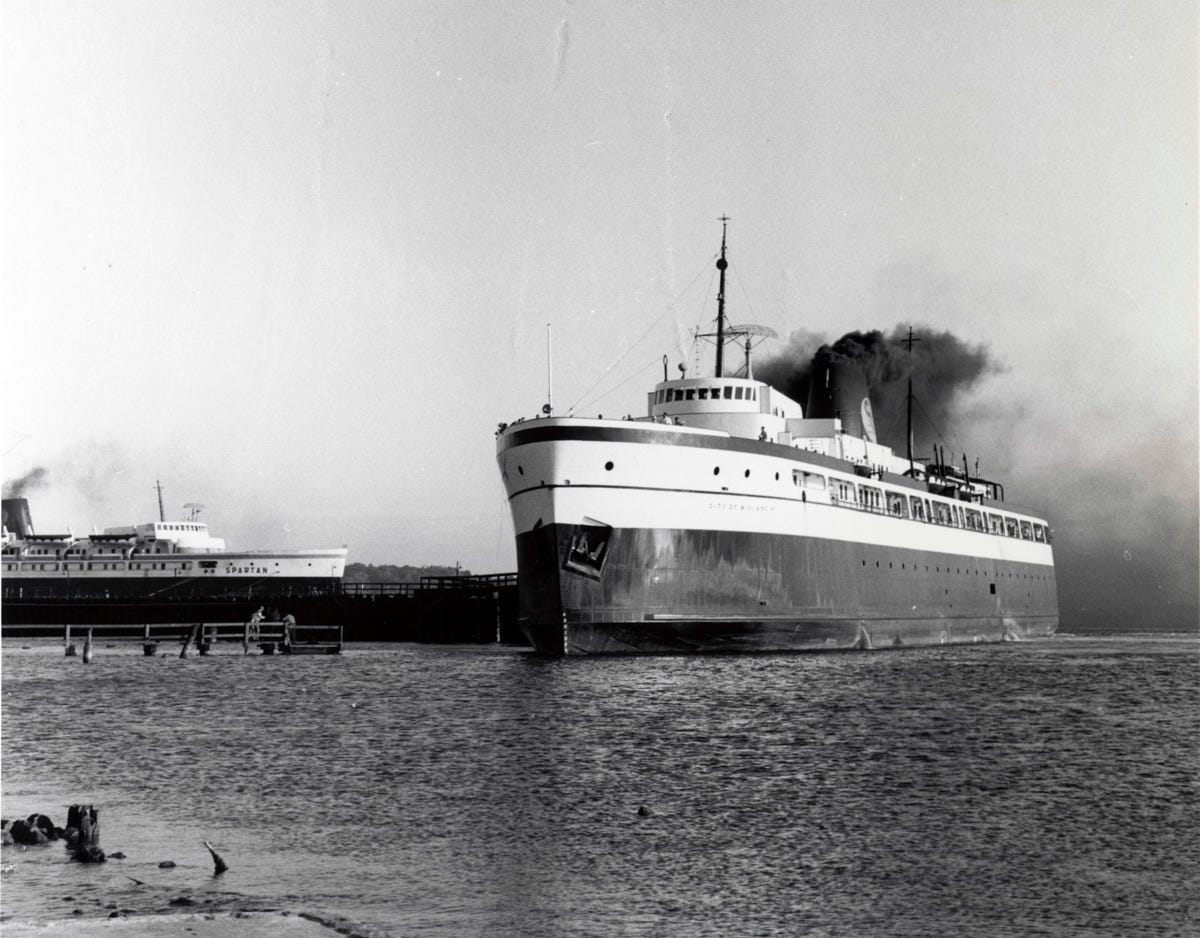
The Manitowoc Shipbuilding Co. built City of Midland 41 at Manitowoc, Wis. Her keel was laid in 1940 and she entered service March 12, 1941, sailing from Manitowoc to Ludington on her maiden voyage. Measuring approximately 406 feet overall, she became the first 400-foot vessel in the Ludington fleet. Contemporary histories placed her construction cost at approximately $2 million.
No. 41 was substantially larger than Nos. 31 and 32. Her car deck accommodated 34 standard railroad cars, compared with 30 aboard the earlier sisters. She could carry 376 passengers and included 74 staterooms, 12 of them larger suites. An upper automobile deck provided space for about 50 vehicles. These features demonstrated how dramatically the carferry business had changed since the original Pere Marquette entered service in 1897.
Her machinery also distinguished her from the turbo-electric Nos. 31 and 32. City of Midland 41 was powered by two five-cylinder Skinner Unaflow steam engines. The engines provided excellent reversing ability, an important characteristic for a carferry routinely maneuvering in confined harbors and backing into railroad slips. The different propulsion arrangement also led the Pere Marquette to begin another numbering series. Instead of becoming No. 33, the vessel was designated No. 41.
Winter operation remained fundamental to the design. Heavy reinforcement made City of Midland 41 a formidable icebreaker. Her bow plating was 1.25 inches thick for about 75 feet aft of the stem, roughly twice the thickness of much of the remaining hull plating. Heavy bow frames were spaced on 18-inch centers, and the forged-steel stem measured 11 inches wide and four inches thick. The bow was shaped to ride upward onto heavy ice until the vessel’s weight broke through it.
The new flagship quickly became one of the fleet’s workhorses. A later account credited No. 41 with traveling more than 1 million miles during her first 10 years. World War II began only months after she entered service, and Ludington’s carferries became an important part of the national transportation system while continuing their year-round movement of railroad freight. The ferries also served as training platforms for U.S. Coast Guard and Navy personnel during the war.
Passenger and automobile traffic became increasingly important during the postwar years. Although No. 41 had been designed with an automobile deck, ramps that allowed more effective use of that space were not installed at Ludington and Manitowoc until 1955. By then, the Lake Michigan crossing was not simply a railroad connection. It had become an important passenger and automobile route linking the two sides of U.S. 10.
The railroad itself changed during No. 41’s career. On June 6, 1947, the Pere Marquette Railway became part of the Chesapeake & Ohio Railway. City of Midland 41 continued operating from Ludington and remained flagship until a new generation of vessels began arriving in the early 1950s.
That transition gives City of Midland 41 a particularly important place in the story. She was the final Lake Michigan carferry constructed for the Pere Marquette Railway. Every new Ludington carferry that followed would be built during the Chesapeake & Ohio era. The line of Pere Marquette steamers that began with the original steel carferry Pere Marquette in 1897 ended with No. 41 in 1941.
Her career, however, was far from over. No. 41 remained in regular service for decades as the older members of the fleet disappeared. By the early 1980s, City of Midland 41, Spartan and Badger were the surviving vessels of the Ludington operation. The Chesapeake & Ohio, by then part of the Chessie System, left the Lake Michigan carferry business in 1983. Michigan-Wisconsin Transportation Co., organized by Ludington businessmen, took over the service and the three vessels.
City of Midland 41 became particularly important to the new company because railroad freight remained the foundation of the operation. The Wisconsin destination eventually centered on Kewaunee, and No. 41 continued hauling loaded railroad cars across Lake Michigan after more than four decades of service.
The end of her railroad carferry career came in 1988. A Coast Guard inspection had revealed deterioration involving the vessel’s boiler mounts, and correcting the problem would require a substantial investment in a ship approaching its 50th year. Michigan-Wisconsin Transportation instead chose to return Badger to service. City of Midland 41 made her final railroad carferry crossings in November 1988 and was laid up at Ludington. Railroad cars continued crossing aboard Badger until the cross-lake rail operation itself ended in 1990.
Charles Conrad, a Ludington native, purchased the surviving carferry operation in 1991 and organized Lake Michigan Carferry. His decision to rebuild Badger around passenger, automobile and commercial-vehicle traffic preserved that vessel, but it left another question: what could be done with City of Midland 41?
The answer ultimately gave No. 41 an entirely different career. In 1997, Lake Michigan Carferry converted the former railroad carferry into a self-loading cargo barge. Most of her passenger superstructure and steam machinery were removed, and the vessel was renamed Pere Marquette 41. A separate company, Pere Marquette Shipping Co., was established to operate the new freight business.
Pere Marquette Shipping acquired the former U.S. Navy tug that became Undaunted. The tug was extensively rebuilt and fitted to operate with Pere Marquette 41 as an articulated tug-barge unit. The combination could carry stone, slag, scrap, pig iron, steel products and other bulk and specialty cargoes. Ludington remained the operation’s home base.
Another major ownership change came in 2020. Interlake Maritime Services acquired the assets of Pere Marquette Shipping Co. and Lake Michigan Carferry, including Pere Marquette 41, Undaunted, SS Badger and the laid-up Spartan. Pere Marquette Shipping subsequently became Interlake Logistics Solutions, a division of Interlake Maritime Services.
The former City of Midland 41 continues to operate today as Pere Marquette 41 in the Undaunted/Pere Marquette 41 tug-barge unit. Ludington harbor remains the operation’s home port and base. The vessel that entered the harbor in 1941 as the final and most advanced carferry built for the Pere Marquette Railway still earns its living from the same port more than eight decades later.
City of Midland 41 was therefore both an ending and a transition. She was the last of the Pere Marquette steamers, but her story never really ended. The hull survived railroad service, conversion and another change of ownership to become one of the most tangible working links to Ludington’s railroad carferry era.
Coming in Part 17: Spartan - the first of the C&O twins.