


By Rob Alway
The Pere Marquette Railway added no new carferries to its Ludington fleet for more than a decade after the second Pere Marquette 18 entered service in 1911. The existing vessels continued moving railroad cars across Lake Michigan through World War I and into the 1920s. That changed in 1924, when the railroad began another major period of fleet development with two new vessels, Pere Marquette 21 and Pere Marquette 22.
Manitowoc Shipbuilding Co. constructed the sister ships in Wisconsin. No. 21 became the first of five Pere Marquette carferries ultimately built at Manitowoc, beginning a long relationship between the shipyard and Ludington’s cross-lake fleet.
The ships were approximately 360 feet long when built and appeared with twin smokestacks. They were larger and faster than the early 350-foot carferries and continued the fleet’s numerical sequence after Nos. 19 and 20.
Railroad freight remained their primary purpose, but the business was changing. Passenger and automobile traffic was becoming increasingly important during the 1920s, and the new vessels offered better accommodations than many of the older freight-oriented ships.
The Pere Marquette Railway became part of the Chesapeake & Ohio Railway in 1947, and Nos. 21 and 22 continued operating from Ludington under their original names. By then, the fleet included the much newer City of Saginaw 31, City of Flint 32 and City of Midland 41.
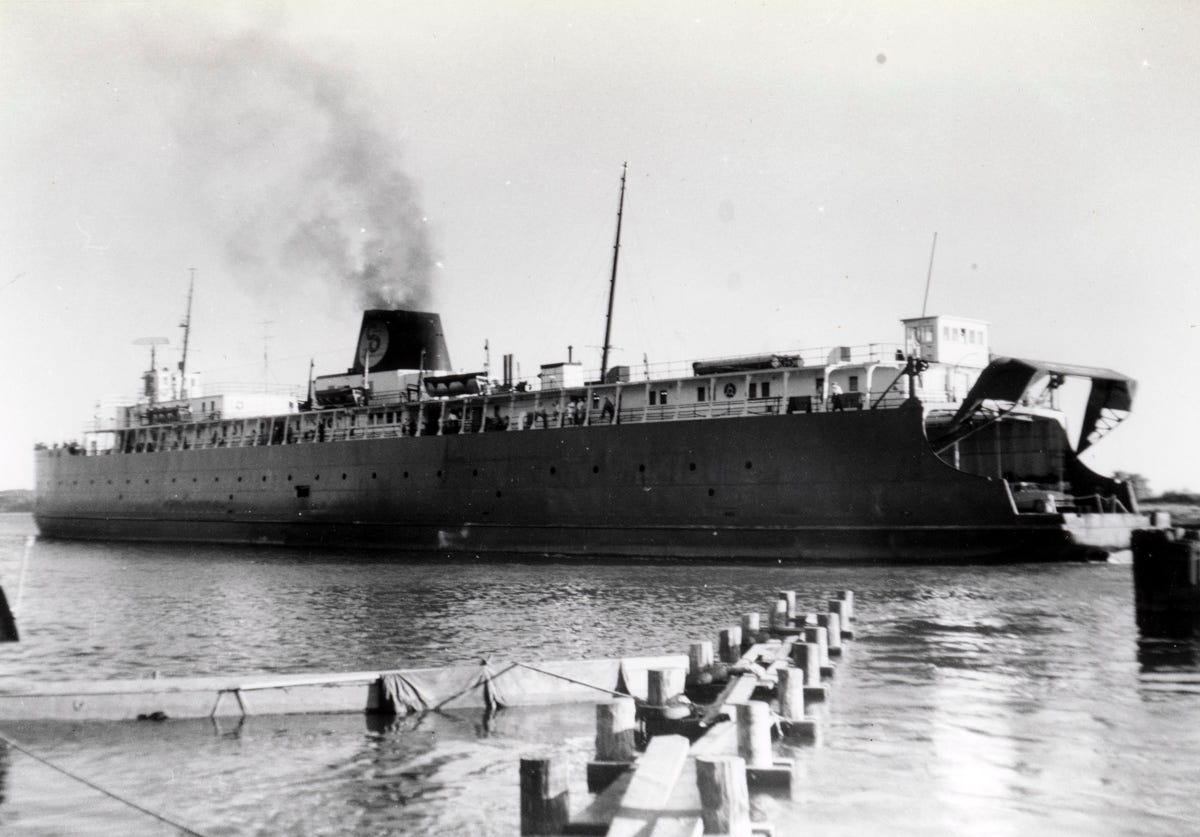
The C&O decided in the early 1950s to modernize Nos. 21 and 22 rather than replace them. Each vessel was cut in two and lengthened by inserting a new midbody section. Detailed contemporary accounts place the addition at 40 feet, bringing the rebuilt ships to roughly 400 feet overall, though at least one later history described the extension as 50 feet.
The reconstruction added room for more railroad cars and additional passenger space. New Skinner Unaflow machinery improved performance, and the old twin-stack appearance gave way to a single smokestack. The rebuilt vessels could continue working beside the newer C&O ships rather than being immediately retired.
The arrival of Spartan and Badger in the early 1950s finally pushed the fleet into its last major generation, but Nos. 21 and 22 remained useful for another two decades. Both were retired in the early 1970s and sold to Construction Aggregates Corp.
No. 21 left Ludington in 1974 and was eventually converted into the dredging vessel The Consolidator. She was later reported lost near Honduras during Hurricane Jeanne in November 1980, with no loss of life.
No. 22 left Ludington in 1973. She eventually came under Panama Dredging ownership and was renamed Pegasus. Later details of the vessel’s final disposition are less certain than the well-documented earlier part of her career.
Nos. 21 and 22 bridged two eras. They were born as traditional Pere Marquette railroad carferries in the 1920s and survived long enough to work beside the final giant steamships of the Chesapeake & Ohio era.
Coming in Part 15: City of Saginaw 31 and City of Flint 32 - turbo-electric power and a new era of cross-lake passenger travel.