


By Rob Alway
The Flint & Pere Marquette Railway reached Ludington in late 1874, completing a rail route of roughly 250 miles across Michigan from the Saginaw Valley to Lake Michigan. Railroad leaders had not chosen Ludington merely as an endpoint. They envisioned the harbor as a western gateway where freight and passengers could continue across Lake Michigan and connect with railroads in Wisconsin.
Cross-lake service began May 31, 1875, nearly six months after the railroad reached Ludington. The first route linked Ludington with Sheboygan, Wis., where connections could be made with the Sheboygan & Fond du Lac Railway and other western lines.
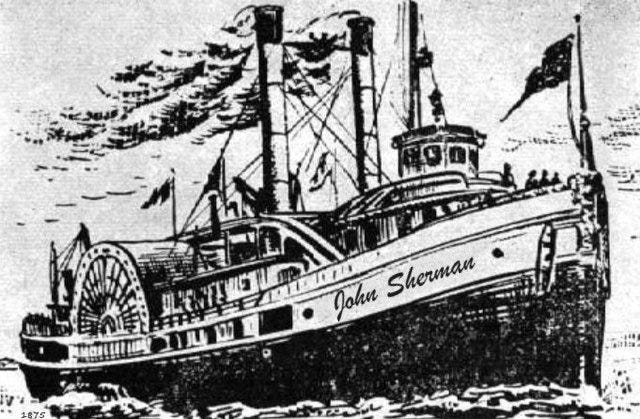
The railroad did not yet own a steamer suitable for the service. Instead, it chartered the wooden sidewheel steamer John Sherman, commanded by Capt. John W. Stewart. The vessel carried passengers, grain and package freight between the two ports during the navigation season.
John Sherman already had an unusual history. Built at Cleveland in 1865 by Peck & Kirby for the U.S. Revenue Cutter Service, the vessel was commissioned in 1866. The wooden sidewheeler was approximately 172 to 175 feet long and was powered by a walking-beam engine. The federal government sold her in 1872, after which she entered commercial service on the Great Lakes.
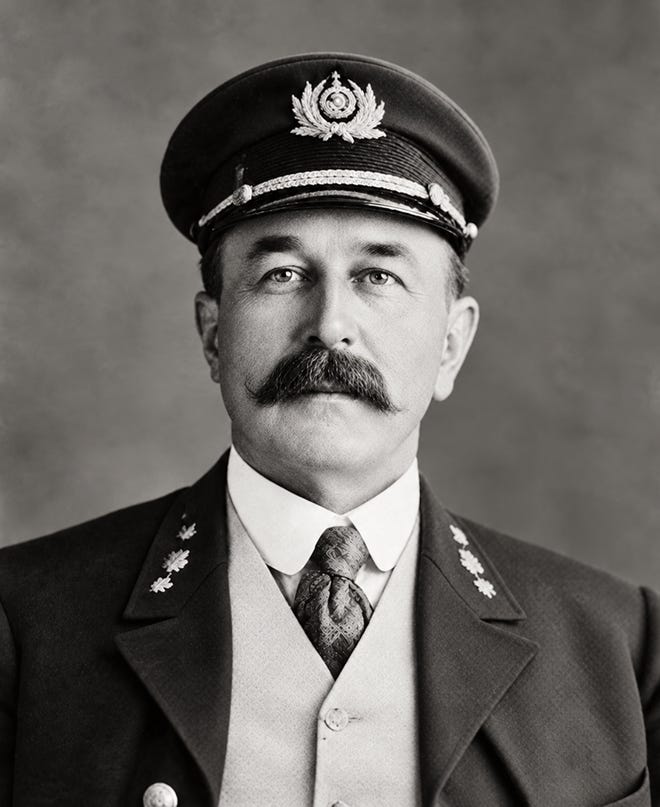
Stewart was already operating John Sherman on Lake Michigan by 1874. The Flint & Pere Marquette chartered the vessel for its new cross-lake route the following year, creating the first direct steamship extension of the railroad from Ludington.
The operation was still a break-bulk system. Railroad cars arriving at Ludington had to be unloaded by hand. Freight was carried into the steamer, crossed Lake Michigan, then was unloaded again in Wisconsin and returned to railroad cars. The process required large numbers of dockworkers and consumed considerable time, but it allowed the Flint & Pere Marquette to avoid routing traffic through congested Chicago.
The John Sherman served the railroad for only the 1875 season. The experience proved that a regular cross-lake connection could extend the railroad’s reach far beyond the Lake Michigan shoreline. The company soon shifted its principal Wisconsin connection south to Milwaukee and entered an agreement with one of Lake Michigan’s best-known steamship companies.
The little sidewheeler’s own career continued long after her brief association with Ludington. She eventually lost her machinery, became a lumber barge and was scrapped in 1893. Her place in Ludington history, however, was secure: John Sherman had opened the water route that would eventually become one of the most remarkable railroad transportation systems on the Great Lakes.
Coming in Part 2: The Goodrich years - when one of Lake Michigan’s great passenger steamship companies carried the railroad’s cross-lake business.