


By Rob Alway
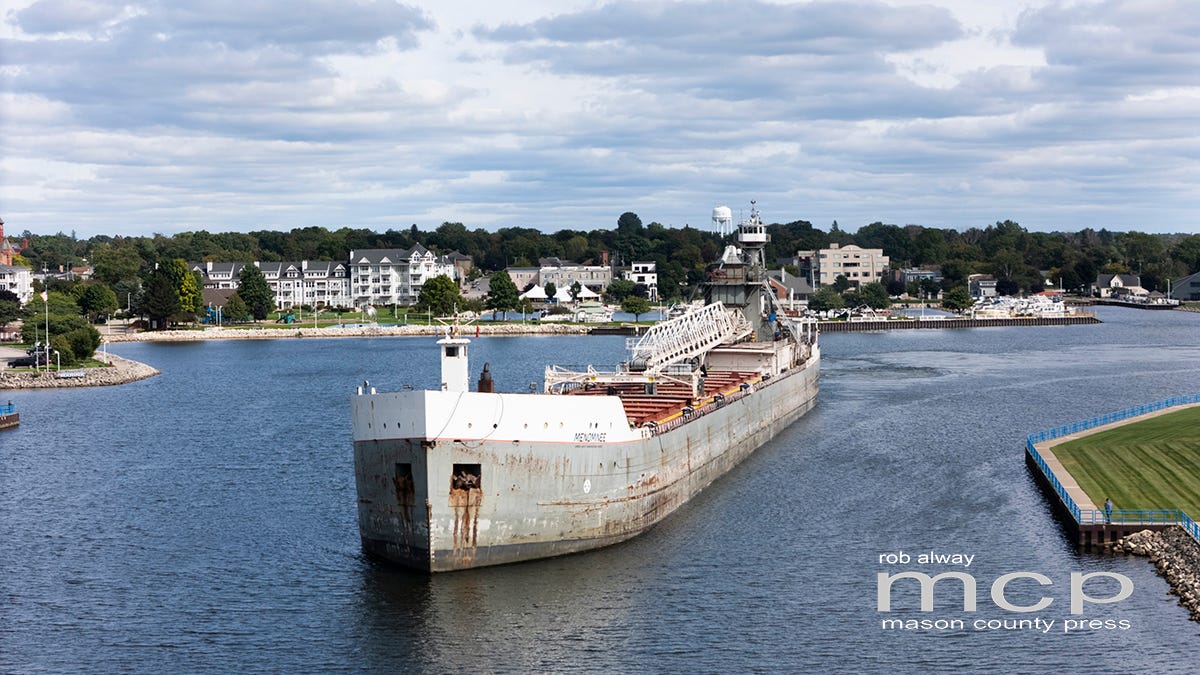
The Olive L. Moore, at 98 years old, is among the oldest commercial vessels still operating on the Great Lakes.
The tug was already 24 years old when the vessel now known as the barge Menominee was launched in 1952. Today, the two vessels operate together as a 728-foot articulated tug-barge unit, transporting bulk cargo throughout the Great Lakes.
Built in 1928 and 1952, respectively, the two vessels have a combined 172 years of maritime history. Both have undergone extensive modifications during their long careers, and neither was originally designed for the work she performs today.
The history of the Olive L. Moore
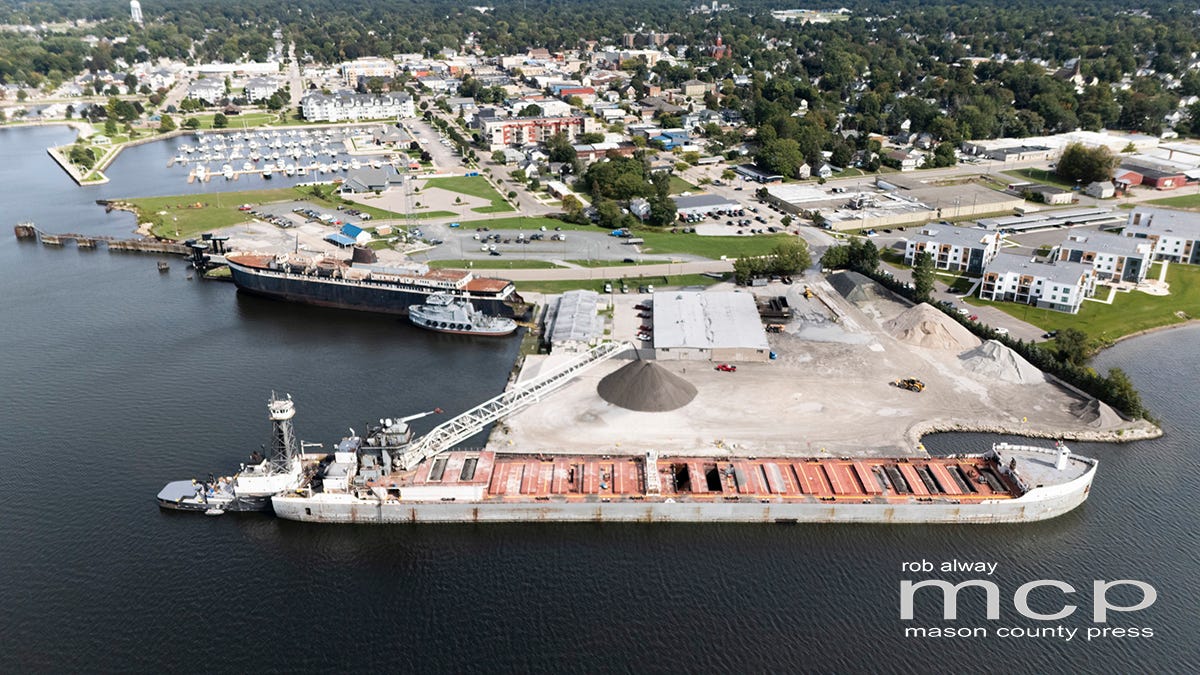
The 125-foot Olive L. Moore was built in 1928 by Manitowoc Shipbuilding Co. in Manitowoc, Wisconsin, as the John F. Cushing for Great Lakes Dredge & Dock Co. of Chicago, Illinois.
In 1965, she was sold to Chicago Marine Fueling Service and renamed James E. Skelly. In 1966, she received the name Olive L. Moore, which she continues to carry.
The tug experienced several changes in ownership and machinery throughout the following decades. After being laid up following a grounding on Lake Michigan in May 1966, she was sold in 1968 to South Range Aggregate Co. of South Range, Michigan, and rebuilt with Fairbanks-Morse diesel engines.
In 1969, Escanaba Towing Co. of Escanaba, Michigan, acquired the tug. During the following years, she handled several barges on the Great Lakes, including Wiltranco, A.E. Nettleton and O.S. McFarland.
The tug passed through additional owners during the 1970s before becoming part of the newly formed Upper Lakes Towing Co. in 1980. She underwent another rebuild and was repowered with two Alco engines. For the next decade, she worked with the self-unloading crane barge Buckeye.
In 1991, the Olive L. Moore was converted into an articulated tug equipped with a Hydraconn coupling system and paired with the self-unloading barge McKee Sons.
That arrangement continued until 2000, when the tug Invincible replaced the Moore as the McKee Sons‘ pushing tug.
The Olive L. Moore subsequently spent several years in limited service and layup.
Her career took another turn in 2006 when she was acquired by K&K Integrated Logistics of Menominee, Michigan. She was again converted for articulated tug-barge service, receiving a new coupling system, rebuilt accommodations and a raised pilothouse.
The rebuilt tug returned to service that year with the barge Lewis J. Kuber, now known as Menominee.
The Menominee began as a steam freighter
The Menominee has a history of her own, dating to 1952 when she was constructed as the bulk freighter Sparrows Point by Bethlehem Steel Corp. at its Sparrows Point, Maryland, shipyard.
Built for Bethlehem’s Great Lakes fleet, the vessel was designed to transport iron ore, coal and other bulk commodities.
Because she was constructed outside the Great Lakes, the Sparrows Point was transported through the inland river system to Chicago, where she underwent final assembly and outfitting before entering service in November 1952.
In 1958, she was lengthened by 72 feet at American Ship Building Co.’s South Chicago yard, increasing her cargo-carrying capacity.
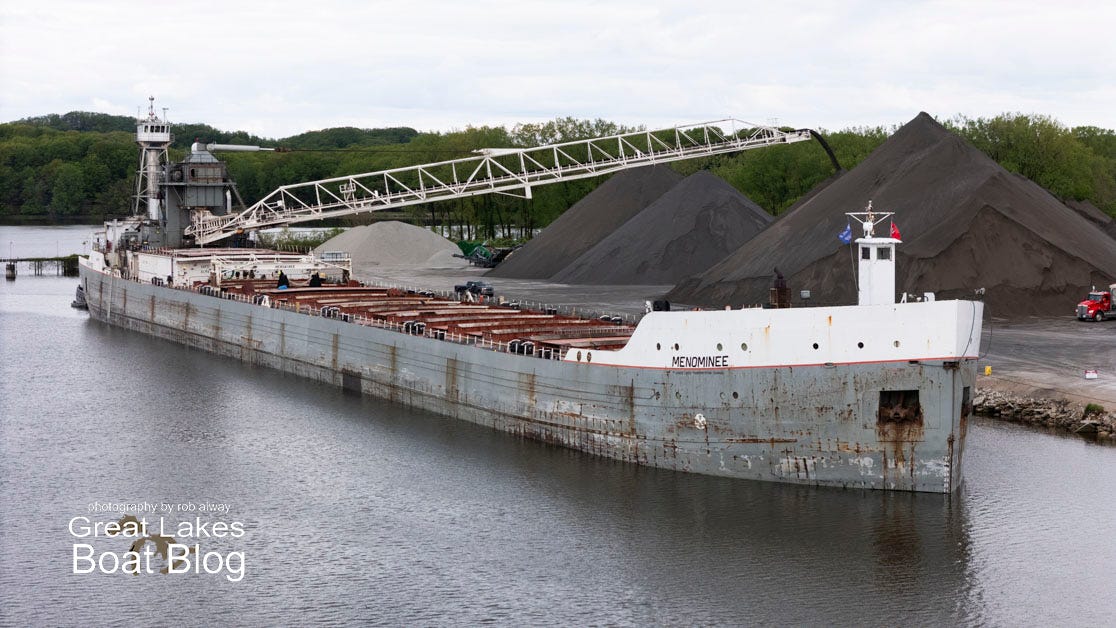
Another major change occurred in 1980 when she was converted from a conventional bulk carrier into a self-unloading vessel at Fraser Shipyards in Superior, Wisconsin. Conveyor systems were installed in her cargo holds, along with unloading equipment and a deck-mounted boom.
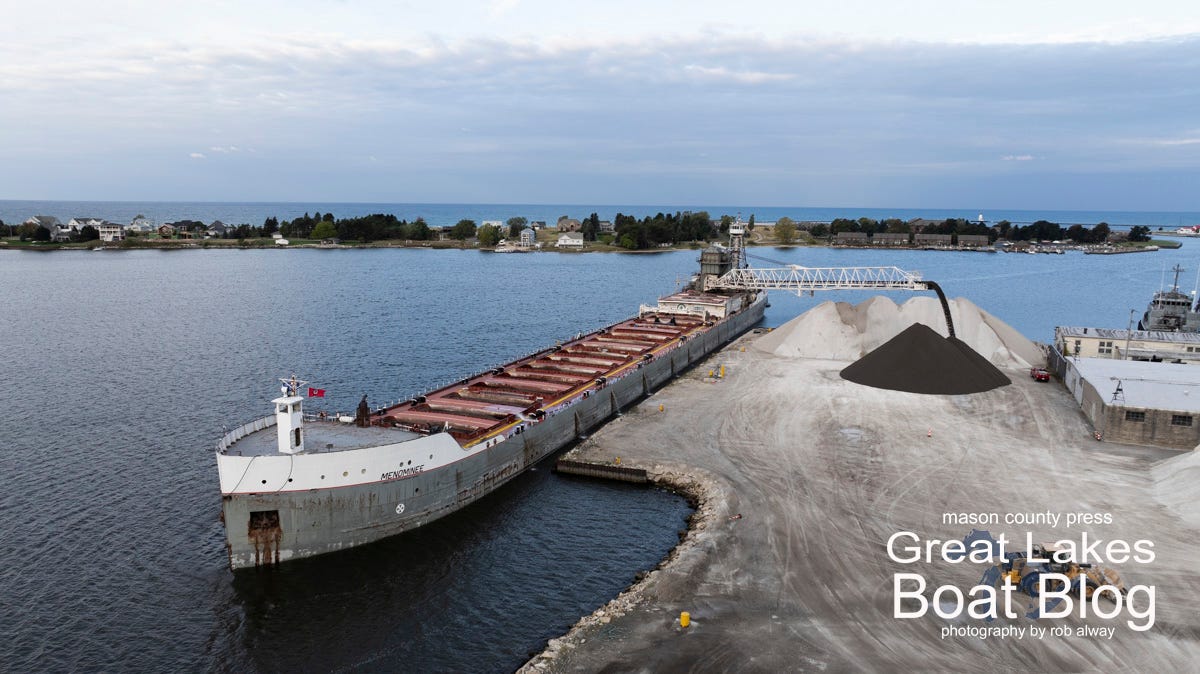
The conversion allowed the vessel to discharge cargo without relying on shore-based unloading equipment.
In 1991, the freighter was sold to Oglebay Norton Co.’s Columbia Transportation Division and renamed Buckeye.
She continued operating as a self-unloading lake freighter until the early 2000s, when she experienced periods of limited service and layup.
In 2005, the vessel was acquired for conversion into an articulated barge. She was taken to Erie, Pennsylvania, where her original propulsion machinery and accommodations were removed and her stern was modified to accommodate a pushing tug.
The conversion was completed in 2006, and the former steam freighter emerged as the self-unloading barge Lewis J. Kuber, paired with the rebuilt Olive L. Moore.
Operating together
Unlike a conventional tug towing a barge on a line, the articulated tug-barge configuration allows the Olive L. Moore to operate from a specially designed notch in the stern of the Menominee.
The mechanical coupling system connects the two vessels while allowing controlled movement between them. The arrangement permits the tug to provide propulsion and steering while the barge carries the cargo.
In February 2011, Rand Logistics acquired the pair, placing them under its Grand River Navigation subsidiary.
The barge was renamed Menominee in May 2017, taking her name from the Menominee River along the Michigan-Wisconsin border.
Today, the Olive L. Moore/Menominee continues to carry construction aggregates and other bulk commodities to ports throughout the Great Lakes.
The combined unit measures approximately 728 feet in length and has a cargo capacity of about 21,000 tons. The barge’s self-unloading system includes a 250-foot discharge boom, allowing cargo to be delivered directly to shoreside storage and handling facilities.
Although the two vessels have been paired for only 20 years, both have undergone substantial changes since their original construction.
The Olive L. Moore has served as a conventional tug, a barge-handling tug and an articulated pushing tug. The Menominee has operated as a steam-powered bulk freighter, a self-unloading freighter and, finally, a self-unloading barge.
Their continuing service in 2026 demonstrates how rebuilding and converting existing vessels have allowed equipment constructed in different eras of Great Lakes shipping to remain commercially useful decades after their original launch dates.
Help support this Substack page and check out our merchandise store.
This story is copyrighted 2026 by Sable Points Media.