


By Rob Alway
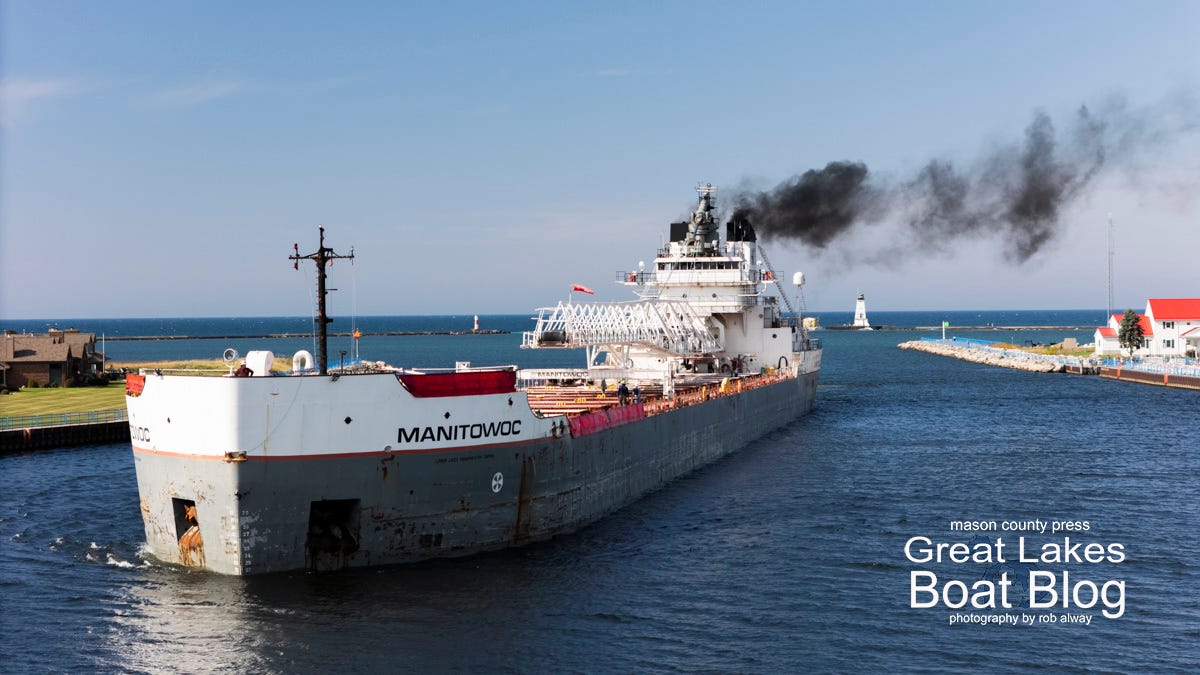
For more than five decades, the MV Manitowoc has transported the raw materials that help keep the Great Lakes economy moving. The 630-foot self-unloading bulk carrier has operated under four names, served several shipping companies and traveled thousands of miles carrying iron ore, coal, limestone and other bulk commodities.
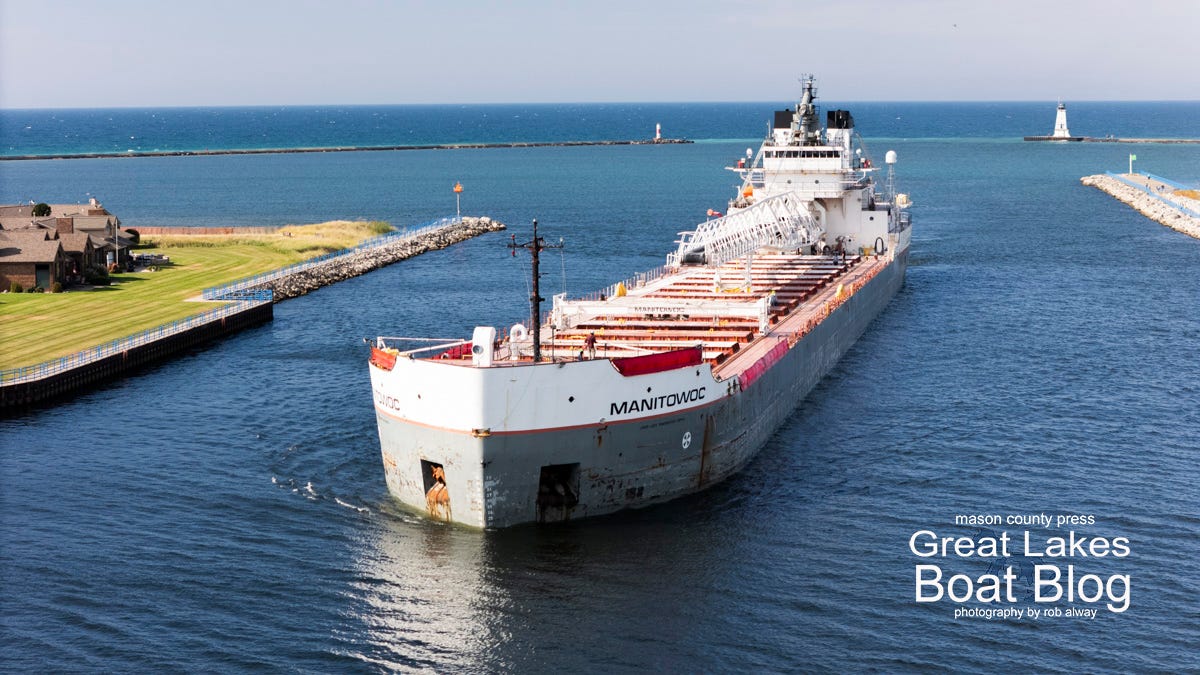
Built in 1973, the Manitowoc is part of a class of vessels designed to navigate the narrower waterways and river ports of the Great Lakes. While she is considerably smaller than the 1,000-foot freighters that dominate the iron ore trade, her size provides an advantage when navigating restricted channels and delivering cargo to docks that larger ships cannot reach.
The Manitowoc is a familiar sight in west Michigan, particularly in the Michigan ports of Ludington and Manistee, where she has frequently delivered limestone and other aggregate materials, along with coal, though she hasn’t made as many trips this season, concentrating more on Lakes Huron and Erie.
On Monday, Oct. 12, 2026, the Manitowoc returned to Ludington, arriving at about noon with a load of aggregate for Great Lakes Materials, a Rieth-Riley Construction terminal located on Pere Marquette Lake. It was only her second visit to Ludington this season. Her previous visit occurred May 16.
Built for the river trade
The Manitowoc was constructed by American Shipbuilding Co. in Lorain, Ohio, as Hull No. 902. She was launched Oct. 7, 1973, and entered service Nov. 15 of that year under the name Paul Thayer.
Originally owned by Union Commerce Bank of Cleveland and managed by Kinsman Marine Transit Co., the vessel was designed for the River Class trade. Kinsman had secured a contract to transport iron ore to the Jones & Laughlin Steel mill along the Cuyahoga River in Cleveland.
Unlike larger Great Lakes bulk carriers designed primarily for open-lake transportation between major loading and unloading terminals, River Class vessels could navigate tighter channels and make deliveries to industrial facilities farther inland.
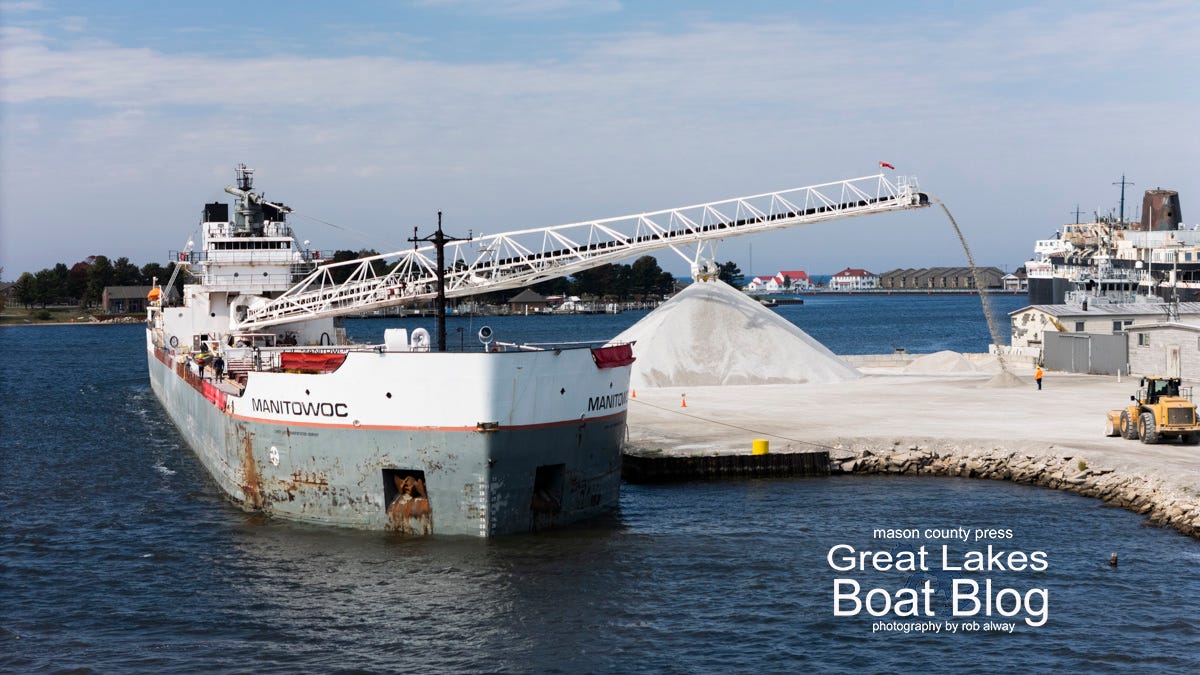
The Paul Thayer was constructed as a self-unloading vessel, eliminating the need for extensive shore-based unloading equipment. Her cargo handling system uses conveyor belts beneath her cargo holds to transfer material to an inclined conveyor and a 260-foot unloading boom mounted near the stern.
The boom allows her to discharge cargo directly onto shore facilities at a maximum rate of approximately 5,000 tons per hour, depending on the cargo and operating conditions.
The ship measures 630 feet long, 68 feet wide and approximately 37 feet deep. She has five cargo holds, 17 hatches and a cargo capacity of approximately 19,600 tons. Her two Alco diesel engines generate a combined 5,600 horsepower, giving her an operating speed of approximately 14 mph.
Her combination of cargo capacity, maneuverability and self-unloading equipment has allowed her to remain an important part of Great Lakes shipping for more than half a century.
Four names, several owners
The Paul Thayer was sold in 1976 to Pringle Transit Co., a Cleveland-based subsidiary of Oglebay Norton Co., one of the major operators of Great Lakes bulk carriers.
In 1978, she underwent a substantial rebuilding of her cargo hold at American Shipbuilding’s Toledo, Ohio, shipyard.
The vessel continued serving the bulk trades under the Pringle Transit name until 1994, when she was transferred directly to Oglebay Norton. On March 31, 1995, she was renamed Earl W. Oglebay during a joint christening ceremony in Cleveland with her sister ship, the former William R. Roesch, which became the David Z. Norton.
The two vessels remained part of the Oglebay Norton fleet until 2006, when they were among the ships sold to Wisconsin & Michigan Steamship Co., a subsidiary of Sand Products Corp. of Muskegon.
The Earl W. Oglebay was subsequently renamed Earl W. in 2007.
In 2008, the ship was acquired by Grand River Navigation Co., a subsidiary of Rand Logistics, and received her current name, Manitowoc, in recognition of the Manitowoc River and the Wisconsin community along Lake Michigan.
Rand Logistics is now known as Mainstay Maritime, based in Williamsville, N.Y., near Buffalo. The Manitowoc continues operating under Grand River Navigation.
Three sister ships
The Manitowoc is one of three nearly identical River Class freighters constructed by American Shipbuilding during the early 1970s.
Her American sister ship is the MV Calumet, also built in 1973. Originally named William R. Roesch, she later sailed as the David Z. Norton and David Z. before receiving her current name in 2008. Like the Manitowoc, she is operated by Grand River Navigation.
The third sister is the Canadian-flagged MV Robert S. Pierson, built in 1974 and originally named Wolverine. She was operated by Lower Lakes Towing of Port Dover, Ontario, which was part of the Rand Logistics fleet. In 2026, the Canadian fleet, including the Robert S. Pierson, was acquired by Algoma Central Corp.
Although the three vessels have experienced several changes in ownership and names, their basic designs reflect the continued importance of smaller, versatile self-unloading freighters in Great Lakes commerce.
A familiar presence in west Michigan
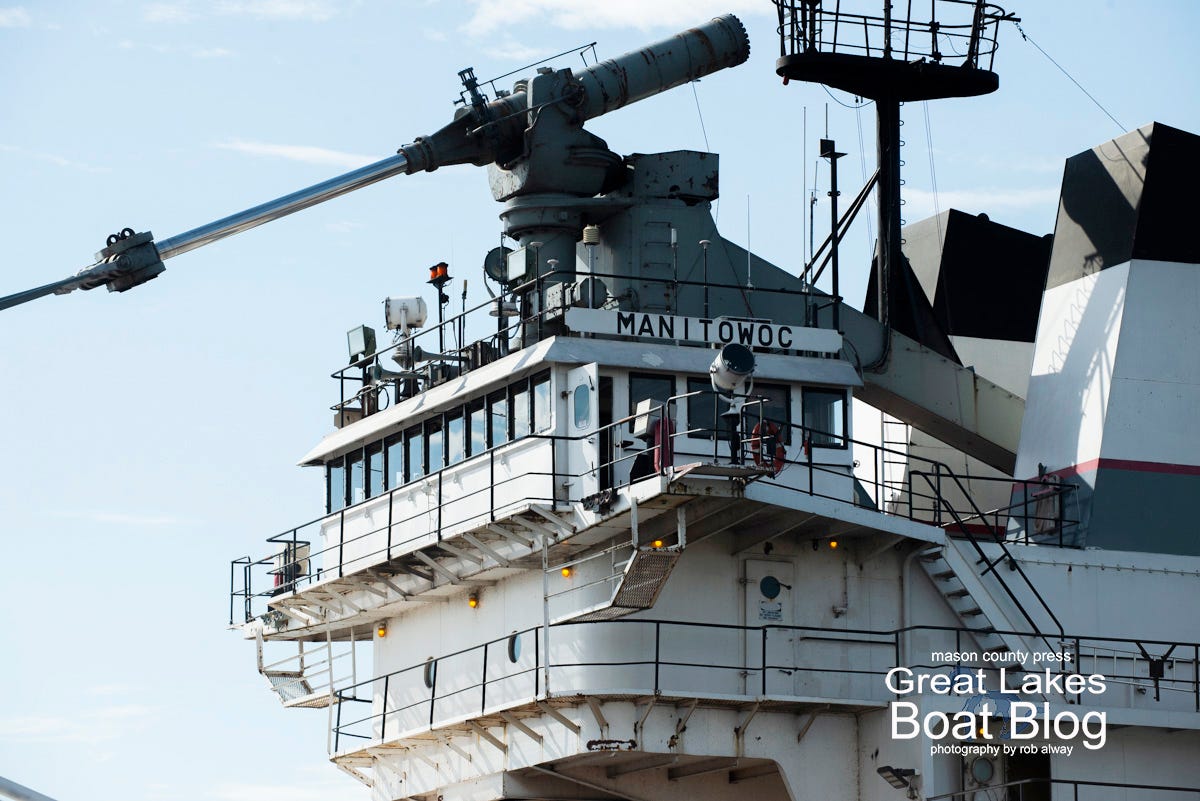
For Great Lakes ship watchers, the Manitowoc is particularly recognizable by her twin exhaust stacks, aft superstructure and long self-unloading boom.
Her maneuverability is especially evident when navigating the Manistee River, where vessels of her size pass through two drawbridges before reaching the industrial docks on Manistee Lake.
The Manitowoc has been a frequent visitor to Manistee, delivering coal to the TES Filer City Station and other bulk cargoes to area terminals. She also regularly carries aggregate to Ludington, where the material is used for road construction and other infrastructure projects.
Help support this Substack page and check out our merchandise store.
This story is copyrighted 2026 by Sable Points Media.