


By Rob Alway
MASTERS OF THE LUDINGTON STEAMERS
Capt. James Brown Muir: First master of the F&PM fleet
By Rob Alway
For more than half a century, Capt. James Brown Muir made his living on the water. He survived violent storms, shipwrecks and a serious accident that cost him part of his right leg. But in November 1888, while commanding one of the first railroad-owned steamships operating out of Ludington, Michigan, the veteran mariner faced something he could not overcome.
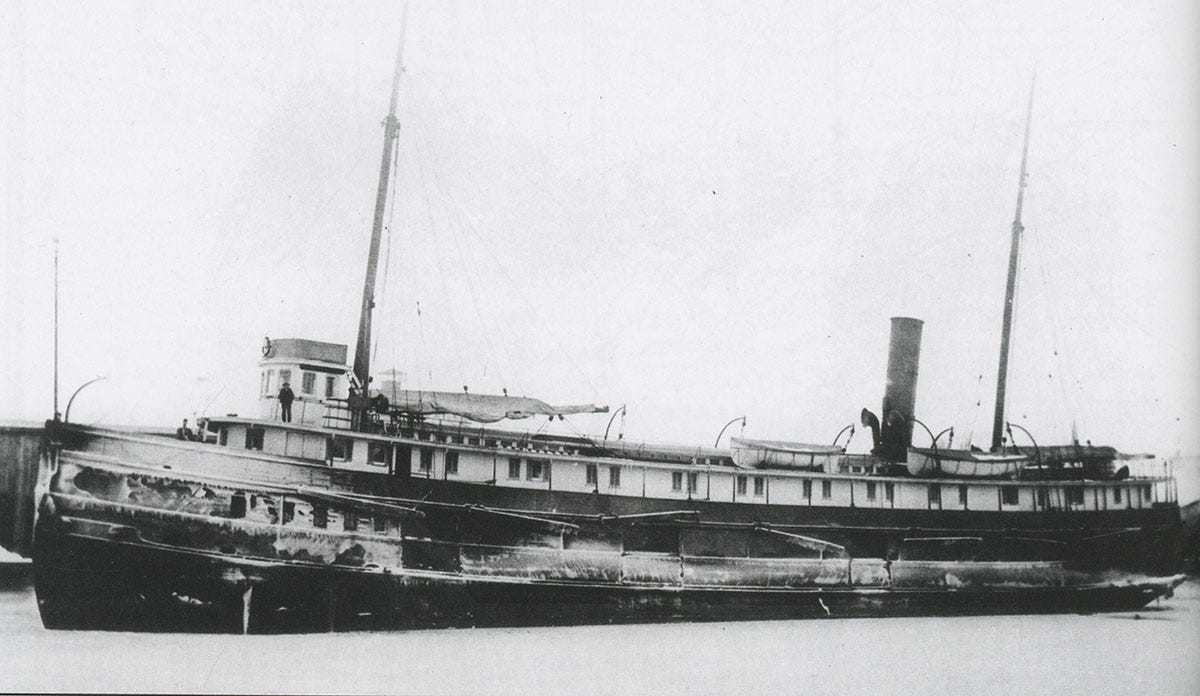
Muir was master of the Flint & Pere Marquette No. 1, commonly known as F&PM No. 1, one of two steamships that launched the Flint & Pere Marquette Railroad’s own cross-lake fleet in 1882. He had commanded the vessel since her arrival in Ludington and was among the most experienced mariners serving the railroad.
On Nov. 10, 1888, Muir informed his first mate that he was feeling ill. Despite his worsening condition, he remained aboard and continued attending to his responsibilities.
By Nov. 18, as F&PM No. 1 returned to Ludington from Chicago, Muir was too sick to stand his watch. Upon arrival, he was taken to the Filer House hotel, where doctors attended to him.
When his condition failed to improve, the railroad arranged for a special train to transport him to his home in East Saginaw, Michigan.
The train arrived shortly after noon on Nov. 22. Within a few hours, Muir was dead.
His death ended a career that stretched from the sailing ships of the early 19th century to the steam-powered commercial fleets transforming Great Lakes transportation.
A childhood at sea
James Brown Muir was born in Scotland in the 1820s. According to his obituary, his seafaring life began when he was only seven years old.
During the following decades, he sailed on both the oceans and Great Lakes, gaining experience aboard a variety of vessels before eventually becoming a captain.
Muir immigrated to the United States and settled in Buffalo, New York, which had become one of the country’s most important Great Lakes shipping centers.
He also served in the United States Navy during the Mexican-American War of 1846 to 1848. According to his obituary, Muir was a noncommissioned officer aboard vessels assigned to blockade Mexican ports.
Following his military service, he continued his commercial maritime career on the Great Lakes.
Among the influential shipping businessmen with whom Muir became associated was Jesse Hoyt, a prominent New York merchant whose interests extended into Michigan’s developing lumber, salt and railroad industries.
Muir commanded vessels owned by Hoyt, including the schooner Starlight, which transported freight between Buffalo and the Saginaw Valley.
Navigating the Saginaw River in the days before tugboats became commonplace was especially challenging for sailing vessels. Captains depended upon favorable winds, careful handling and their knowledge of the river’s channels to reach their destinations.
Muir became known for his skill in handling vessels under difficult conditions.
A desperate escape from White Shoal
One of the most dramatic accounts of Muir’s seamanship appeared in the Nov. 3, 1875, edition of the Buffalo Commercial Advertiser.
The newspaper recounted an earlier incident when Muir commanded the Oleander, a two-masted hermaphrodite brig, also known as a brigantine.
While sailing from Chicago, the vessel encountered a violent gale near White Shoal in the Straits of Mackinac.
The storm tore away much of her canvas, leaving the ship unable to maneuver effectively as she was driven toward dangerous rocks.
Muir ordered the anchors dropped, but the brig remained dangerously close to the shoal.
Rather than abandon the vessel, he directed his crew to gather the damaged sails and repair enough canvas to regain control.
With both anchors holding and the stern approaching the rocks, the crew continued working.
Once sufficient sail had been repaired, Muir made his decision. He ordered the anchor chains slipped, sacrificing the anchors to free the vessel.
Under the remaining canvas, he maneuvered Oleander away from the shoal.
The brig eventually reached the Manitou Islands, where the crew completed additional repairs. Muir then navigated her safely to Detroit without anchors or chains.
The newspaper credited the incident with establishing Muir’s reputation as an exceptional sailor and bringing him to the attention of prominent vessel owners.
It was the kind of experience that distinguished Great Lakes captains during the age of sail, when a master’s judgment could determine whether a ship and her crew survived a storm.
The wreck of the Gibson
By 1875, Muir was captain and part owner of the schooner Gibson.
That autumn, he was preparing for what reportedly would be his final voyage before returning to Scotland to claim a substantial inheritance.
His plans changed dramatically on Oct. 31, 1875, when Gibson encountered a severe gale on Lake Erie and went ashore near Port Burwell, Ontario.
The vessel, carrying a cargo of wheat, was wrecked. All members of her crew survived.
The loss attracted attention in Buffalo, where Muir was already recognized as an accomplished mariner.
In a letter published in the Buffalo Commercial Advertiser, a writer using the name Sinbad defended Muir’s abilities, noting that his record demonstrated sound judgment and resourcefulness in emergencies.
Despite the loss of Gibson, Muir continued his Great Lakes career.
He subsequently commanded and held an ownership interest in the Helen Pratt, another vessel associated with Jesse Hoyt’s maritime interests.
His relationship with Hoyt would eventually connect him to the railroad and to Ludington.
A new career with the railroad
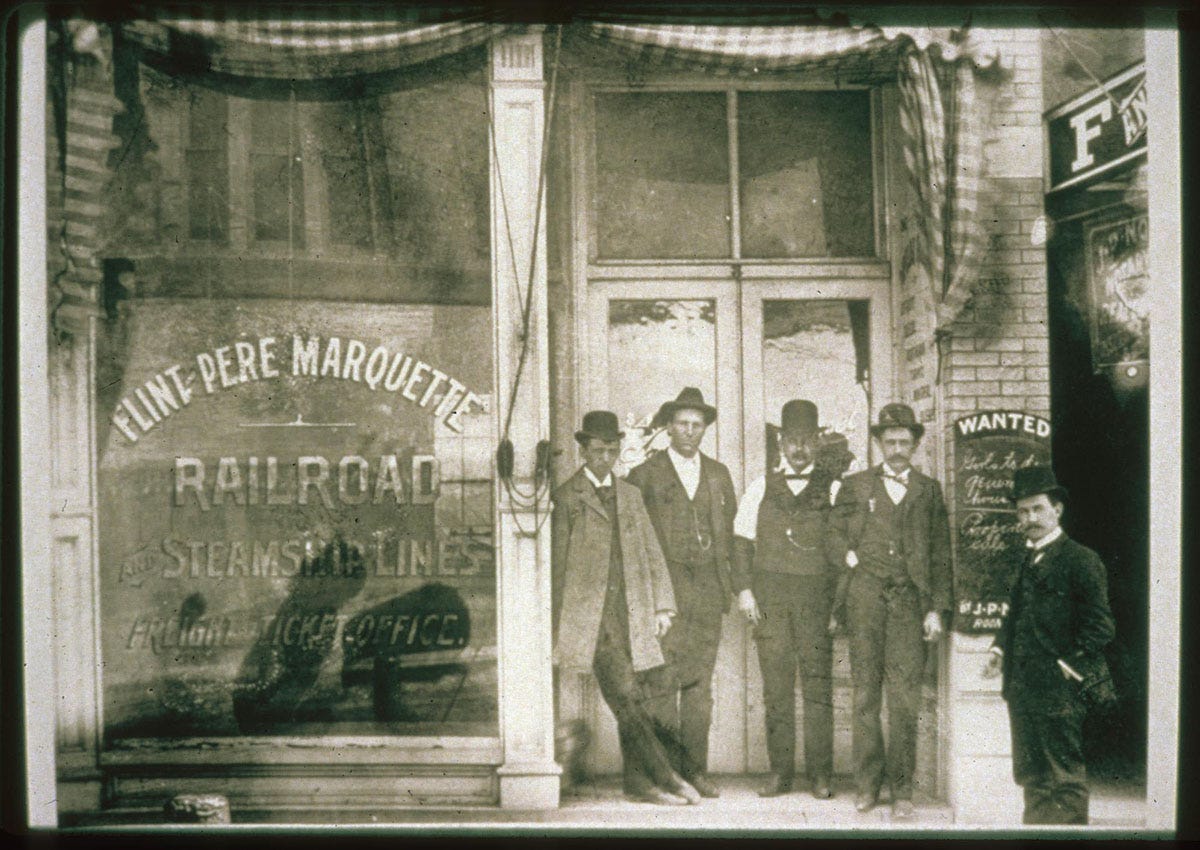
The Flint & Pere Marquette Railroad reached Ludington in December 1874, opening an important transportation corridor between Michigan’s interior and Lake Michigan.
Cross-lake steamship service began in May 1875, initially using chartered vessels to connect Ludington with Wisconsin ports.
The railroad later established an agreement with the Goodrich Transportation Company, which supplied steamships for moving freight and passengers across Lake Michigan.
Jesse Hoyt, who had become president of the railroad in 1875, was closely involved in developing the company’s transportation network.
Muir moved his family to East Saginaw in 1878 and became associated with the Flint & Pere Marquette’s marine operations.
That same year, he suffered a serious accident in Ludington that resulted in the amputation of his right leg below the knee.
The surviving accounts offer little information about the circumstances of the accident, but the injury did not end his career.
Muir returned to the pilothouse and continued commanding vessels.
For a man who had spent virtually his entire life at sea, the loss of part of a leg apparently presented another challenge to overcome rather than a reason to retire.
The first Black Boats
In 1882, the Flint & Pere Marquette Railroad took an important step toward controlling its own cross-lake transportation network.
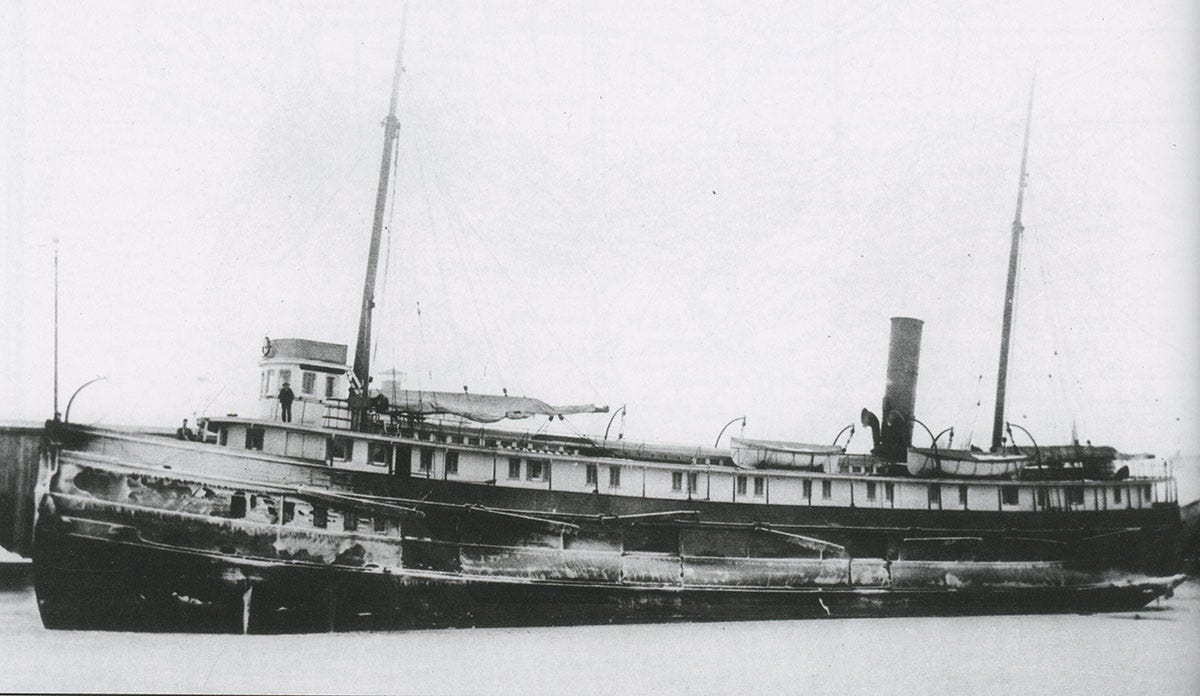
The company ordered two wooden propeller steamships from the Detroit Dry Dock Company. Designed by naval architect Frank E. Kirby, they were named F&PM No. 1 and F&PM No. 2.
The vessels were originally about 144 feet long and designed to transport freight and a limited number of passengers. They were lengthened to approximately 181 feet in 1883.
Their dark-painted wooden hulls helped establish the fleet’s familiar nickname, the Black Boats.
Muir was appointed the first master of F&PM No. 1, bringing her to Ludington in September 1882.
Capt. John W. Duddleson commanded her sister ship, F&PM No. 2.
The vessels operated between Ludington, Manistee, Milwaukee and Chicago, transporting freight and passengers while connecting with the railroad’s expanding transportation system.
Their cargo included salt and other commodities that were unloaded from railroad cars, transferred aboard the steamships and reloaded into freight cars after reaching the opposite shore.
This was known as break-bulk shipping.
Although labor-intensive, the service allowed the railroad to move substantial quantities of freight across Lake Michigan without routing everything through Chicago.
Operating its own steamships also gave the Flint & Pere Marquette greater control over vessel schedules, crews and shipping rates.
The new fleet gradually ended the railroad’s dependence on outside steamship operators.
For Muir, commanding F&PM No. 1 was the culmination of decades of maritime experience.
He had sailed before steamships became dominant on the Great Lakes. He had commanded sailing vessels through dangerous waters, survived shipwrecks and navigated difficult river channels.
Now he was entrusted with one of the ships that would establish a new era of railroad-operated transportation on Lake Michigan.
A captain remembered
Muir’s professional accomplishments were accompanied by considerable personal loss.
He married Jane Holland Vickery on Aug. 11, 1853, in Buffalo. The couple had nine children, several of whom died during childhood or young adulthood.
Despite the demands of his profession, Muir maintained his family home in East Saginaw.
He was also a member of the Masonic fraternity, retaining his association with a Buffalo lodge after relocating to Michigan.
Following his death in November 1888, Masonic services were conducted before his remains were returned to Buffalo for burial.
His death was widely noted in Michigan and New York newspapers.
The Saginaw Weekly Courier, in its Nov. 29, 1888, obituary, described a captain who had earned the admiration not only of his fellow mariners but also of the passengers who traveled aboard his vessel.
The newspaper recalled his professional judgment, personal kindness and willingness to help others.
Muir had commanded F&PM No. 1 for six years, from her inaugural season until his death.
During those years, the Flint & Pere Marquette established the foundation of a marine operation that would eventually grow into one of the most significant railroad car ferry fleets on the Great Lakes.
The railroad’s first dedicated railcar ferry entered service in 1897, allowing entire railroad cars to be transported across Lake Michigan without unloading their contents.
That innovation would transform the industry and lead to the great Ludington car ferries of the 20th century.
But before those vessels came the Black Boats, and among the men who established their service was a Scottish-born sailor who had first gone to sea as a child.
Capt. James Brown Muir belonged to two maritime eras. He learned his profession aboard sailing ships and ended his career commanding a steamship at the beginning of Ludington’s railroad fleet.
His legacy was not simply that he became the first master of F&PM No. 1, but that he brought a lifetime of seamanship to a transportation system that would help define Ludington’s maritime history for more than a century.
Sources: Historical information for this article was drawn from “The End of Life’s Voyage,” Saginaw Weekly Courier, Nov. 29, 1888; “Death of Capt. James B. Muir, of Buffalo,” Detroit Free Press, Nov. 23, 1888; “A True Sailor,” Buffalo Commercial Advertiser, Nov. 3, 1875; and “Development of the Pere Marquette Marine,” Ludington Record Appeal, Feb. 4, 1904. Additional historical context was obtained from George W. Hilton’s The Great Lakes Car Ferries (Howell-North Books, 1962), Willis F. Dunbar’s All Aboard! The Story of Michigan’s Railroads (William B. Eerdmans Publishing Co., 1969), Detroit Historical Society vessel plans, the Pere Marquette Historical Society’s marine fleet roster, and research previously published in Mason County Press.
This article is adapted from Rob Alway’s research for “Masters of the Ludington Steamers: The Captains, Engineers and Others Who Powered a Great Lakes Tradition.”