


The Captains, Engineers and Others Who Powered a Great Lakes Tradition
By Rob Alway
Editor’s Note: Masters of the Ludington Steamers: The Captains, Engineers and Others Who Powered a Great Lakes Tradition is an ongoing historical research project exploring the lives and careers of the men who helped establish Ludington, Michigan, as one of the Great Lakes’ most important maritime ports. Through biographical accounts of captains, chief engineers and other mariners, the series examines the people behind the vessels that connected Michigan and Wisconsin, transported passengers and freight, and helped shape the region’s maritime heritage. Drawing from historic newspapers, archival records, photographs and other primary sources, these stories seek to preserve the personal histories of individuals whose contributions to Great Lakes shipping have often been overshadowed by the ships they served.
The stories posted in this series are abridged versions of what will eventually be a book documenting the mariners who helped build and sustain Ludington’s cross-lake shipping tradition.
Capt. Robert Caswell
On a Thursday afternoon in May 1889, Capt. Robert Caswell was doing what he had done for more than two decades: maneuvering commercial vessels through the harbor at Ludington, Michigan.
The 54-year-old captain was commanding a harbor tug when the vessel he was towing swung around and struck a Flint and Pere Marquette Railroad boat stranded on the sandbar between the harbor piers. Caswell, who had suffered from heart disease for several years, had already complained of dizziness and difficulty keeping his balance.
He returned home that evening in worsening condition. After a severe coughing spell around 11 p.m., his wife, Charlotte, sent one of their children for help. Before assistance arrived, Caswell collapsed in her arms and died.
The Ludington Record, in its May 9, 1889, account of his death, remembered him as “a friend to the poor, a father to the orphan, a champion of the oppressed, a devoted husband and affectionate father.”
Caswell was not a railroad executive or master of one of the large steamers that would come to define Ludington’s cross-lake trade. He commanded the smaller, powerful tugboats that helped those vessels, and countless schooners before them, enter and leave port safely.
From farming to the lakes
Robert Caswell was born May 20, 1834, in Chippewa, Upper Canada, now Ontario, to American parents. His family moved to Buffalo, New York, in 1839 and to a farm outside Milwaukee, Wisconsin, two years later.
He grew up working the family farm but entered business in 1857, joining Timothy O’Brien in a hardware partnership in Columbus, Wisconsin. The business relied heavily on credit. When the wheat crop failed in 1859, the partners could no longer meet their obligations.
Following a prolonged illness, Caswell turned to the lakes, taking command of a vessel owned by his father and brother. He continued sailing until 1867, when the growth of Ludington’s lumber port offered a new opportunity. These early details were preserved in the Record‘s extensive obituary.
A port in need of tugboats
During the 1860s, Pere Marquette Lake provided sheltered waters for a developing center of lumber, salt, fishing and agricultural commerce. Schooners moved lumber and other cargo around the Great Lakes, but the entrance from Lake Michigan could be treacherous. Sandbars, currents, wind and waves complicated passage, especially for sailing vessels. Once inside, vessels still needed help maneuvering around the busy waterfront.
Tugboats supplied that assistance, towing ships through the entrance and positioning them beside sawmills, docks and warehouses. Their captains needed intimate knowledge of the harbor, precise handling skills and the judgment to work safely in difficult conditions.
Caswell’s introduction to the port was closely associated with lumber businessman James Ludington. In a March 18, 1867, letter to L. H. Foster, Ludington announced the purchase of the tug Cyclone for $8,000 and explained that Caswell would bring her over.
“We have bought the tug ‘Cyclone’ for $8,000,” Ludington wrote. “She is just right. We will have her there in time.”
Historian Rose D. Hawley reproduced that letter in her Oct. 13, 1958, Ludington Daily News column, “James Ludington’s Letters.” The correspondence also discussed an opportunity for a Caswell family member to purchase a one-quarter interest in the tug. Caswell and Ludington initially shared ownership, and Caswell subsequently bought out Ludington’s interest.
Brought from Chicago in the spring of 1867, Cyclone helped connect the increasingly busy harbor with the lake traffic on which the city’s industries depended. For Caswell, she marked the beginning of a long career as both tugboat operator and working captain.
A fleet and a new kind of vessel
Caswell developed partnerships with other men active in Ludington shipping, including Capt. Amos Breinig, David A. Melendy and James Foley. Breinig brought the tug B. W. Aldrich to Ludington in 1871. The two captains formed a partnership that endured until Caswell’s death.
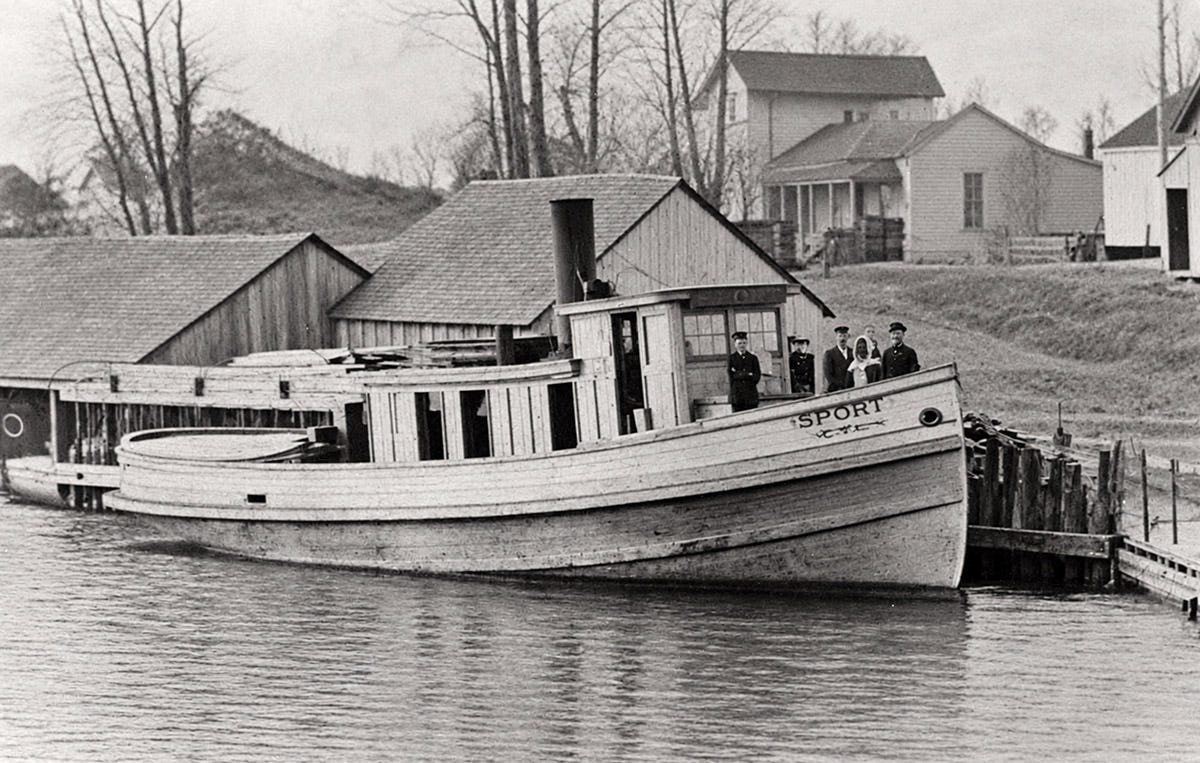
By the late 1870s, another notable vessel, Sport, was working in Ludington’s harbor. Designed by Frank E. Kirby and built in 1873 at Wyandotte, near Detroit, for industrialist Eber Brock Ward, the 57-foot tug had iron framing and a steel hull. She is widely recognized as the first steel tug on the Great Lakes and was among the country’s earliest steel-hulled vessels.
Sport was an early achievement for Kirby, who became one of the lakes’ foremost naval architects. His later work included the passenger steamer Tashmoo and the railroad car ferry Chief Wawatam. His career is documented by the Detroit Historical Society, while Michigan’s historical marker for Sport recognizes the tug’s pioneering construction.
The presence of Sport alongside working harbor tugs such as Cyclone and B. W. Aldrich reflected the shift from wooden sailing vessels toward iron, steel and steam. Sport outlived Caswell by decades; she sank in Lake Huron during a December 1920 storm, and her wreck was discovered in 1987.
Caswell remained active at the helm even as the ownership arrangements of his tug business changed. A March 19, 2022, account from the Mason County Historical Society, drawing on its archival records, reported that his tugboats moved 154 vessels into and out of Ludington harbor during 1885.
By then, the harbor was serving more than the lumber trade. The Flint and Pere Marquette Railroad had inaugurated its cross-lake service in 1875, helping transform Ludington into a railroad shipping port. The tugboats supported both older sailing traffic and the growing movement of steam-powered vessels.
The work could also carry crews into danger. On Oct. 31, 1878, the four-masted schooner J. H. Rutter lost her rudder near Big Sable Point in a storm. Capt. John Montgomery Crawford placed Caswell in command of the tug Margaret for an attempt to assist her. The schooner ultimately grounded outside Ludington’s harbor entrance. Capt. Frederick Kendrick led the subsequent rescue of her crew, receiving a United States Gold Lifesaving Medal. The incident is recounted in later historical accounts, including James L. Cabot’s July 6, 2002, Ludington Daily News article. Kendrick’s rescue will receive fuller treatment in his own chapter of this series.
A captain in public life
Caswell’s standing extended well beyond the waterfront. He served several terms as a local supervisor and four years as a First Ward alderman before becoming Ludington’s mayor in 1885 and 1886. He faced no opposition in his second mayoral election and was serving on the board of education when he died.
The Record observed that Caswell was “in no sense a politician,” suggesting that others had repeatedly pressed him to seek office. A Republican, he was also a Mason associated with Apollo Commandery and a member of the Knights of Labor.
The obituary emphasized his willingness to help people in difficulty and his preference for practical assistance over public acclaim. Its portrait was of a captain whose commitment to the community was as familiar as his work in the harbor.
Caswell’s family life spanned two marriages. In January 1854, he married Elizabeth Daly, whom he had known in Wisconsin. They had three children, but only their daughter Emmeretta survived him. Elizabeth died of consumption, now known as tuberculosis.
On Dec. 19, 1872, he married Charlotte Harbaugh in Ludington. They had six children, four of whom survived their father. The family lived at 205 N. Ferry St.
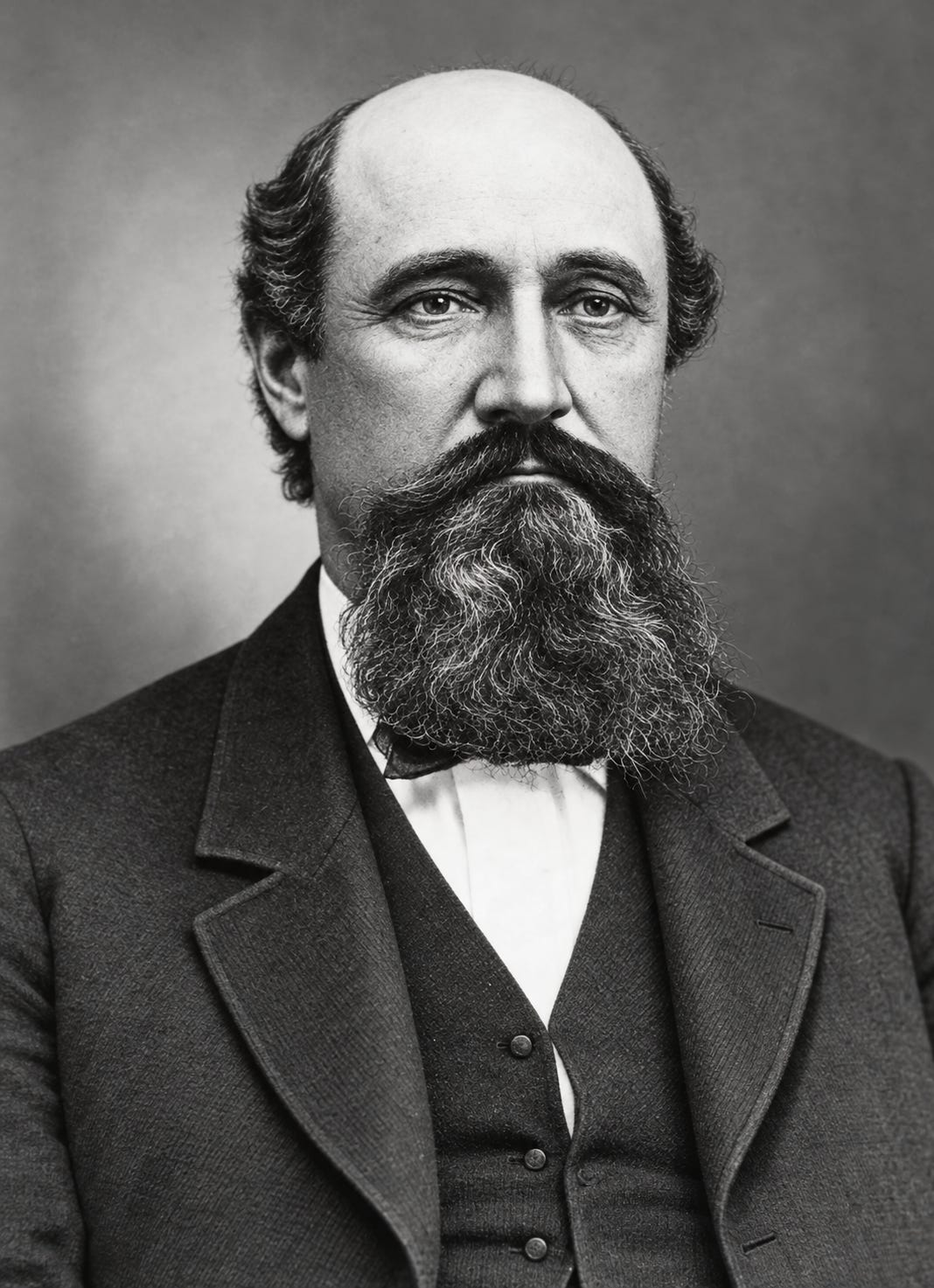
One daughter, Frances Caswell Hanna, later became a historian of Ludington’s early years. In a recollection quoted by the Mason County Historical Society, she described her father as blue-eyed, bald and bearded. He was touchy about his baldness, she recalled, but enjoyed one woman’s remark: “But Captain, you know they never put marble tops on poor furniture.”
His final voyage
Caswell had struggled with heart disease for years. During the winter before his death, he traveled to the Pacific Coast seeking relief and reportedly returned home feeling better. When navigation resumed in the spring of 1889, he went back to work.
His final day on the tug proved difficult. After the towing mishap and worsening symptoms, he returned to the family home, where he died that night.
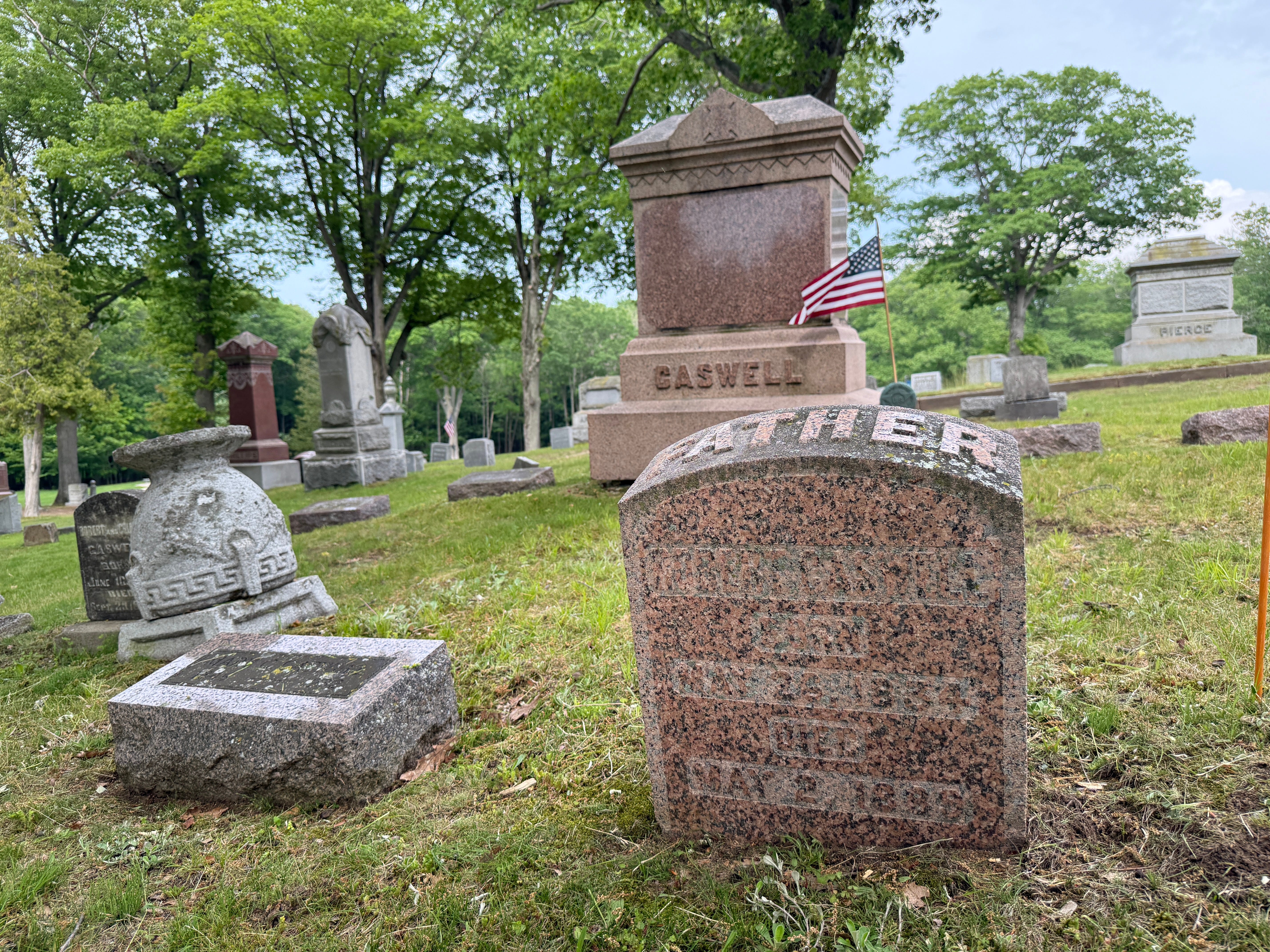
The contemporary Record account identifies that day as Thursday, May 2, 1889. Some later summaries give May 3. Without a definitive death registration, that discrepancy remains unresolved. Caswell was only weeks away from his 55th birthday.
His funeral was held the following Sunday at Ludington’s opera house. According to the Record, the hall filled beyond capacity, with perhaps only a third of those wishing to attend able to enter. Members of the Masonic fraternity and Knights of Labor joined the procession, and the Rev. W. J. Maybee delivered the address.
More than 100 horse-drawn teams accompanied the procession to the cemetery, where Masonic services were conducted at the graveside.
Caswell was buried in what is now Lakeview Cemetery, where his family monument remains. In her 1958 examination of James Ludington’s letters, Rose D. Hawley also wrote that Ludington’s Robert Street had been named for the captain.
The schooners, railroad steamers and later car ferries are the vessels most often associated with Ludington’s maritime history. But those larger operations depended on the harbor captains who handled towing lines, navigated narrow entrances and answered calls for help in rough weather.
For more than 20 years, Capt. Robert Caswell was one of those men. His tugboats kept the port moving, and his public service helped shape the community growing around it.
This article is adapted from Rob Alway’s research for “Masters of the Ludington Steamers: The Captains, Engineers and Others Who Powered a Great Lakes Tradition.”
Help support this Substack page and check out our merchandise store.
This story is copyrighted 2026 by Sable Points Media.