


By Rob Alway
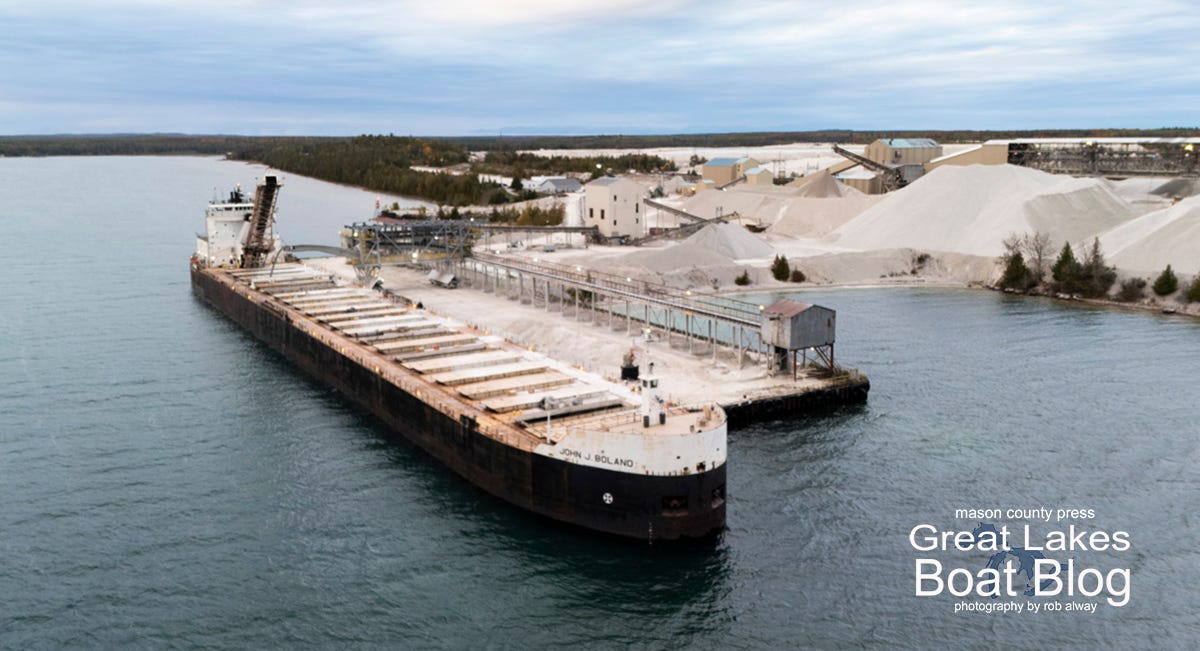
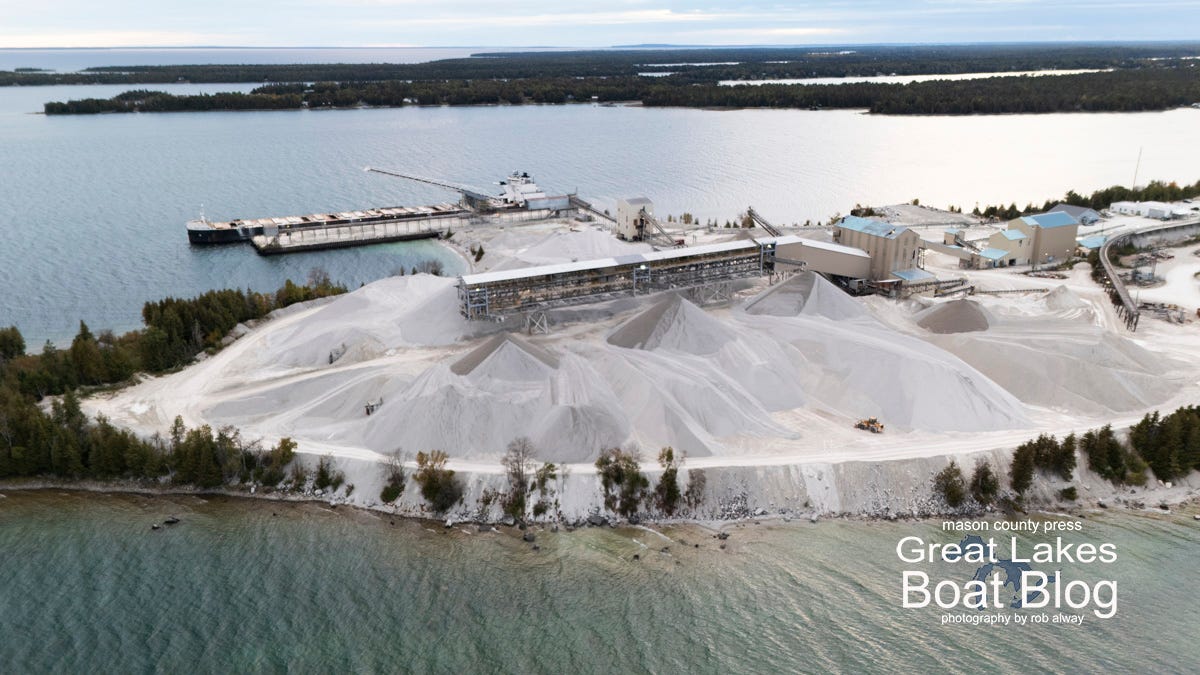
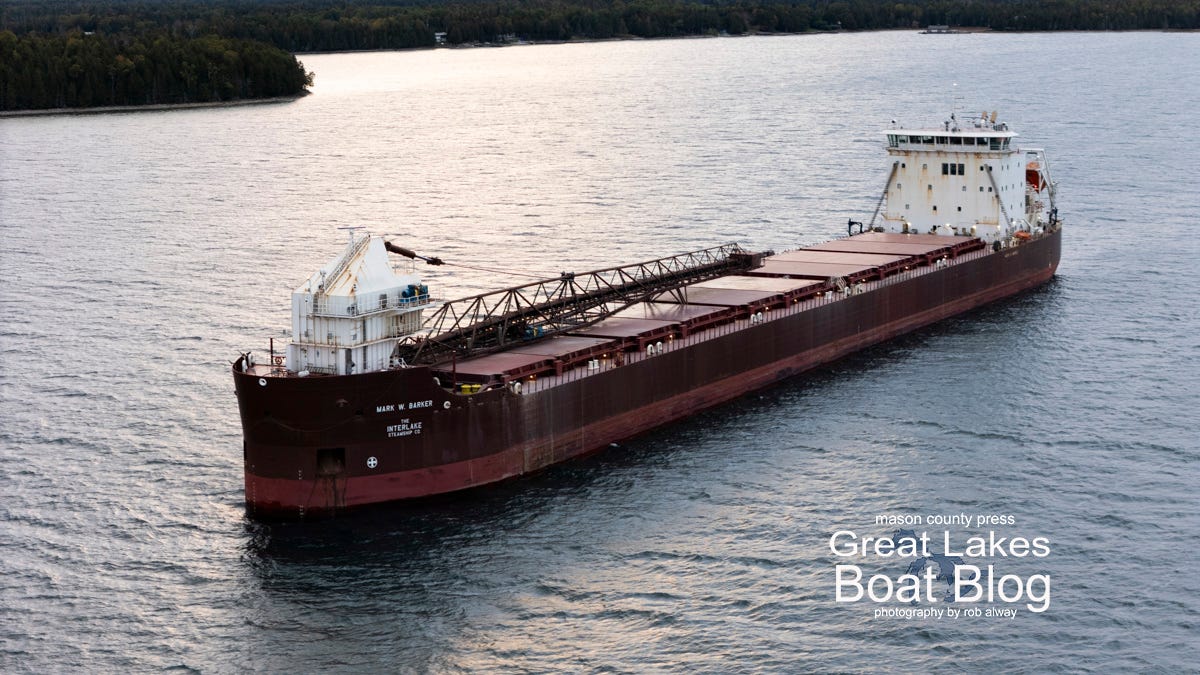
CEDARVILLE, Michigan — The 680-foot John J. Boland was loading limestone at Port Dolomite on Saturday, Oct. 3, 2026, while the 639-foot Mark W. Barker waited offshore in McKay Bay. By early the next morning, the Boland had departed, the Barker was under the loading equipment and the steamship Wilfred Sykes had arrived to wait her turn.
I was at Port Dolomite preparing to board the Wilfred Sykes for a five-day voyage on the Great Lakes. The wait provided an opportunity to photograph the two other freighters and observe activity at the busy limestone port.
Located near Cedarville in Michigan’s eastern Upper Peninsula, Port Dolomite is a major shipping point for dolomitic limestone. The operation was originally developed by United States Steel Corp. in the 1950s and is now owned by Carmeuse. Stone from the quarry is processed at the waterfront facility and loaded aboard Great Lakes freighters for delivery to steel mills and other industrial customers.
Although the John J. Boland and Mark W. Barker were built nearly 50 years apart, both came from the same shipyard in Sturgeon Bay, Wisconsin.
John J. Boland: A veteran of the lakes
The John J. Boland was built in 1973 by Bay Shipbuilding Corp. at Sturgeon Bay, Wisconsin, for American Steamship Co. of Buffalo, New York.
Originally named Charles E. Wilson, she was the first of 10 vessels launched as part of American Steamship’s fleet modernization program, financed under provisions of the Merchant Marine Act of 1970.
The $13.7 million freighter was launched March 10, 1973, and entered service that September. Her maiden voyage took her to Escanaba, Michigan, where she loaded iron ore.
The vessel’s original namesake was Charles Erwin Wilson, who served as president of General Motors from 1941 until 1953, when he resigned to become secretary of defense under President Dwight D. Eisenhower.
In January 2000, the Charles E. Wilson was renamed John J. Boland while in winter layup at Fraser Shipyards in Superior, Wisconsin.
The name honored John J. Boland, one of the founders of the Great Lakes shipping interests that developed into American Steamship Co. The vessel became the fourth freighter to carry the name.
Her immediate predecessor, a 1953-built freighter, was sold to Lower Lakes Towing and renamed Saginaw. That vessel continues to operate on the Great Lakes.
The present John J. Boland measures 680 feet long and 78 feet wide. Her 22 cargo hatches provide access to six holds capable of carrying approximately 33,800 tons of bulk cargo.
She is powered by two General Motors diesel engines producing a combined 7,200 horsepower. Her self-unloading system includes a 250-foot stern-mounted boom, which allows her to discharge cargo without relying on shore-based unloading equipment.
The Boland has carried iron ore, coal, limestone and other bulk commodities throughout her career.
One of her more notable assignments came June 19, 2004, when she delivered the final shipment of coal to the Wisconsin Electric power plant at Port Washington, Wisconsin. The 19,000-ton cargo ended approximately 70 years of coal deliveries to the facility by water.
The Boland now operates under Grand River Navigation, part of the Great Lakes shipping fleet that includes American Steamship Co.
When I arrived at Port Dolomite on Oct. 3, the 53-year-old freighter was alongside the dock taking on another load of stone.
Mark W. Barker: The newest addition to Interlake’s fleet
The Mark W. Barker was completed in 2022 by Fincantieri Bay Shipbuilding at Sturgeon Bay, the same shipyard where the Boland had been constructed in 1973.
Her construction was unusual for an industry in which many vessels have remained in service for 50 years or longer.
The Barker was the first new U.S.-flagged Great Lakes bulk carrier constructed at a Great Lakes shipyard in nearly four decades and the first new vessel built for the Interlake Steamship Co. since 1981.
Interlake announced plans for the ship in April 2019. Construction began that August, and her keel was laid June 23, 2020.
She was launched Oct. 28, 2021, and departed Sturgeon Bay on her maiden voyage July 27, 2022.
Her first assignment was a trip to Port Inland, Michigan, on northern Lake Michigan, where she loaded stone for delivery to Muskegon, Michigan. Port Inland is a separate limestone shipping facility from Port Dolomite.
The Barker was officially christened Sept. 1, 2022, in Cleveland, Ohio.
She is named for Mark W. Barker, president and chief executive officer of Interlake Steamship Co. and the second generation of the Barker family to lead the company.
His father, James R. Barker, is the namesake of the 1,004-foot James R. Barker, built in 1976.
Designed for smaller ports
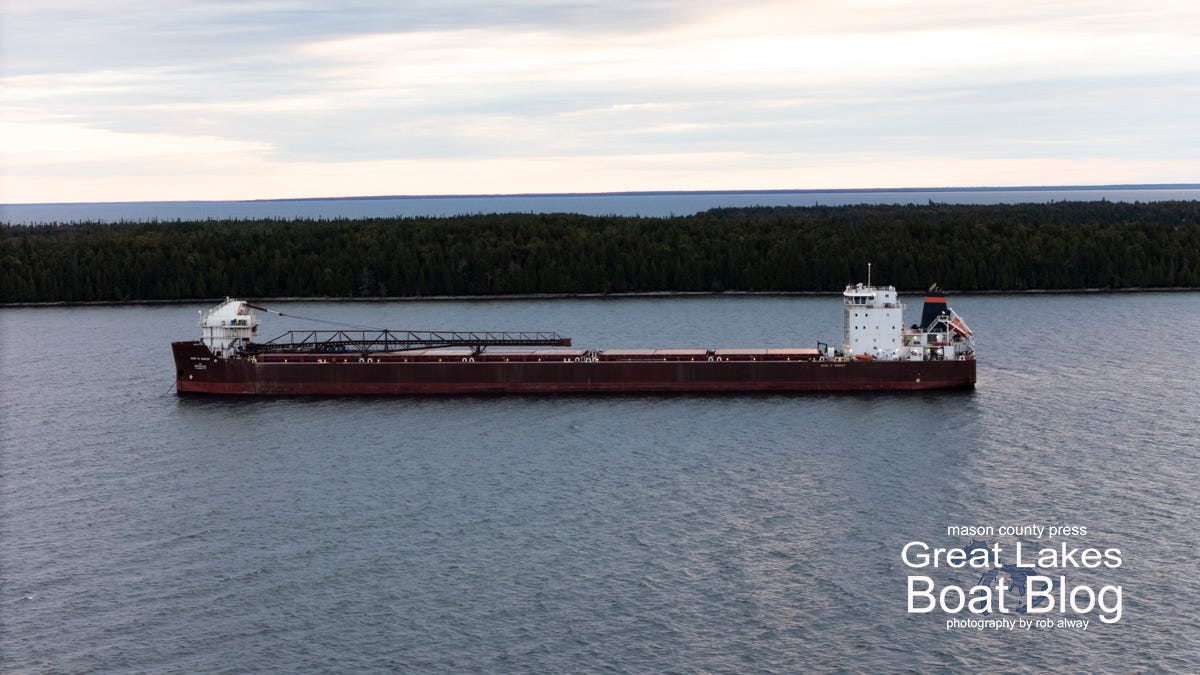
At 639 feet long and 78 feet wide, the Mark W. Barker is smaller than many of the bulk carriers constructed during the 1970s and 1980s.
Her dimensions allow her to navigate smaller harbors and waterways, particularly the winding Cuyahoga River in Cleveland.
The vessel has a carrying capacity of approximately 26,000 tons and can transport limestone, iron ore, salt and other bulk commodities.
Her cargo hold differs from the traditional arrangements found aboard most Great Lakes self-unloaders.
Rather than the sloping sides commonly used to funnel bulk cargo toward conveyor belts, the Barker has a square-shaped, flat-bottomed cargo hold. Five large hydraulically operated hatch covers provide access to the hold.
The arrangement allows her to carry oversized industrial components and other cargoes that would be difficult to load aboard conventional lake freighters.
The ship also has a forward-mounted self-unloading boom, unlike the stern-mounted equipment found aboard most self-unloading Great Lakes freighters.
Her propulsion system consists of two Electro-Motive Diesel engines producing a combined 8,000 horsepower, driving a single controllable-pitch propeller. Bow and stern thrusters provide additional maneuverability in confined waterways.
The Barker was also the first Great Lakes freighter built with engines meeting the Environmental Protection Agency’s Tier 4 marine emissions standards. Her diesel engines use selective catalytic reduction technology to reduce nitrogen oxide emissions.
Another connection to Great Lakes industry was the steel used in her construction. Iron ore mined in Minnesota was transported by lake freighter to Indiana, where it was manufactured into steel that was subsequently used to build the vessel in Wisconsin.
A busy weekend at Port Dolomite
By early Sunday morning, Oct. 4, the John J. Boland had completed loading and departed Port Dolomite.
The Mark W. Barker had moved into the berth and was taking on her own cargo of limestone.
Meanwhile, the 678-foot steamship Wilfred Sykes, built in 1949 at Lorain, Ohio, had arrived and was waiting to load.
The three ships were built in different decades: the Sykes in 1949, the Boland in 1973 and the Barker in 2022. All three remain active participants in the Great Lakes bulk cargo trade.
For me, the weekend began with the opportunity to photograph the John J. Boland loading and the Mark W. Barker waiting in the bay. By Sunday morning, the Barker had taken the Boland‘s place at the dock, and I was preparing to begin my voyage aboard the Wilfred Sykes.
Our ship would have to wait until the Barker finished loading before taking her own turn at Port Dolomite.
Help support this Substack page and check out our merchandise store.
This story is copyrighted 2026 by Sable Points Media.