


By Rob Alway
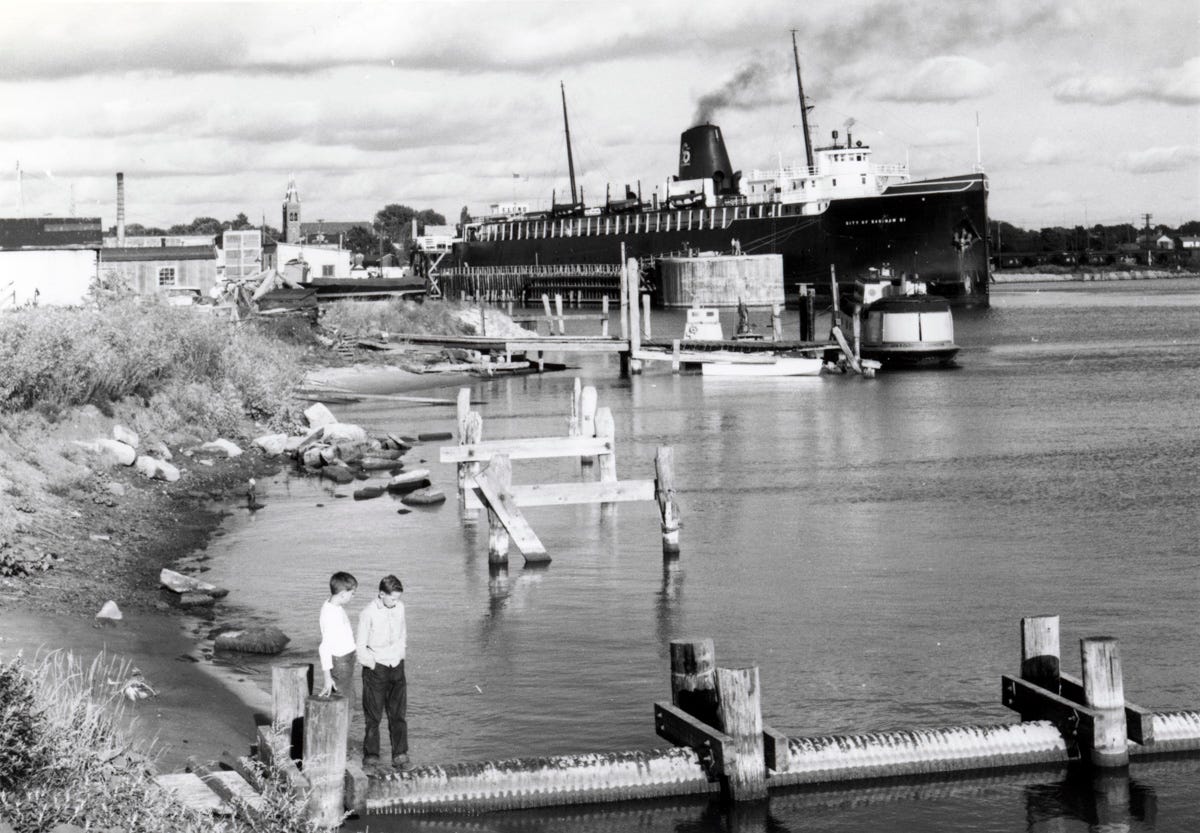
The Pere Marquette Railway opened another chapter in Ludington carferry history at the end of the 1920s with City of Saginaw 31 and City of Flint 32. The nearly identical sisters combined greater speed, new propulsion technology and much more elaborate passenger accommodations than the freight-oriented vessels that had defined much of the earlier fleet.
The railroad ordered the two ships from Manitowoc Shipbuilding Co. in December 1928. City of Saginaw 31 entered service in 1929, followed by City of Flint 32 in 1930. The sisters measured approximately 381.5 feet long with a 57-foot beam and could carry 30 standard freight cars on four tracks.
Their propulsion marked a major departure from earlier vessels. Instead of direct reciprocating steam engines, the sisters used turbo-electric drive. Steam turbines generated electricity that powered large electric propulsion motors. Contemporary accounts reported about 3,600 horsepower for each motor and a service speed near 18 mph, considerably faster than many of the older carferries.
The numbering system changed again because of the new machinery. Rather than continue with No. 23 after Nos. 21 and 22, the railroad began the 30-series. The new vessels became Nos. 31 and 32, reflecting their distinct mechanical arrangement.
Passenger travel had also become a major consideration. Each ship had 43 staterooms, including larger parlor accommodations, and public spaces designed to make the Lake Michigan crossing attractive to motorists and travelers as well as railroad customers. The railroad named the vessels for Saginaw and Flint, two important Michigan cities along its system.
City of Saginaw 31 cost about $1.425 million. Later histories credited her arrival with beginning a new era of cross-lake passenger service. The straight-line route between Ludington and Wisconsin offered motorists an alternative to driving around the southern end of Lake Michigan through Chicago.
City of Flint 32 arrived a few months later and became flagship. The sisters established impressive operating records. One contemporary account reported that together they traveled approximately 1.186 million miles on their Ludington-Manitowoc assignment through the end of 1939.
No. 32’s 1939 mileage became particularly famous. One later fleet history gave the total as 100,000 miles in a single year, while another account placed it at 110,000 and described the performance as a world record at the time. The discrepancy remains, but both sources agree that City of Flint 32 achieved an extraordinary annual mileage for a Great Lakes vessel.
The growing passenger business could be seen in fleet totals. In 1950, the Ludington carferries carried 144,952 passengers and 51,508 automobiles, producing more than $1 million in passenger-related revenue. Railroad freight still dominated the operation, but the water route had become an important part of the U.S. 10 travel corridor.
City of Flint 32 survived a dramatic grounding just north of the Ludington north breakwater during the great storm of Nov. 11, 1940. She remained in the fleet for another three decades before being sold in 1970 and later used as a barge on the Detroit River.
City of Saginaw 31 remained in Pere Marquette and later C&O service until 1971, when fire badly damaged the vessel while she awaited overhaul at Manitowoc. She was subsequently sold and scrapped in Canada.
The next major addition arrived in 1941. She would be longer, faster and more powerful than any Ludington carferry before her, and her new propulsion system would once again prompt the railroad to begin another numbering series.
Coming in Part 16: City of Midland 41 - the last of the Pere Marquette steamers.