


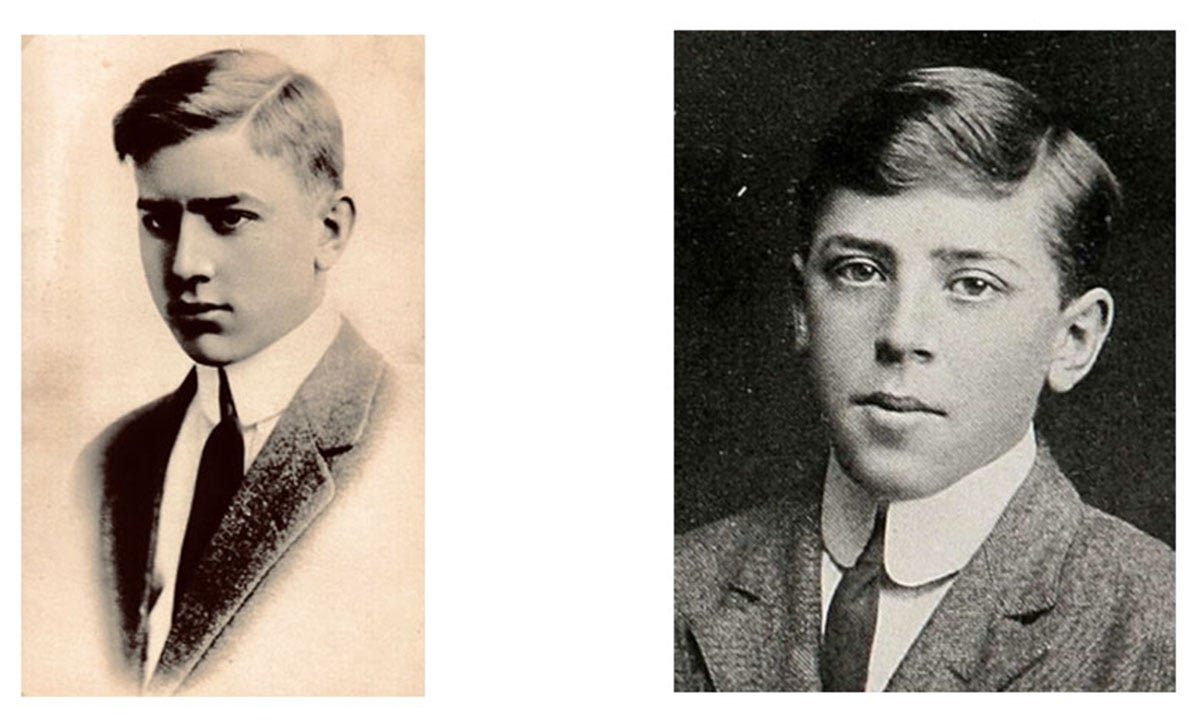
An American merchant mariner died when a tanker was attacked in the North Sea in March 1917. Seventeen months later, his younger brother was killed on a battlefield in France. Their deaths left a lasting legacy of service and sacrifice.
By Rob Alway
Editor’s note: On Veterans Day, Nov. 11, Americans honor those who have served in the nation’s armed forces. This Veterans Day, Great Lakes Boat Blog remembers two brothers from Ludington, Michigan, whose lives were lost during World War I. One was a merchant mariner killed aboard an American tanker in the North Sea before the United States formally entered the war. The other was an Army artilleryman who died fighting in France. Their stories reflect the sacrifices made both at sea and on land during the First World War.
At 8:15 p.m. on March 21, 1917, the American oil tanker SS Healdton was making her way through the North Sea, approximately 23 nautical miles north by east of the Terschelling lightship, off the coast of the Netherlands.
The ship was traveling at 10 knots when an explosion struck her port side amidships, wrecking the engine room and knocking her electric generator out of action. Her lights went dark. A second explosion struck farther aft, igniting a fire in the ship’s bunkers.
Among the crew was 23-year-old Emery Eric Johannes Leveaux, an oiler from Ludington, a Great Lakes port on the eastern shore of Lake Michigan.
Within approximately 20 minutes, the tanker was gone.
Leveaux was among 21 men who died in the sinking. Thirteen of the dead were American citizens.
His death came just 16 days before the United States formally entered World War I.
Emery was the first member of the Leveaux family to enter service and the first Mason County, Michigan, resident to die in the conflict. His younger brother, Cosmer Magnus Leveaux, would follow him in death the following year, this time on a battlefield in France.
Of the 48 Mason County residents who lost their lives serving during World War I, perhaps no family suffered a greater loss than the Leveaux family.
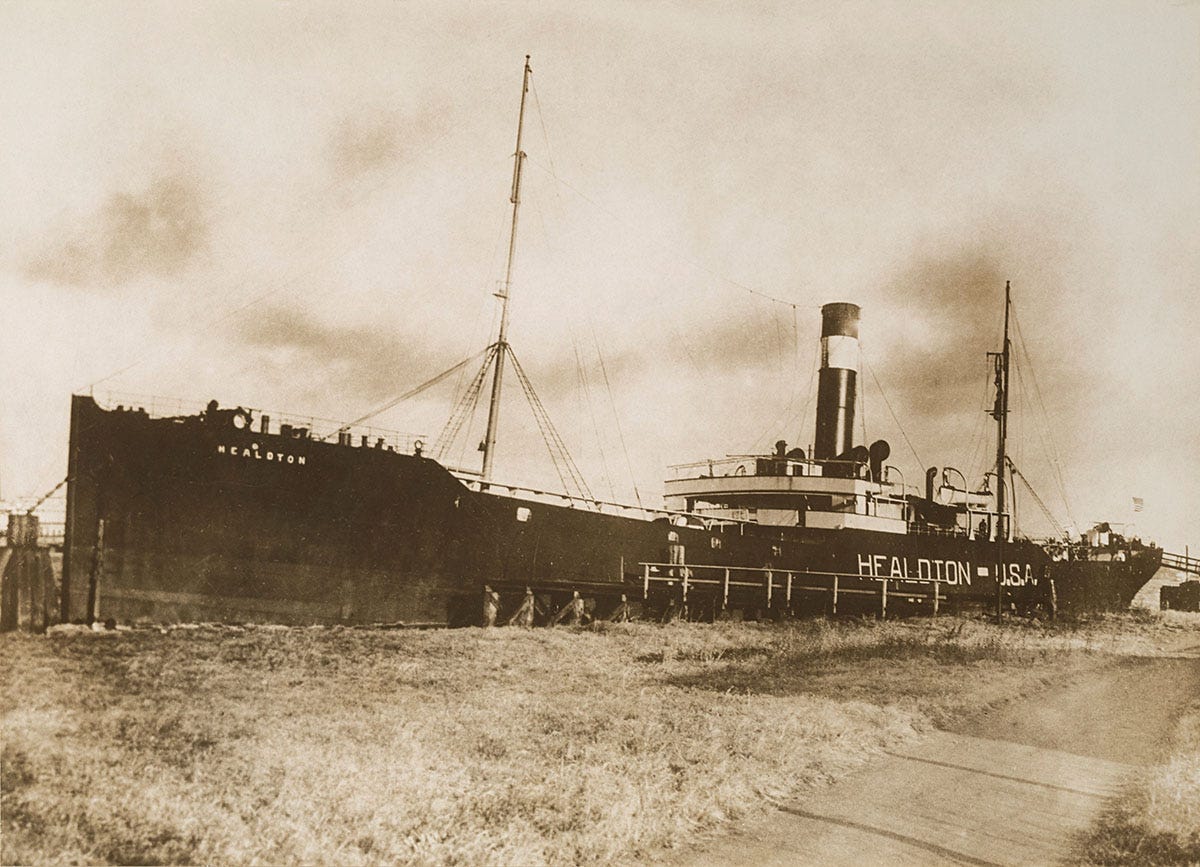
The tanker Healdton
The Healdton was owned by the Standard Oil Company of New Jersey. She had originally been named Purelight and was owned by Purelight Steam Ship Company Ltd.
Built at Greenock & Grangemouth Dockyard Company in Scotland, she was launched as SS Purelight on July 1, 1908.
She was 369 feet long, with a breadth of 50.9 feet and a depth of 27.3 feet. She was powered by a single screw driven by a three-cylinder triple-expansion steam engine manufactured by John G. Kincaid & Co. of Greenock, Scotland.
In 1911, ownership transferred to Pure Oil Co., which had belonged to the Pennsylvania Trading Company AG, a German company.
In 1914, Purelight was equipped with submarine signaling and wireless telegraphy. When the European war began in August 1914, she was in Hamburg, Germany.
In 1916, the Standard Oil Company acquired the ship and renamed her Healdton, changing her registry from Hamburg to New York.
On Jan. 26, 1917, Healdton departed Philadelphia, Pennsylvania, carrying 6,200 tons of kerosene bound for Rotterdam, the Netherlands, a neutral country.
She was laid up in Halifax, Nova Scotia, Canada, from Feb. 9 until March 9, when she set sail for Bergen, Norway. She departed Bergen on March 20, again heading for Rotterdam.
The ship’s American nationality was prominently displayed. The words “Healdton — USA” were painted in white letters several feet high amidships on both sides of her black hull. At night, the letters were illuminated.
The markings were intended to make the vessel’s nationality unmistakable in waters where merchant shipping was increasingly threatened by German submarines.
Despite those markings, Healdton would not complete her voyage.
A ship lost in minutes
The first explosion struck Healdton amidships at approximately 8:15 p.m. on March 21.
The blast wrecked her engine room, putting the electric generator out of commission and disabling all the ship’s lights.
The second explosion struck the bunkers farther aft and started a fire.
The tanker began listing to port and settling by the stern. Two crewmen were killed after becoming trapped below decks.
The surviving crew members prepared to lower the lifeboats.
One lifeboat capsized shortly after being launched, killing all but one of its occupants. Capt. Charles Christopher later stated that the boat had been cut from its towline prematurely.
Christopher and 12 other men abandoned ship in a second lifeboat, while eight crew members, including the chief officer, escaped in a third.
About 20 minutes after the explosions, Healdton sank beneath the North Sea.
Christopher later reported seeing a submarine surface approximately 100 feet away before diving again.
The following morning, the search for survivors began.
At 8 a.m. on March 22, the steam trawler Java sighted the sail of the No. 2 lifeboat, containing the captain, and went to investigate.
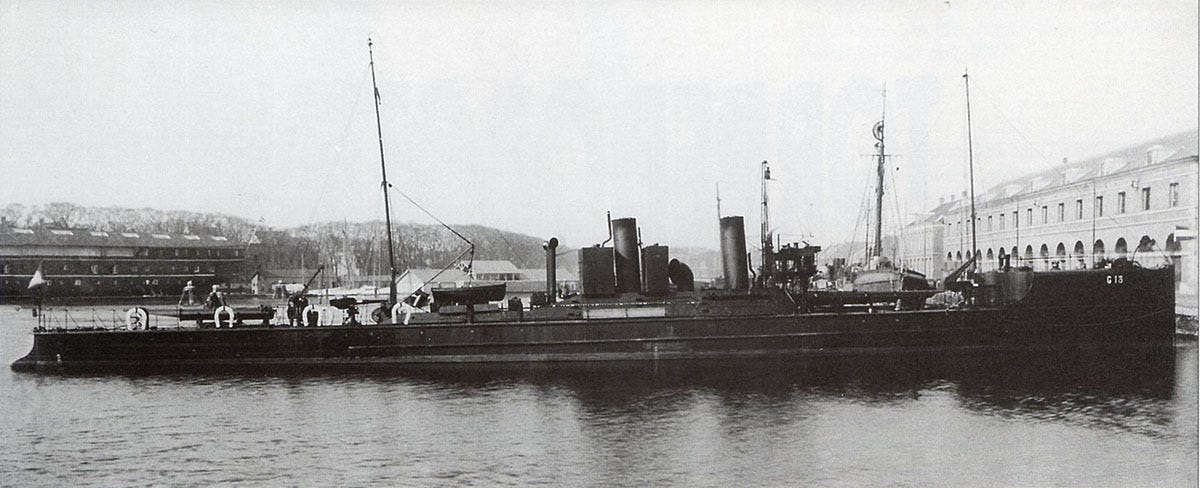
At 2 p.m., the Royal Netherlands Navy torpedo boat Hr.Ms. G-13 found the third lifeboat and took its survivors to Terschelling.
Two men aboard that boat were naked, their clothing having either been blown off or burned away in the explosions. One sailor had died of hypothermia before rescuers arrived.
Later that day, the Dutch steam trawler Ocean located the first lifeboat.
It had capsized, but one crewman had managed to right it and climb aboard.
Among the 21 dead were 13 U.S. citizens, including the second officer, third officer, third engineer and Emery Leveaux, the young oiler from Ludington.
For Leveaux, whose work placed him among the ship’s engineering personnel, the attack that destroyed the engine room proved fatal.
He was just 23 years old.
A maritime tragedy before America’s declaration of war
When Healdton sank, the United States was still officially neutral in the European conflict.
The war had begun on July 28, 1914, when Austria-Hungary declared war on Serbia. Although the fighting eventually engulfed much of Europe, the United States had attempted to remain outside the conflict.
But German submarine attacks on merchant vessels, including American ships, increasingly threatened American lives and commerce.
The destruction of Healdton was among the incidents that demonstrated the danger faced by American merchant mariners in European waters.
On April 2, 1917, President Woodrow Wilson addressed a joint session of Congress, requesting a declaration of war against Germany.
Wilson cited Germany’s violation of its pledge to suspend unrestricted submarine warfare in the North Atlantic Ocean and Mediterranean Sea, as well as German efforts to entice Mexico into an alliance against the United States.
On April 4, the U.S. Senate voted to support Wilson’s request.
The House of Representatives concurred on April 6, formally bringing the United States into World War I.
By then, Emery Leveaux was already dead.
He had lost his life serving aboard an American merchant vessel at a time when the nation’s merchant mariners were becoming increasingly exposed to the dangers of submarine warfare.
His death also underscored the important role of the merchant marine in carrying fuel and other cargo across oceans threatened by war.
A family with roots in Sweden and the Great Lakes
Emery Eric Johannes Leveaux was born in October 1893, one of six children of Karl Johan Olsson Leveaux and Emma Johnson Leveaux.
Karl Johan Olsson Leveaux (1866-1969), known locally as John, was born in Stockholm, Sweden, and immigrated to the United States in 1888, settling in Ludington.
He changed the family name from Olsson to Leveaux.
Emma Johnson (1868-1922) was also born in Sweden and immigrated to the United States in 1882.
The Leveaux family lived on the Buttersville Peninsula, along Lake Michigan south of Ludington. They likely resided in an area on the peninsula’s northern tip commonly known as Fin Town, a neighborhood occupied primarily by residents of Scandinavian descent.
Karl and Emma had six children: Jennie (1890-1922), Emery Eric Johannes (1893-1917), Cosmer Magnus (1896-1918), Amy (1901-1952), Carl L. (1903-1993) and John F. (1904-1989).
According to the 1910 U.S. Census, Karl was a farmer.
Little biographical information about Emery exists beyond the circumstances of his death.
His siblings attended and graduated from Ludington High School, making it possible that Emery also attended the school, perhaps graduating in 1910 or 1911. However, this has not been confirmed.
His career eventually took him from the shores of Lake Michigan to ocean-going merchant vessels and, ultimately, the North Sea.
It was there that Emery’s life ended, thousands of miles from the family home in Ludington.
For the Leveaux family, the loss was devastating. But the family’s tragedy was not over.
Cosmer Leveaux: A younger brother goes to war
Cosmer Magnus Leveaux was born in March 1896 in Ludington.
Known as Cassy to his high school classmates, Cosmer was small in stature, as reflected in his senior quote in the 1913 Ludington High School Oriole yearbook:
“Valuable goods often come in small packages.”
After graduating from Ludington High School, Cosmer attended Michigan Agricultural College (MAC), now Michigan State University, in East Lansing, Michigan. He earned a degree in forestry, graduating in 1917.
His college friends called him Joe.
At MAC, Cosmer was active in the Cadet Corps, fencing, the forestry club, Xi Sigma Pi, and the Alpha Epsilon fraternity.
He had been engaged to Hildah Cummings, who was enrolled in the college’s bacteriology department.
Cosmer’s name can be found on two memorials at Michigan State University. One is located at Williams Hall, honoring MAC’s fallen soldiers, and another is at the school’s agricultural college.
According to a newspaper account about the Leveaux brothers, Cosmer joined the Army to avenge Emery’s death.
He joined Battery C of the Michigan National Guard Field Artillery, which became part of the U.S. Army’s 119th Field Artillery Regiment, 32nd Infantry Division — the famed Red Arrow Division.
The 32nd Infantry Division was formed from Army National Guard units from Michigan and Wisconsin and would fight during both World War I and World War II.
Two months after the United States declared war on Germany, the division was activated at Camp MacArthur in Waco, Texas.
Wisconsin furnished approximately 15,000 soldiers, while another 8,000 came from Michigan.
The division included the 125th, 126th, 127th and 128th Infantry Regiments, as well as three artillery regiments within the 57th Field Artillery Brigade.
According to military records, Cosmer Leveaux departed New York City for France aboard a military transport on Feb. 26, 1918.
At some point during his service, he was promoted from private to corporal.
The Red Arrow Division in France
The 32nd Division arrived on the Western Front in France in February 1918.
It was the sixth U.S. division to join the American Expeditionary Forces under Gen. John J. Pershing.
The division’s shoulder patch, depicting a red arrow piercing a line, symbolized the fact that the 32nd Division penetrated every German defensive line it faced during World War I.
On July 15, 1918, 23 German divisions attacked toward Reims, France, hoping to draw Allied troops away from Belgium.
This attack was part of what became known as the Aisne-Marne Offensive.
The Allies halted the German advance two days later. With the German offensive stalled, Allied commander Ferdinand Foch launched a counteroffensive that included fighting at Soissons and Château-Thierry. Earlier that summer, American troops had also fought at Belleau Wood.
The Allies, with significant support from the American Expeditionary Forces, fought an increasingly mobile offensive using tanks and other new technologies.
On Aug. 7, 1918, the 32nd Division was relieved at the front by the 28th Infantry Division.
In the fighting since July 30, the German line had been driven steadily backward over difficult ground, from strongly fortified positions on the Ourcq River to the Vesle River, a distance of approximately 12 miles.
The American attacks culminated in the 64th Infantry Brigade’s capture of the important town of Fismes, on the Vesle River, on Aug. 7, and the 63rd Brigade’s capture of an important German railhead along the Vesle on Aug. 4.
During the preceding week, the division had captured 18 villages and fortified farms, four pieces of heavy artillery, five pieces of light artillery, 10 trench mortars, 28 machine guns and hundreds of rifles.
The division had faced three German divisions in the offensive: the Fourth Prussian Guards, the 200th and the 216th.
One German officer and 96 German soldiers were taken prisoner.
The 32nd Division suffered 4,597 casualties from all causes during the offensive. These included 797 killed or dying of wounds, 1,153 severely wounded, 2,009 slightly wounded, 618 gassed, 12 missing and eight captured, including two officers and six enlisted men.
Among the division’s dead was Cosmer Leveaux.
A second son lost
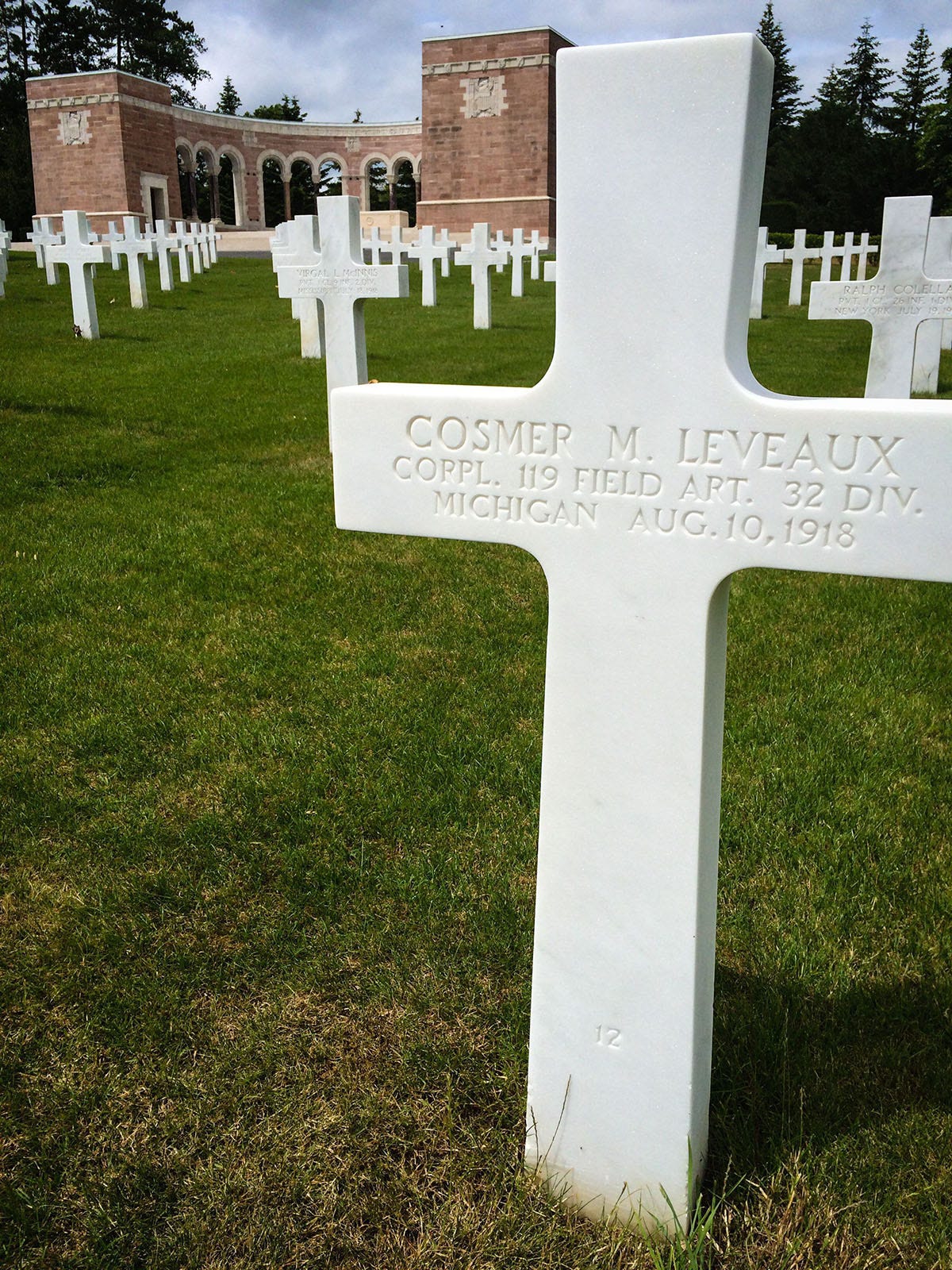
Cosmer died on Aug. 10, 1918, on the Chéry-Chartreuve battlefield in the Aisne region of France.
He was 22 years old.
According to accounts of his death, Cosmer was killed by shrapnel when German artillery struck the gun he was operating.
Eleven other soldiers were also killed.
Another Ludington soldier, Cpl. Edwin Harold Ewing, died in early August 1918, just days before Cosmer Leveaux. Ewing served with Company I, 126th Infantry Regiment, 32nd Division. During fighting near Fismes, France, he was responsible for delivering battlefield messages between units. According to a 1919 account published by Michigan Agricultural College, Ewing successfully carried an important message through heavy German artillery fire but was mortally wounded while returning. His name was later given to Ludington's Edwin H. Ewing American Legion Post 76.
By August, the Allies had eliminated the German salient and were moving toward what would become the final months of the war.
The armistice ending the fighting took effect on Nov. 11, 1918, three months and one day after Cosmer’s death.
Emery had been killed at sea before his country formally entered the war. Cosmer had died on a French battlefield as American troops helped turn the tide of the conflict.
The brothers never returned home.

Remembering Emery and Cosmer
Emery Leveaux was buried at sea.
His younger brother, Cosmer, was buried at Oise-Aisne American Cemetery at Fère-en-Tardenois, France.
His grave is located in Plot D, Row 34, Grave 12.
In Ludington, their hometown, the two brothers would be remembered together.
Leveaux Memorial Park is a small, understated park just south of Ludington Avenue (US 10), between Staffon and Madison streets.
On May 18, 1925, the Ludington City Council passed an ordinance changing the name of East End Park to Leveaux Memorial Park in honor of Emery and Cosmer Leveaux.
The park was named for the two first-generation Americans who had lost their lives during World War I, one aboard an American merchant ship and the other serving in the United States Army.
Since March 1952, the park has been cared for by the Mason County Garden Club. Today, the club maintains the park in cooperation with the City of Ludington’s Department of Public Works.
The park remains a quiet memorial to the brothers, more than a century after their deaths.
In addition to the park, the now-defunct Ludington Veterans of Foreign Wars post was named in honor of the Leveaux brothers.
Although their graves are separated by the sea and the European continent, their names remain together in their hometown.
The Leveaux family after the war
The deaths of Emery and Cosmer were not the only tragedies endured by the Leveaux family.
The family lost two more members in 1922.
Jennie Leveaux, the oldest child of Karl and Emma, was born Oct. 13, 1890, in Pere Marquette Township, Michigan, near Ludington. She died in New York City on May 30, 1922, at the age of 31.
Emma Leveaux, the family’s matriarch, died Aug. 21, 1922, of chronic bronchitis. She was 54 years old.
The family’s remaining children eventually established lives outside Ludington.
Amy Leveaux, born Feb. 21, 1901, graduated from Michigan Agricultural College in 1925. She married Frank J. Schroeder, and the couple resided in Great Valley, New York, beginning in 1935. They had one son.
Amy died March 10, 1952. Her death was memorialized in a 1952 Michigan State College alumni publication.
Karl “John” Leveaux lived to be 103 years old. He died March 2, 1969, in Middleport, New York, likely near his son John, who also lived in upstate New York.
John F. Leveaux died in 1989.
Carl L. Leveaux, the youngest surviving son of Karl and Emma, lived in Maryland and died in 1993.

Clarifying a family story
Previously published historical accounts of the Leveaux family have stated that Emery and Cosmer had a sister who served as an Army nurse during World War I.
Some accounts identify the sister as Amy, while others identify her as Jennie. Other versions claim that the sister died of influenza during the war or during the Spanish influenza pandemic.
However, available records do not support the conclusion that either sister died during World War I.
The 1916 Ludington High School Oriole yearbook lists Amy as a freshman who would have graduated with the class of 1919.
The 1920 U.S. Census shows both Jennie, then 30, and Amy, 18, living with their parents in Pere Marquette Township.
The 1952 Michigan State College alumni publication confirms that Amy Leveaux Schroeder died March 10, 1952, decades after the war.
Jennie died May 30, 1922. It is possible that complications related to the influenza pandemic contributed to her death, but that has not been established.
Although the family’s record includes these discrepancies, the sacrifices of Emery and Cosmer are well documented.
A legacy across generations
For the Leveaux family, World War I brought the loss of two sons serving their country in very different capacities.
Emery’s death illustrated the dangers encountered by American merchant mariners even before the United States became a formal combatant. Men aboard merchant vessels carried the fuel, supplies and cargo upon which nations depended, often sailing through waters where the distinction between civilian commerce and military targets had become increasingly blurred.
Cosmer’s death represented the enormous sacrifice of the soldiers who crossed the Atlantic to fight on the Western Front.
One brother died aboard a steam-powered tanker in the North Sea in March 1917. The other died operating an artillery gun in France in August 1918.
Their stories are connected not only by family, but by the global nature of the First World War — a conflict that reached from the merchant shipping lanes of the North Atlantic and North Sea to the trenches and battlefields of Europe.
On Veterans Day, their names serve as a reminder of those who left their homes to serve, and of the families whose lives were forever changed when they did not return.
In Ludington, along the Lake Michigan shoreline where the Leveaux brothers grew up, their memorial remains.
And more than a century later, the names Emery and Cosmer Leveaux continue to be remembered together.
Research note: Historical records referenced in the original research include U.S. Census records, Ludington High School Oriole yearbooks, Michigan Agricultural College records, military service and 32nd Infantry Division accounts, contemporary newspaper reports, and a 1952 Michigan State College alumni publication. The account of the Healdton sinking includes descriptions of the ship’s history, the reported explosions, lifeboat operations and subsequent rescue of survivors.