


By Rob Alway
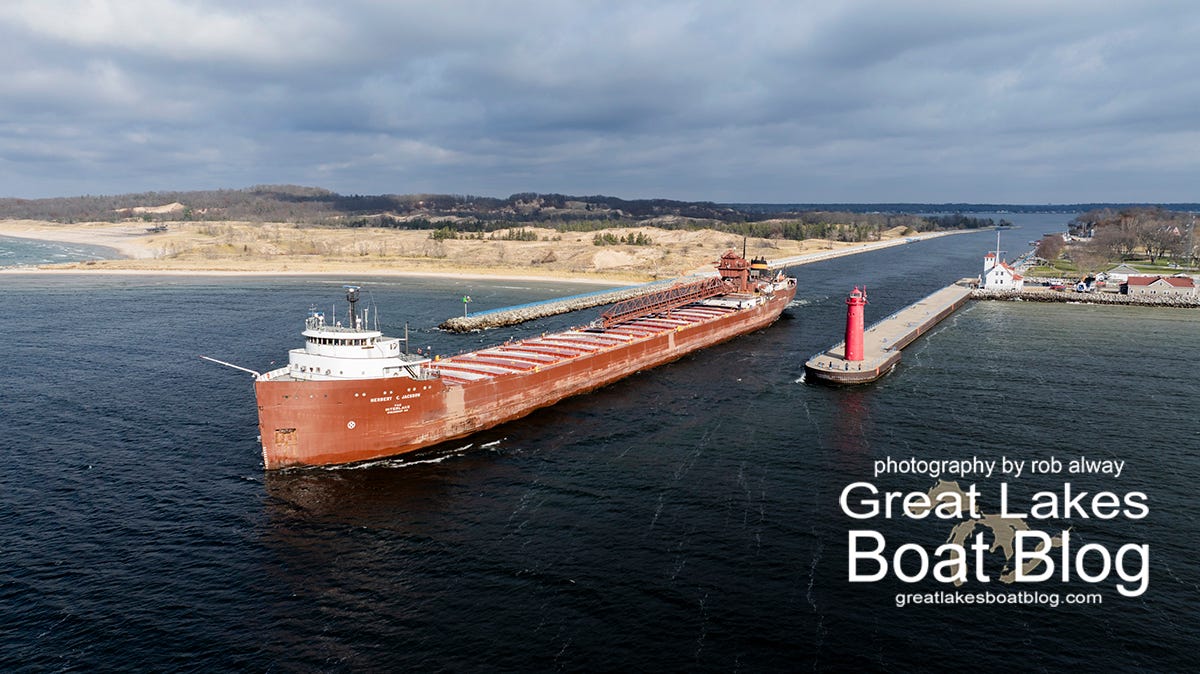
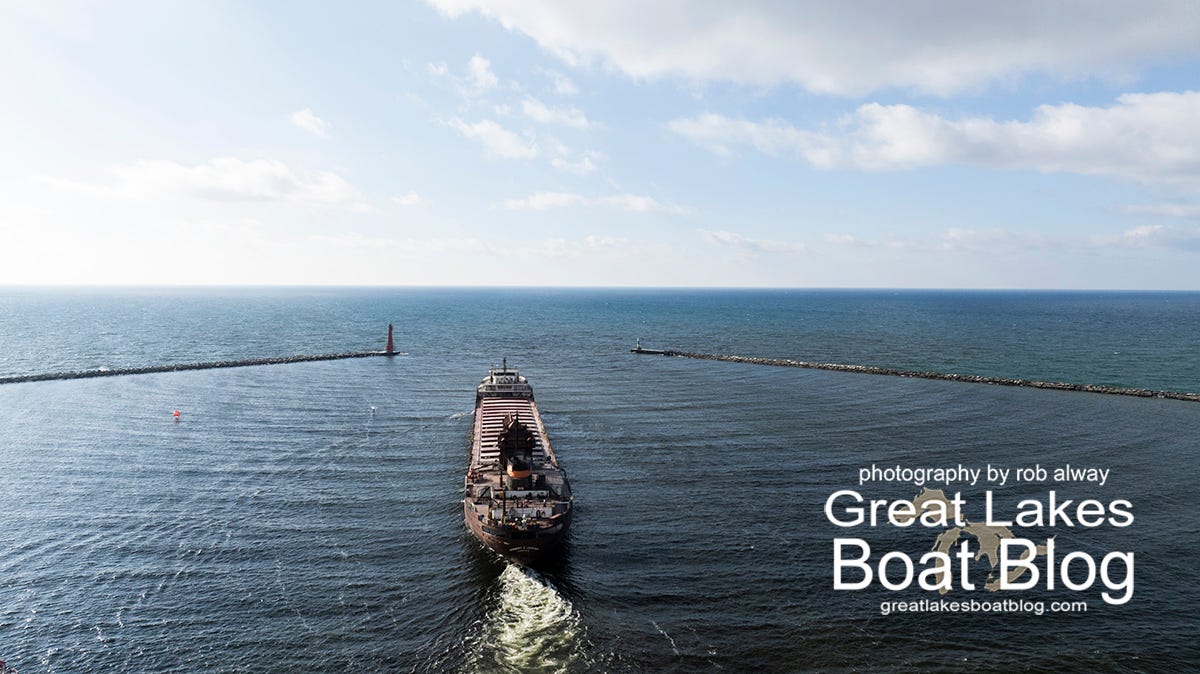
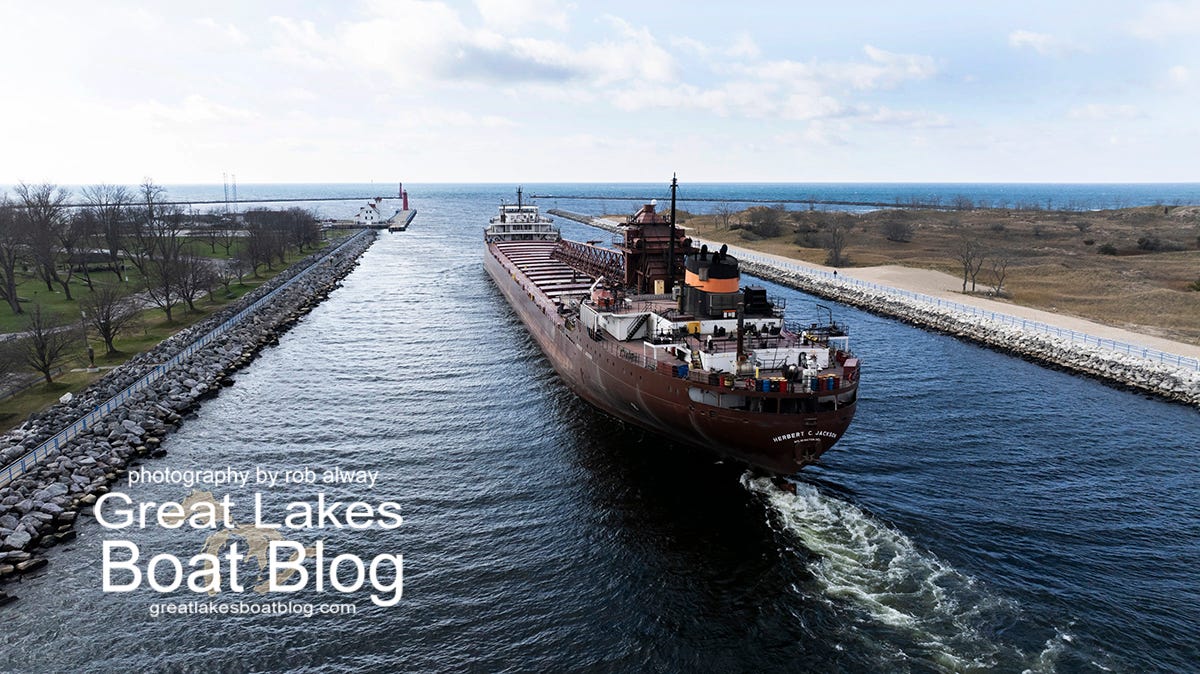
MUSKEGON, MICHIGAN — Shortly after 1 p.m. Saturday, November 28, 2026, the Herbert C. Jackson cleared the Muskegon pierheads and turned north on Lake Michigan. The Interlake Steamship Company self-unloading bulk carrier had arrived early that morning with a cargo of limestone loaded at Port Inland, near Gulliver in Michigan’s Upper Peninsula.
The Jackson delivered her cargo to the Verplank Port Facility at the eastern end of Muskegon Lake, the former site of Consumers Energy’s B.C. Cobb coal-fired generating plant. For nearly seven decades, Great Lakes freighters delivered coal to the plant, which ceased operations in 2016 and was subsequently demolished.
In 2022, the property began a new chapter in its maritime history with the opening of Verplank’s deepwater bulk commodity terminal. Once a destination for coal shipments to fuel electricity production, the site continues to serve Great Lakes commercial navigation, now handling limestone and other bulk commodities.
Like the dock where she unloaded Saturday morning, the Herbert C. Jackson has undergone a significant transformation to remain a productive part of the Great Lakes maritime industry.
When the Jackson sailed into Fraser Shipyards in Superior, Wisconsin, in December 2015, she was closing a chapter in the history of one of the Great Lakes’ most prominent shipping companies. For 56 years, her steam turbine had propelled her through the inland seas, transporting the raw materials that sustained American industry. She was the last steam-powered vessel operating for the Interlake Steamship Company.
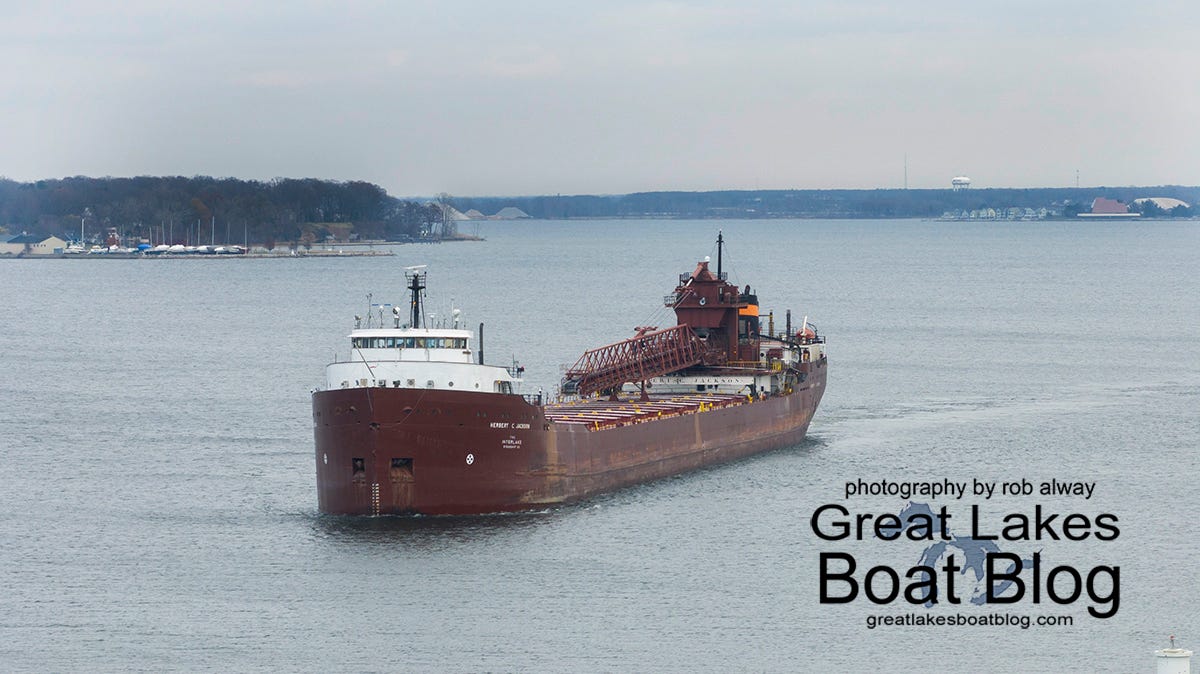
Nine months later, she emerged from the shipyard with a modern diesel propulsion system. Although her machinery had changed considerably, her traditional Great Lakes freighter profile remained largely intact.
Now in her 68th sailing season, the Herbert C. Jackson represents one of the defining characteristics of Great Lakes shipping: the ability to modernize vessels and extend their productive lives across generations.
At 690 feet long, she is considerably smaller than Interlake’s thousand-footers. Her dimensions and versatility, however, allow her to serve industrial facilities and navigate harbors that cannot accommodate the fleet’s largest vessels, ensuring that she continues to fill an important role in the movement of raw materials throughout the Great Lakes.
The final years of a Michigan shipbuilding giant
The Herbert C. Jackson was constructed by Great Lakes Engineering Works at its River Rouge shipyard near Detroit. Designated Hull No. 302, her keel was laid in June 1958.
Earlier that month, the shipyard had launched Hull No. 301, perhaps the most recognized vessel in Great Lakes maritime history, the Edmund Fitzgerald.
The Jackson was launched sideways into the water on February 20, 1959, establishing a record at the shipyard for the weight of a vessel launched in that manner.
Great Lakes Engineering Works had been a major force in American shipbuilding since its establishment in 1902. During both world wars, the company contributed to the nation’s industrial and military efforts while also constructing numerous vessels for commercial Great Lakes shipping companies.
By the time the Jackson entered service in May 1959, however, the shipyard was nearing the end of its existence.
Only one more vessel would be constructed there, the Arthur B. Homer, built for Bethlehem Steel Corporation and placed into service in 1960. Great Lakes Engineering Works was dissolved in 1961.
The Herbert C. Jackson remains a working example of the shipbuilding craftsmanship that once defined Detroit’s industrial waterfront.
The man whose name she carries
The vessel was named in honor of Herbert Cooper Jackson, an executive with Pickands Mather & Company, the Cleveland, Ohio-based industrial enterprise that controlled the Interlake Steamship Company.
Born in Cleveland on March 27, 1894, Jackson graduated from Yale University in 1916 and subsequently joined Pickands Mather.
The company was deeply involved in the mining, transportation and distribution of the raw materials necessary for American steel production. Its maritime operations provided an essential transportation link between the iron ore deposits of the upper Great Lakes and the industrial centers of the lower lakes.
Jackson became a partner in the company in 1942 and served as managing partner from 1955 to 1960. He then became executive vice president, retiring in December 1962 after 46 years with the company.
He remained a director until 1965 and died in Cleveland on December 1, 1981.
The vessel bearing his name has operated in the Interlake fleet throughout her career and has never been renamed.
A traditional Great Lakes ore carrier
As originally constructed, the Herbert C. Jackson measured 690 feet in length, 75 feet in beam and 37 feet, 6 inches in hull depth.
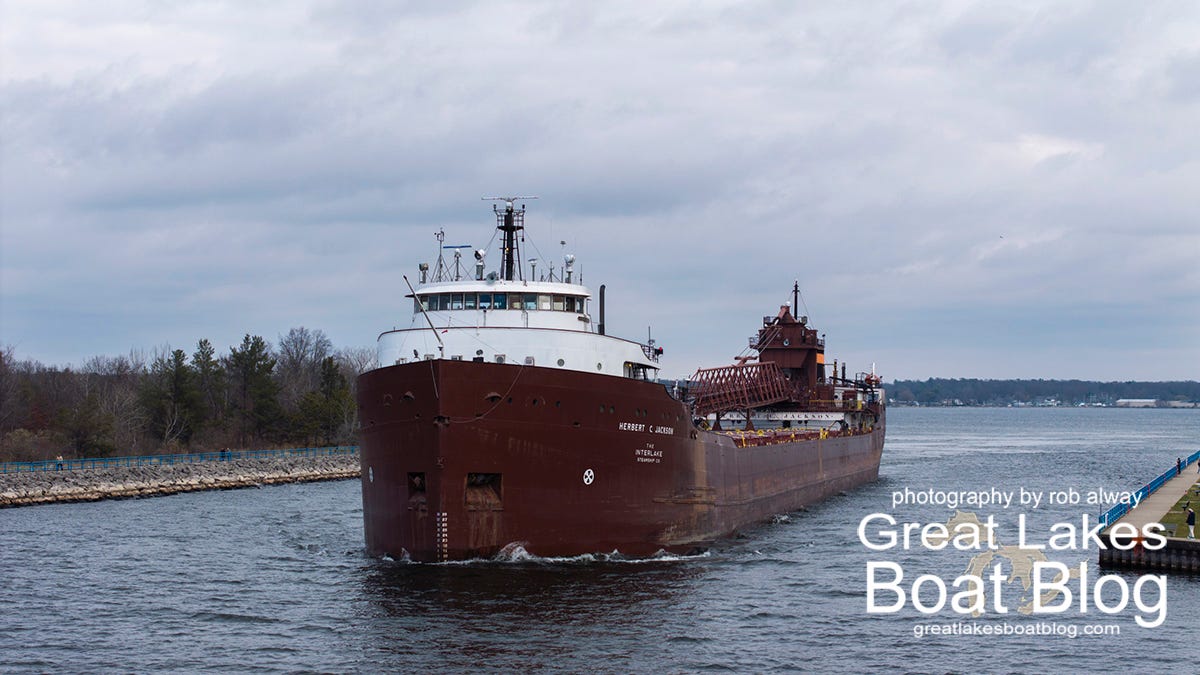
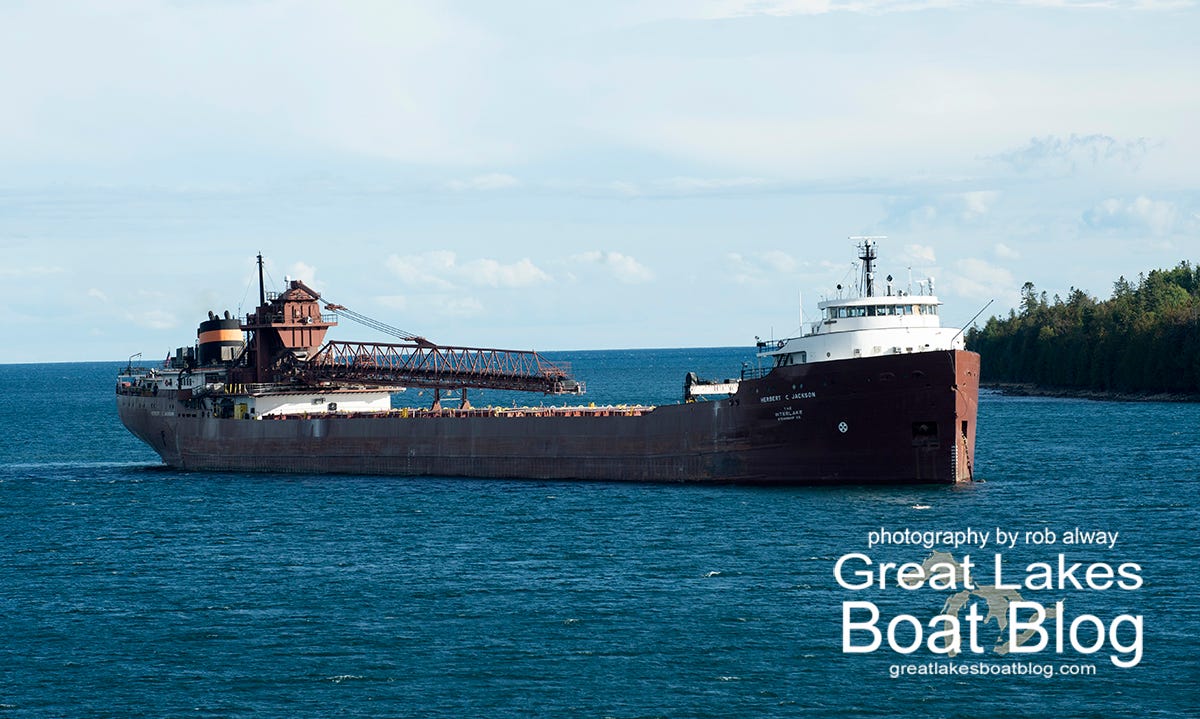
She featured the traditional configuration of a Great Lakes bulk freighter, with her pilothouse and forward accommodations located near the bow and her engine room, stack and additional accommodations at the stern.
Between the two deckhouses stretched an expansive cargo deck with 20 hatches providing access to four cargo holds.
Her original cargo capacity was approximately 24,400 gross tons.
Propulsion was provided by a General Electric cross-compound steam turbine supplied by two coal-fired water-tube boilers manufactured by Combustion Engineering.
Unlike modern self-unloading freighters, the Jackson was originally a straight-deck, or gearless, bulk carrier. She depended on shore-based unloading equipment to remove cargo from her holds.
Her arrival coincided with a transformational year in North American maritime transportation. The opening of the St. Lawrence Seaway in 1959 provided expanded access between the Great Lakes and the Atlantic Ocean.
A strike affecting Great Lakes commerce resulted in the Jackson spending much of her inaugural season transporting iron ore from Labrador through the newly opened Seaway.
Over the ensuing decades, however, much of her work would involve the movement of iron ore between Lake Superior ports and steelmaking facilities along the lower Great Lakes.
Becoming a self-unloader
The first major transformation of the Herbert C. Jackson occurred during the winter of 1974–75 at Defoe Shipbuilding Company in Bay City, Michigan.
Interlake was modernizing its fleet as self-unloading technology became increasingly important to the economics of Great Lakes shipping.
The conversion involved extensive modifications to the vessel’s cargo holds and the installation of a conveyor system beneath them.
Cargo is released from the holds onto a conveyor belt, transported toward the stern and elevated to a 250-foot unloading boom. The boom can be positioned over a receiving facility on shore, allowing the vessel to discharge cargo using her own equipment.
The conversion substantially increased the number of facilities the Jackson could serve, particularly those lacking the expensive infrastructure necessary to unload traditional straight-deck freighters.
During the same shipyard stay, her coal-fired boilers were converted to burn fuel oil and were automated.
Following the conversion, her cargo capacity increased to approximately 24,800 gross tons, the capacity Interlake continues to list for the vessel.
Further improvements followed.
A bow thruster, first installed in 1966, improved her ability to maneuver in confined waterways. During the winter of 1985–86, polymer liners were installed in her cargo holds to improve the flow of bulk materials into her unloading system.
In 1988, she received a replacement 1,000-horsepower bow thruster engine taken from her inactive fleetmate, the John Sherwin. A stern thruster was installed during the winter of 1997–98 at Fraser Shipyards.
These improvements helped make the Jackson particularly well suited for service in narrow industrial rivers and smaller harbors.
Christmas trees, rescued boaters and changing industries
While iron ore, coal, limestone and grain have accounted for much of the Herbert C. Jackson’s commercial activity, some of her more memorable voyages have involved unusual assignments.
In December 1970, she transported 57 Christmas trees, each approximately 12 feet tall, from Minnesota to Cleveland. The trees were destined for a national Christmas display in Washington, D.C.
On October 1, 1986, the crew of the Jackson rescued two boaters who had been adrift on Lake Michigan for approximately 80 hours.
Her commercial career has also reflected significant changes in the industrial landscape of the Great Lakes.
In 1998, she delivered cargo to LTV Steel in Cleveland, becoming one of the largest vessels to navigate the winding Cuyahoga River.
On April 28, 2001, she delivered a cargo of grain from Superior, Wisconsin, to Buffalo, New York. At the time, she was the largest vessel by tonnage to navigate the Buffalo River.
On June 30, 2004, the Jackson delivered the final shipment of coal to the power plant at Port Washington, Wisconsin, before the facility transitioned to natural gas.
The occasion marked the end of an era for the community. The vessel was decorated with flags and opened for public tours.
Two years later, the crew encountered an unusual navigational obstacle on Michigan’s Rouge River.
On August 1, 2006, excessive heat caused the metal components of the Dix Avenue Bridge to expand, preventing the bridge from opening.
Working with the bridge operator, the crew used a hose to cool the bridge’s metal components. The effort succeeded, allowing the vessel to continue upriver with a cargo of taconite pellets from Marquette, Michigan.
A bridge comes down
One of the more unusual accidents in the vessel’s history occurred on May 12, 2013, while she was navigating the Rouge River.
The Jackson had been granted clearance to pass through the open Jefferson Avenue Bridge when the drawbridge began descending into her path.
Despite efforts by the vessel’s master to stop her, the bridge struck the freighter’s bow.
Damage to the vessel was estimated at $5,000, while the historic bridge sustained extensive damage. None of the 24 people aboard the vessel was injured.
An investigation by the National Transportation Safety Board determined that the bridge tender was legally intoxicated and had improperly lowered the bridge as the vessel began passing through the span.
Federal investigators found no malfunction of the vessel’s equipment or the bridge’s operating machinery.
The end of steam at Interlake Steamship Company
By the early 21st century, the Herbert C. Jackson was among a dwindling number of commercially operating steam-powered freighters on the Great Lakes.
Interlake had embarked on an ambitious, decade-long, $100 million fleet modernization program that included converting several of its older steam-powered vessels to diesel propulsion.
Among the vessels repowered were the Lee A. Tregurtha, Kaye E. Barker and Honorable James L. Oberstar.
The Jackson was the final steamship scheduled for conversion.
On December 21, 2015, she arrived at Fraser Shipyards in Superior, Wisconsin, concluding her career as a steam-powered vessel.
Her General Electric steam turbine and boilers were removed and replaced with two MaK 6M32E marine diesel engines producing a combined 6,250 brake horsepower, according to Interlake’s announcement at the time.
The project also included a new reduction gearbox, shaft-driven electrical generators, a controllable-pitch propeller system and exhaust heat recovery equipment.
The latter captures heat from the engines’ exhaust to produce steam for heating accommodations and supporting auxiliary systems.
Although she was no longer propelled by steam, steam would continue to serve a purpose aboard the vessel.
Interlake estimated that the conversion would reduce the vessel’s carbon dioxide emissions by 57 percent, sulfur oxide emissions by 63 percent and particulate matter emissions by 35 percent.
The new machinery also offered improved reliability, greater automation and reduced maintenance requirements.
On September 25, 2016, the Herbert C. Jackson departed Fraser Shipyards and returned to commercial service, completing Interlake’s transition away from steam propulsion.
The advantages of being smaller
The introduction of thousand-foot freighters during the 1970s and early 1980s greatly increased the carrying capacity of the Great Lakes fleet. However, larger vessels are not necessarily practical for every shipping assignment.
The dimensions of the Herbert C. Jackson allow her to navigate rivers, turning basins and harbors inaccessible to many of Interlake’s larger vessels.
Unlike the thousand-footers, she can also utilize the MacArthur Lock at Sault Ste. Marie, Michigan, rather than being restricted to the larger Poe Lock.
Her assignments have included the transportation of iron ore from Marquette to steelmaking facilities in Dearborn, Michigan, and the movement of ore through the Cuyahoga River in Cleveland.
She also transports limestone, coal and other bulk commodities, serving a variety of customers throughout the Great Lakes.
Her combination of self-unloading equipment, bow and stern thrusters, modern propulsion machinery and relatively modest dimensions makes her a valuable river-class freighter.
A living piece of maritime history
As the Herbert C. Jackson approaches seven decades of service, her career illustrates why Great Lakes freighters often enjoy considerably longer working lives than their oceangoing counterparts.
The freshwater environment, seasonal maintenance, periodic dry docking and substantial investments in modernization allow many American and Canadian vessels to remain commercially viable well beyond their originally anticipated service lives.
The Jackson has witnessed the opening of the St. Lawrence Seaway, the arrival of the thousand-foot freighters, the decline of traditional steam propulsion and significant changes in the American steel and energy industries.
Her original shipyard disappeared more than six decades ago. The company whose executive she was named after underwent significant corporate changes. Her original propulsion machinery has been removed, and her cargo-handling capabilities have been substantially redesigned.
Yet, her familiar profile remains recognizable to generations of Great Lakes boatwatchers.
She is not a museum ship or a preserved relic of a bygone industrial era. She remains an active participant in the industry that built her.
For the Herbert C. Jackson, history is still being written, one cargo at a time.
I thoroughly enjoyed the well written narrative centered around The Great Lakes and it's shipping industry A great ship it is indeed! Thank you!