

By Rob Alway
The four tugboats of Basic Towing Inc. in Escanaba, Michigan, are a working collection of Great Lakes maritime history. Three began their careers in government service. The fourth spent decades working at one of Lake Michigan’s prominent shipyards.
The oldest, Erika Kobasic, entered service with the U.S. Coast Guard in 1939, before the outbreak of World War II. Nickelena was built for the U.S. Navy in 1973. Krystal began as a U.S. Army small tug in the 1950s, while Escort was built for Peterson Builders in Sturgeon Bay, Wisconsin.
Together, the four vessels make up a fleet whose assignments include ship assistance, barge towing, icebreaking and shipyard work. Their home port is Escanaba, on Little Bay de Noc, but their work takes them to commercial ports and shipyards across the Great Lakes. They spend most of their time in Sturgeon Bay, Wisconsin.
Basic Towing is a sister company of North Shore Marine Terminal & Logistics, which operates from the former Basic Marine shipyard property in Escanaba. Marine operations at the site date to 1979. Established in 2014, North Shore Marine Terminal provides marine construction, ship repair, cargo handling, vessel berthing and heavy-lift services. Its waterfront facilities and equipment complement the work of the towing fleet.
The company’s two larger tugs, Nickelena and Erika Kobasic, each have 2,000 horsepower according to its current fleet listing. The smaller Krystal and Escort perform harbor and shipyard work, with the four vessels suited to different assignments.
Nickelena: A Navy harbor tug finds another career
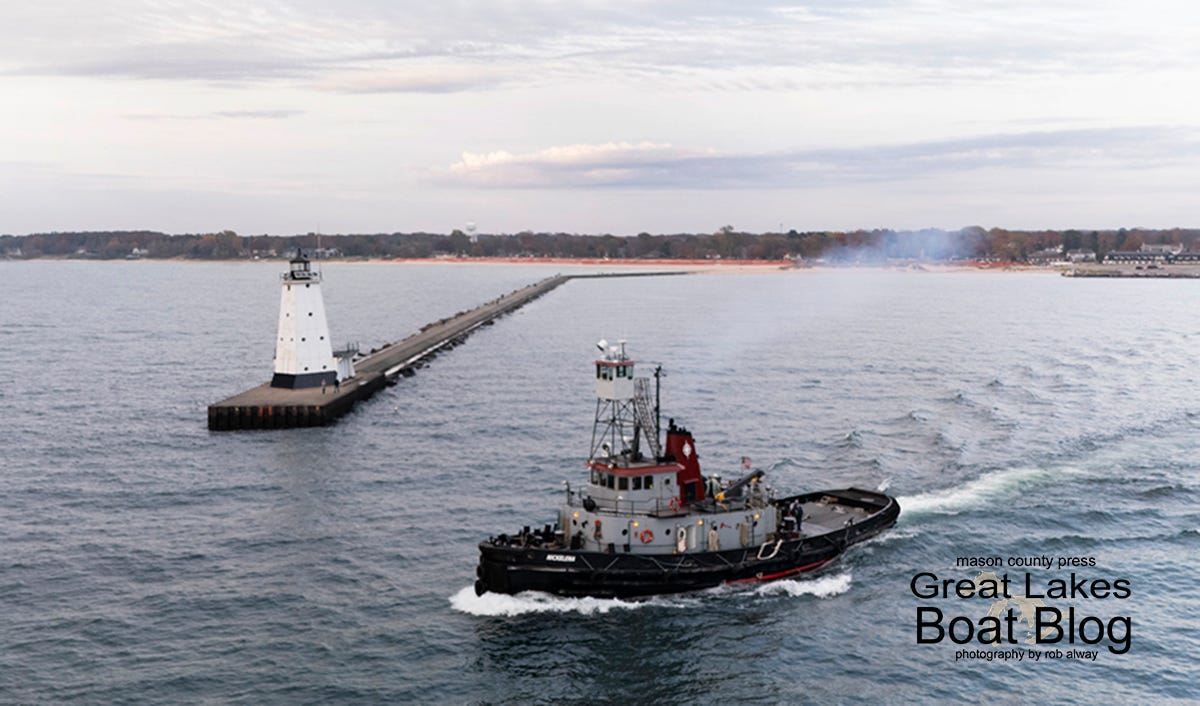
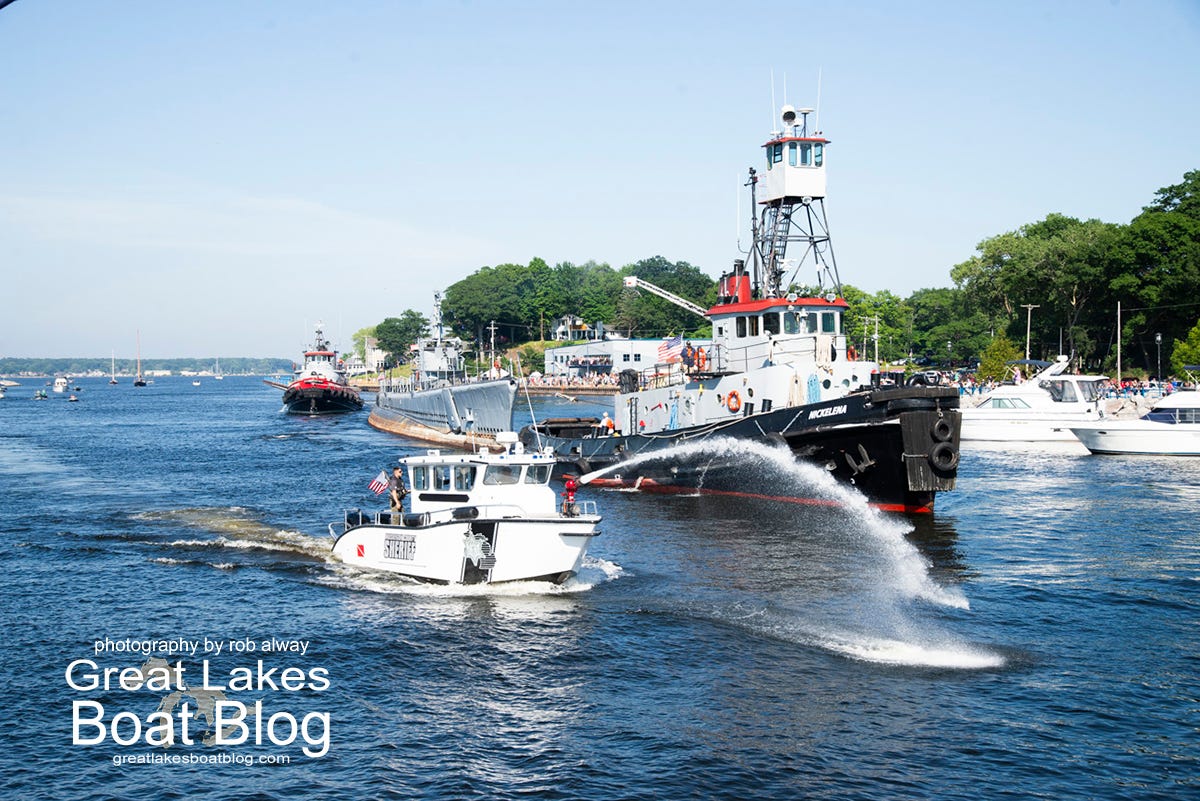
Nickelena began her career as Chetek (YTB-827), a Natick-class district harbor tug built for the U.S. Navy by Marinette Marine Corp. in Marinette, Wisconsin. Her keel was laid May 21, 1973, and she was launched Oct. 25 of that year. The Navy accepted delivery Dec. 8, 1973.
Assigned to the Fifth Naval District at Norfolk, Virginia, Chetek was designed for the demanding work of handling larger ships in harbor. A harbor tug’s relatively small size belies the power and precision required to move a much larger vessel alongside a pier or away from a shipyard berth.
In March 1996, Chetek transferred to the U.S. Army Corps of Engineers, initially retaining her name. The Corps renamed her Koziol in 2000. In 2005, she passed to the St. Lawrence Seaway Development Corp., continuing government service on the inland waterways.
The tug subsequently entered Basic Marine’s Escanaba operation in the mid-2000s and was renamed Nickelena. In 2010, an elevated pilothouse was added above the original wheelhouse, providing the higher sight lines valuable when working with barges and large vessels. The modification gave her the distinctive profile she carries today.
Basic Towing lists Nickelena at 102 feet long, with a 30-foot beam and 2,000 horsepower. Vessel histories identify her as a single-screw tug powered by a Fairbanks-Morse diesel engine.
Her commercial career has included towing large marine construction loads and assisting vessels at the region’s shipyards. At Fincantieri Bay Shipbuilding in Sturgeon Bay and Fincantieri Marinette Marine, work can involve maneuvering ships in confined waters where careful coordination between tug crews and the vessel being moved is essential.
Erika Kobasic: A Coast Guard veteran of World War II
Erika Kobasic has the longest history in the fleet. She was built in 1939 at Gulfport Works in Port Arthur, Texas, as the U.S. Coast Guard cutter Arundel (WYT-90), one of four 110-foot harbor tugs built for the service. Launched June 24, she was commissioned July 6, 1939.
Designed for towing, harbor assistance and icebreaking, Arundel belonged to a class capable of breaking ice as thick as three feet, according to the Coast Guard Historian’s Office. During the winter of 1940, she broke ice on the Hudson River in New York.
World War II brought duty in the North Atlantic. Based at Boston, Massachusetts, she served with the Greenland Patrol, part of the Coast Guard’s support of American maritime and military operations in northern waters.
After the war, Arundel served at New York, then Portland, Maine, and New Bedford, Massachusetts. She arrived on the Great Lakes following a transfer to Chicago, Illinois, in 1952 and spent much of her remaining Coast Guard career in the region.
Her assignments demonstrate how varied the duties of a working tug could be. In August 1965, she assisted with the search for debris after a United Airlines aircraft crashed in Lake Michigan. In February 1968, she helped free the tug Silver Star from ice and escort her to Holland, Michigan. Later that month, she assisted in the medical evacuation of a crewman from the tanker Meteor near St. Joseph, Michigan. In April 1970, she aided the grounded vessel Stadacona near the Mackinac Bridge.
Arundel transferred to Buffalo, New York, in 1980 and was decommissioned April 30, 1982, after almost 43 years in the Coast Guard. She then entered commercial service with Muskegon-based Andrie interests as Karen Andrie. Basic Marine acquired her in 1990 and renamed her Erika Kobasic.
Today, Basic Towing lists Erika Kobasic at 104 feet long, with a 25-foot beam and 2,000 horsepower. She continues to undertake towing, ship assistance and icebreaking assignments.
The work continued through the winter of 2026, when Basic Towing reported that Erika Kobasic and her crew spent about a month in Detroit, Michigan, breaking ice and assisting large vessels moving into and out of the area. More than eight decades after her commissioning, the former cutter was still carrying out duties closely related to those for which she was built.
Krystal: From Army small tug to Escanaba
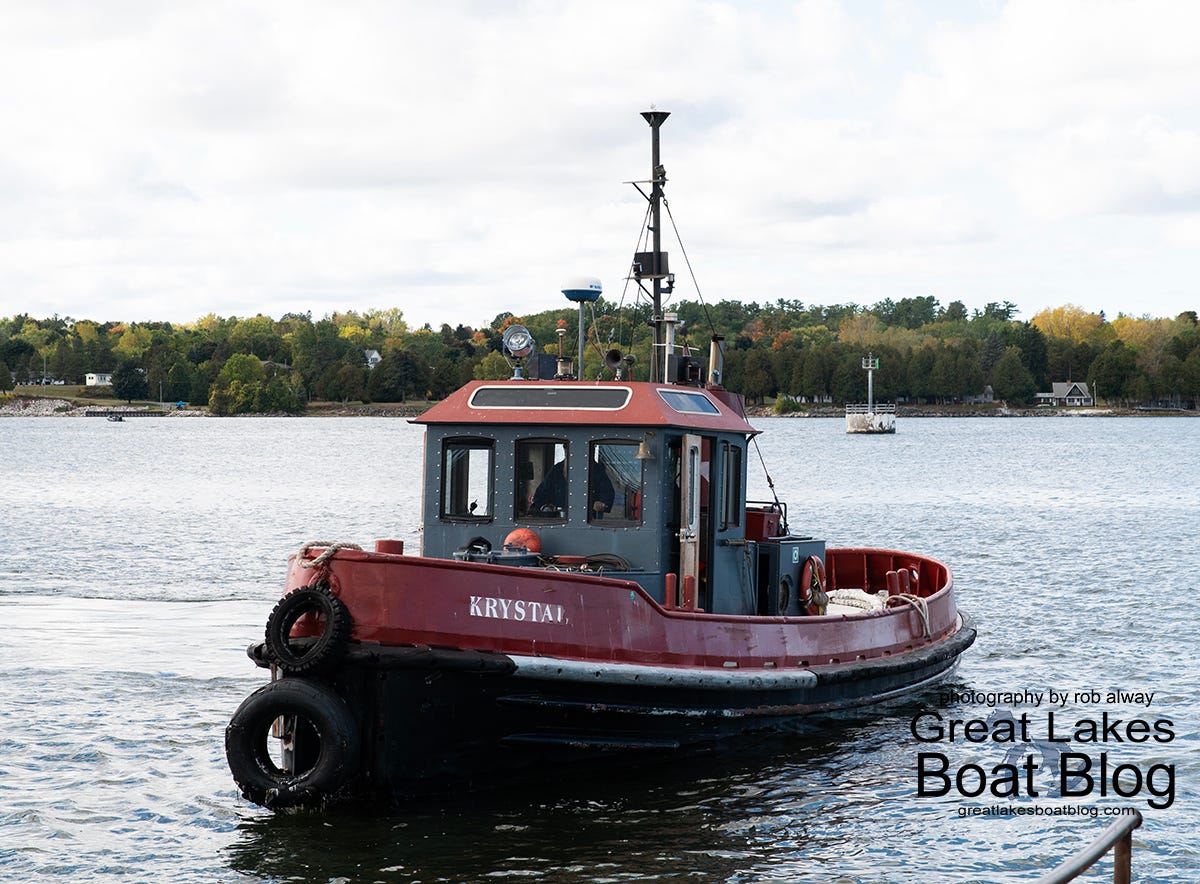
Krystal is considerably smaller than Nickelena and Erika Kobasic, but she, too, has a military past.
Built in 1954 by Roamer Boat Works in Holland, Michigan, as hull No. 22, the 45-foot tug entered service with the U.S. Army under the designation ST-2168. The initials ST identified her as a small tug, a practical vessel designed to move barges and other equipment in harbors and sheltered waterways.
In 1962, she was transferred to the U.S. Army Corps of Engineers and renamed Thunder Bay. This second phase of her government career connected the tug with the Corps, whose work on the Great Lakes includes navigation infrastructure, dredging and harbor maintenance.
Basic Marine acquired Thunder Bay in 2002 and renamed her Krystal. The company’s published fleet specifications list her at 45 feet long, with a beam of 13 feet and 310 horsepower. Vessel records identify her as a single-screw, steel-hulled tug.
Her history provides another link between military and civilian maritime work. While the larger vessels handle heavy towing and icebreaking assignments, a smaller tug such as Krystal has practical advantages for maneuvering in restricted spaces, assisting around docks and moving equipment in a shipyard setting.
Escort: A survivor of Peterson Builders
Escort followed a different path into the Escanaba fleet. Rather than being built for military service, she was constructed in 1954 by Peterson Builders Inc. of Sturgeon Bay, Wisconsin, for the shipyard’s own use.
The yard traced its origins to Peterson Boat Works, founded by Martin Peterson in 1907. After a fire in 1918, the enterprise was revived in 1933 by his son, Fred. It became Peterson Builders after World War II and grew into an important constructor of specialized military vessels, including submarine chasers, minesweepers and other Navy craft.
Escort‘s original assignment was the close-quarters work of a shipyard tug, helping move vessels around the company’s waterfront. She was built to work where the yard’s employees launched, repaired and outfitted larger craft, and where there was little room for error in an awkward maneuver.
In 1996, the tug was sold to Basic Marine in Escanaba, retaining the name Escort. Peterson Builders closed in 1998, making the tug a surviving working link to the former Sturgeon Bay shipbuilder.
Basic Towing’s current specifications list Escort at 47 feet long, with a 14-foot beam and 300 horsepower. Her duties have included yard work at Escanaba and ship assistance in Sturgeon Bay.
Although she never served in the military herself, Escort spent her early years in the orbit of a shipyard that contributed substantially to American naval construction. That connection gives the smallest-scale work of the fleet its own place in Great Lakes history.
Four working tugs, one Great Lakes operation
The tugs’ different sizes and capabilities give Basic Towing flexibility. A heavy tow across open water calls for different equipment than a vessel movement inside a shipyard or a short maneuver along a crowded dock. Ice adds another layer of difficulty when a tug must open a route or guide a larger ship through restricted water.
In the summer of 2025, Nickelena and Erika Kobasic worked together on an assignment with a particularly strong historical connection. The two tugs moved the museum submarine Cobia (SS-245) from the Wisconsin Maritime Museum in Manitowoc, Wisconsin, to Fincantieri Bay Shipbuilding in Sturgeon Bay for dry-dock maintenance. The tow brought together three vessels with histories rooted in American military service.
Another historical tug took place in July 2026 when the Nickelena and Erika Kobasic towed the USS Silversides (SS-236) museum ship from its berth along the Muskegon, Michigan channel also to the Sturgeon Bay shipyard for dry-dock maintenance. The tugs returned the historic submarine on Oct. 31, 2026.
Basic Towing has also documented work assisting commercial vessels into and out of dry docks at Sturgeon Bay, and ship movements at Fincantieri Marinette Marine. In 2026, the company reported continuing work at both shipyards, including assistance with Navy vessels at Marinette.
Much of this work happens outside public view. The crew of a tug may spend hours preparing for a maneuver that lasts only minutes. Successful ship assistance requires an understanding of wind, current, hull movement, towline forces and the available room between a vessel and the structures around it.
In Escanaba, the towing fleet works alongside North Shore Marine Terminal’s dock facilities and marine construction operations. That combination of tugboats, barges, repair capabilities and cargo-handling equipment allows the companies to take on varied assignments beyond routine harbor towing.
Working vessels with long memories
Great Lakes shipping is commonly identified with its bulk carriers, carferries and passenger vessels. But tugs make much of that traffic possible, guiding ships through tight harbor spaces, supporting construction projects and helping keep ports open through winter.
Basic Towing’s four tugs embody different chapters of that history. Erika Kobasic began her service before World War II and worked the North Atlantic as a Coast Guard cutter. Nickelena was built for the Navy, then served two other federal agencies before entering commercial towing. Krystal started as an Army small tug and later worked for the Corps of Engineers. Escort helped sustain operations at a major Wisconsin shipyard that no longer exists.
All four continue a tradition of practical waterfront work from their home port at Escanaba. Their stories demonstrate how a tugboat can outlast changes in ownership, purpose and even the industries that first put her to work.
Sources: North Shore Marine Terminal & Logistics and Basic Towing Inc. fleet listings and 2024-2026 project updates; U.S. Coast Guard Historian’s Office, Arundel (1939); NavSource Naval History, Chetek (YTB-827); Tugboat Information vessel histories for Nickelena, Erika Kobasic, Krystal and Escort; Great Lakes Tugs & Workboats; ShipbuildingHistory.com, Peterson Builders; Mason County Press.