


By Rob Alway
Masters of the Ludington Steamers — Stories of Ludington’s Cross-Lake Rail Fleet Captains and Other Port Mariners
The later life of “Sockless Jerry” Simpson
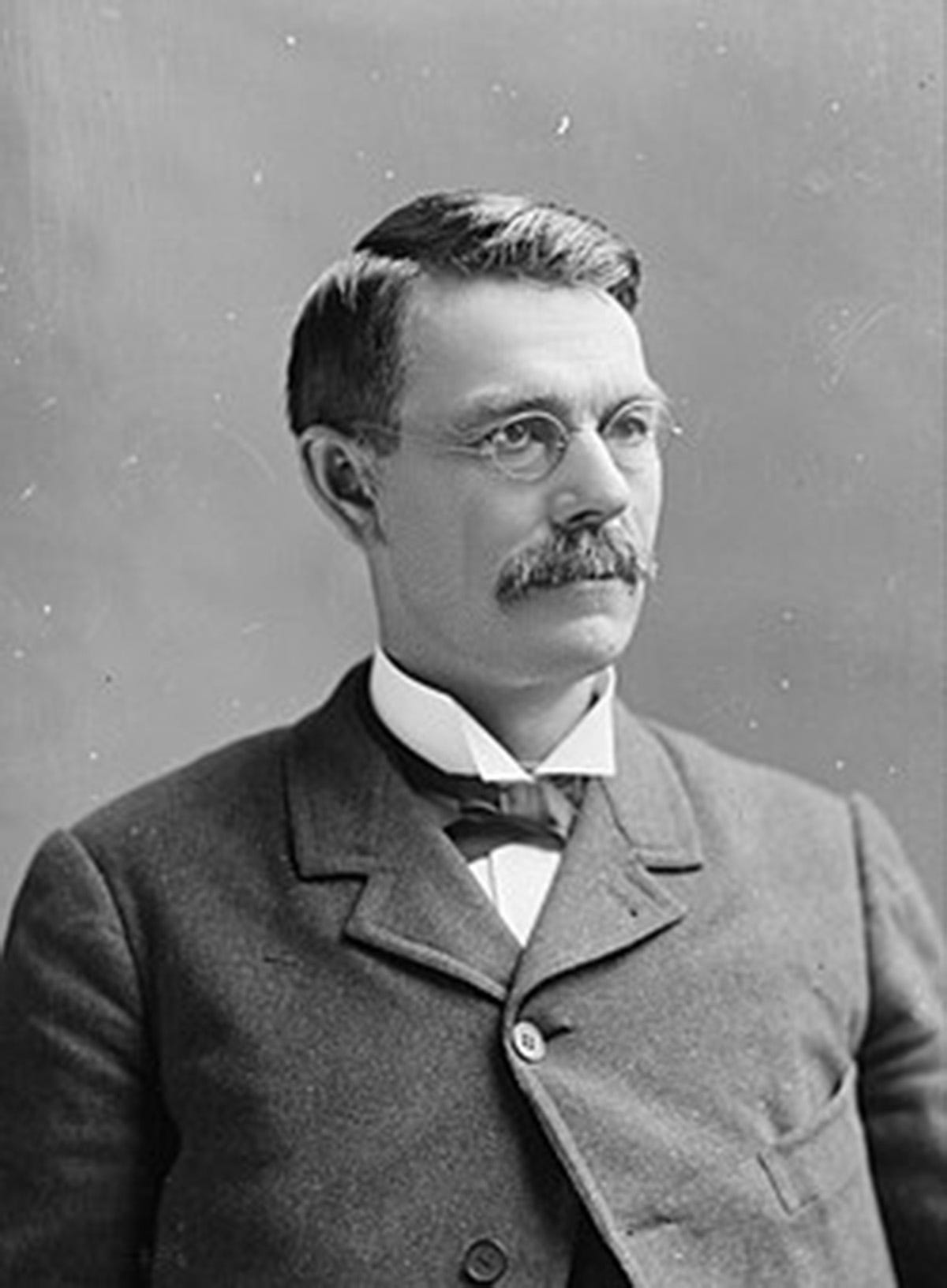
The Rutter disaster had a surprising afterlife through the career of her master, Jerry Simpson. He had been born on March 31, 1842, on Prince Edward Island, Canada, according to his congressional biography, and went to sea at fourteen. He spent more than two decades working on the Great Lakes and also served briefly in the Twelfth Illinois Volunteer Infantry during the Civil War. Simpson’s dates and early career appear in the U.S. House of Representatives’ History, Art & Archives biography, supplemented by files in the Rose Hawley Archives.
Simpson left lake navigation around the time of the Rutter incident and settled in Kansas. Farming and ranching proved uncertain pursuits, and he became involved in the agrarian protest movements that challenged established political and economic power in the late nineteenth century. He campaigned as a Populist, arguing that farmers and working people deserved a larger voice in government. His opponents ridiculed his supposed lack of proper hosiery, and he came to be known nationally as “Sockless Jerry.” He turned the epithet into part of his political identity. The Kansas Historical Society’s account of Populism explains the political movement. Rose Hawley’s research typescript preserves later recollections from Holiday magazine and Walter Havighurst’s The Long Ships Passing, which should be read as retrospective accounts.
He served three terms in the United States House of Representatives, from 1891 to 1895 and again from 1897 to 1899. In the halls of Congress and Washington hotels, historical writers recalled, Simpson told the story of his near-disaster off Ludington, Michigan. Local authors later drew attention to the irony: a master whose vessel had been saved through the work of a federal tug had become a congressional critic of entrenched power and an advocate for ordinary people. It would be too simple to attribute his political views to the shipwreck, but it is clear that he never entirely left his maritime past behind. Simpson died at Wichita, Kansas, on October 23, 1905. His congressional service is recorded by the U.S. House of Representatives; the 1907 Ludington Chronicle and Rose Hawley’s research notes preserve accounts of his retelling of the wreck.
The survivor stories also continued among Ludington families. Andrew Newberg’s experience was recalled by descendants, and the names of men who had stood in the shrouds were carried forward in newspaper anniversaries. The historical record preserves only a partial roster, but the endurance of family recollections is itself evidence of how deeply the event entered local memory. The men’s ordeal was not abstract heroism. They had been invited to perform a practical job, worked in a dark, moving hold, and unexpectedly found themselves suspended in the rigging of a sinking vessel, hoping that someone would reach them before the storm did.
The schooner that survived the wreck
The J. H. Rutter‘s own career did not end at Ludington. With the gale over, salvors brought pumping equipment to the stranded vessel. Damaged grain was removed, the hull was freed from the beach, and the schooner was repaired and given a new rudder. She returned to service in the spring of 1879. What appeared on November 1 to be a complete marine disaster became, for the vessel herself, an expensive interruption in a much longer working life. The salvage and return to service are traced in Sterling Berry’s Great Lakes Vessel History and the 1907 Ludington Chronicle retrospective, with additional archival reports preserved by Rose Hawley.
Her ownership changed during 1879. She passed first to L. Ellsworth of Milwaukee, Wisconsin, then to Thomas Adams and Jesse H. Farwell of Detroit, Michigan. Her later history included further incidents, including a grounding near DeTour, Michigan, in October 1883 while under tow by the steam barge Farwell during a southeast gale. Her towline reportedly broke. Such accidents were common risks for large sailing barges working in the rough and sometimes confined waters of the Great Lakes. The Rutter nevertheless continued in the grain and bulk trade for years. Sterling Berry’s Great Lakes Vessel History and the original Kendrick manuscript document the later ownership and the 1883 DeTour grounding.
In 1898 she was sold to the Atlantic Transportation Company and removed from Great Lakes service. Her lake enrollment was surrendered at Ogdensburg, New York, on October 18, 1898. She continued as a cargo barge along the Atlantic coast, associated with the coal trade. Four decades after her dramatic grounding off Ludington, the Rutter finally sank on October 23, 1918, following a collision with the steamer Texan in New York Harbor. That loss occurred only weeks after Kendrick’s death, a striking coincidence in the long history of the schooner and the man who had once risked his life to rescue those aboard her. Sterling Berry’s Great Lakes Vessel History documents the 1898 departure from the lakes, the surrendered enrollment and the 1918 collision in New York Harbor.
A rudder on the Epworth shore
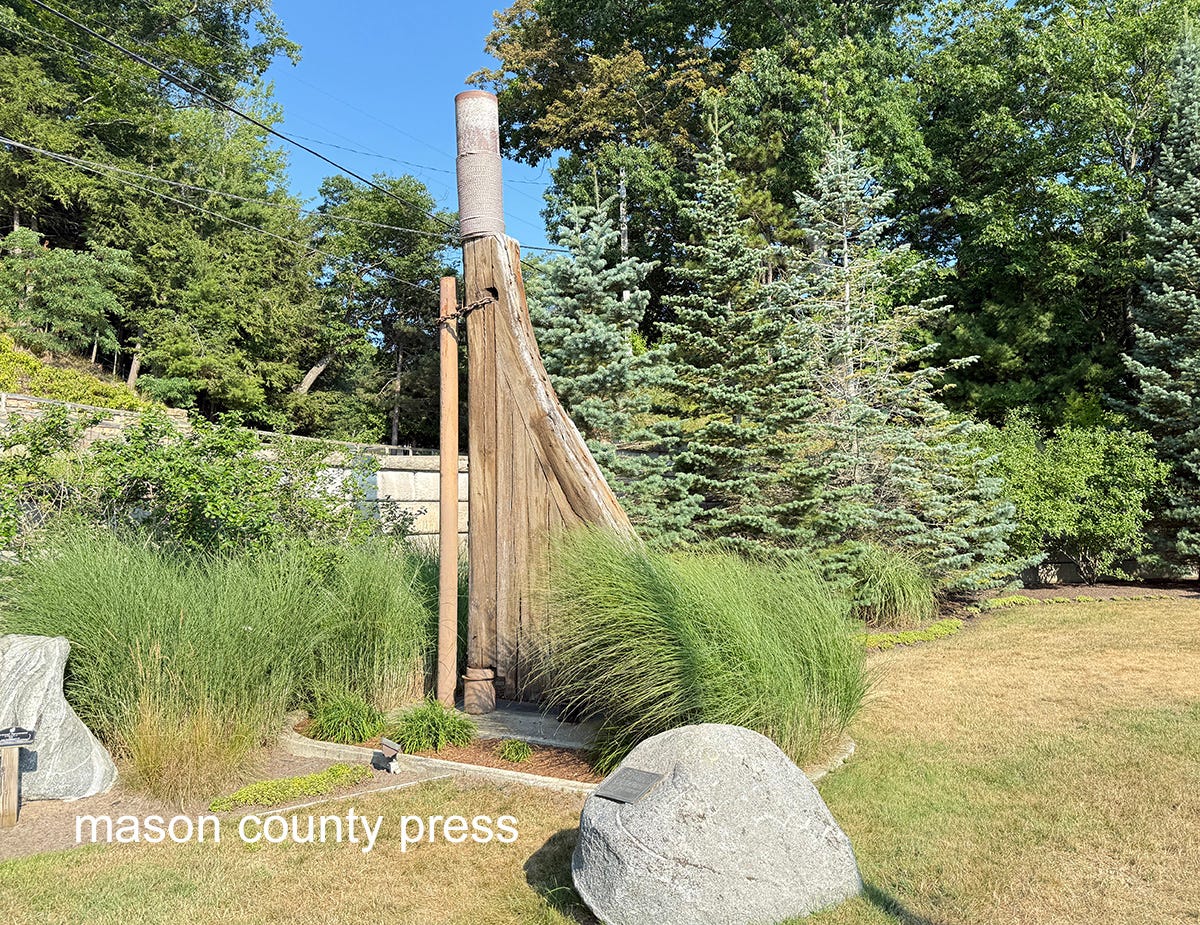
More than a century after the Rutter lost her rudder near Big Sable Point, an old wooden rudder was discovered on the Lake Michigan beach at Epworth Heights, a resort community north of Ludington. The artifact came ashore in the spring of 1989 and was placed on public display near Lincoln and Epworth avenues. A bronze tablet dated June 8, 1991, describes it as a relic of Great Lakes maritime history and states that it was believed to have originated from a nineteenth-century schooner, possibly of the 1860s. It does not identify the vessel by name. The artifact and plaque, titled “A Treasure from the Past” and dated June 8, 1991, are documented in photographs supplied with the original Kendrick research.
The coincidence has invited an attractive possibility: could the rudder have been the very one lost by the J. H. Rutter in 1878? The schooner’s loss of steering gear is well documented, and a rudder recovered from the same broad section of coast naturally attracts attention. But the plaque itself makes no such attribution, and the surviving evidence does not provide a proven chain of identification. The plaque and the original Kendrick manuscript raise the possibility but do not establish that the recovered rudder belonged to the Rutter.
The question became the subject of a 2024 book by Richard C. “Dick” Newberg and his son Richard A. “Andy” Newberg, Do You Have the Rutter’s Rudder? Their interest was more than antiquarian. Dick Newberg’s great-grandfather, Andrew Newberg, had been among the men who boarded the schooner and endured the gale in her rigging. The family’s book brought together documentary research, remembered stories, and the continuing question posed by the Epworth artifact. It is another example of how the rescue continues to engage descendants and maritime historians rather than remaining a forgotten paragraph in a government report. The account of the book and the family connection comes from Richard C. Newberg and Richard A. Newberg’s Do You Have the Rutter’s Rudder? (2024), the original Kendrick manuscript and related Rose Hawley Archives clippings.

The measure of the man
Frederick Kendrick did not command a grand passenger steamer or one of the rail carferries that later made Ludington famous. He was a government tug captain, working with the practical vessels that maintained navigable harbors and made commercial transportation possible. For that reason, his place among the masters and other mariners of the Ludington steamers is especially instructive. Maritime history is not confined to the largest vessels or the most recognizable company flags. It includes the government boats, harbor tugs, lifesaving surfboats, scows, engineers, fishermen, and shore workers whose combined efforts sustained a port.
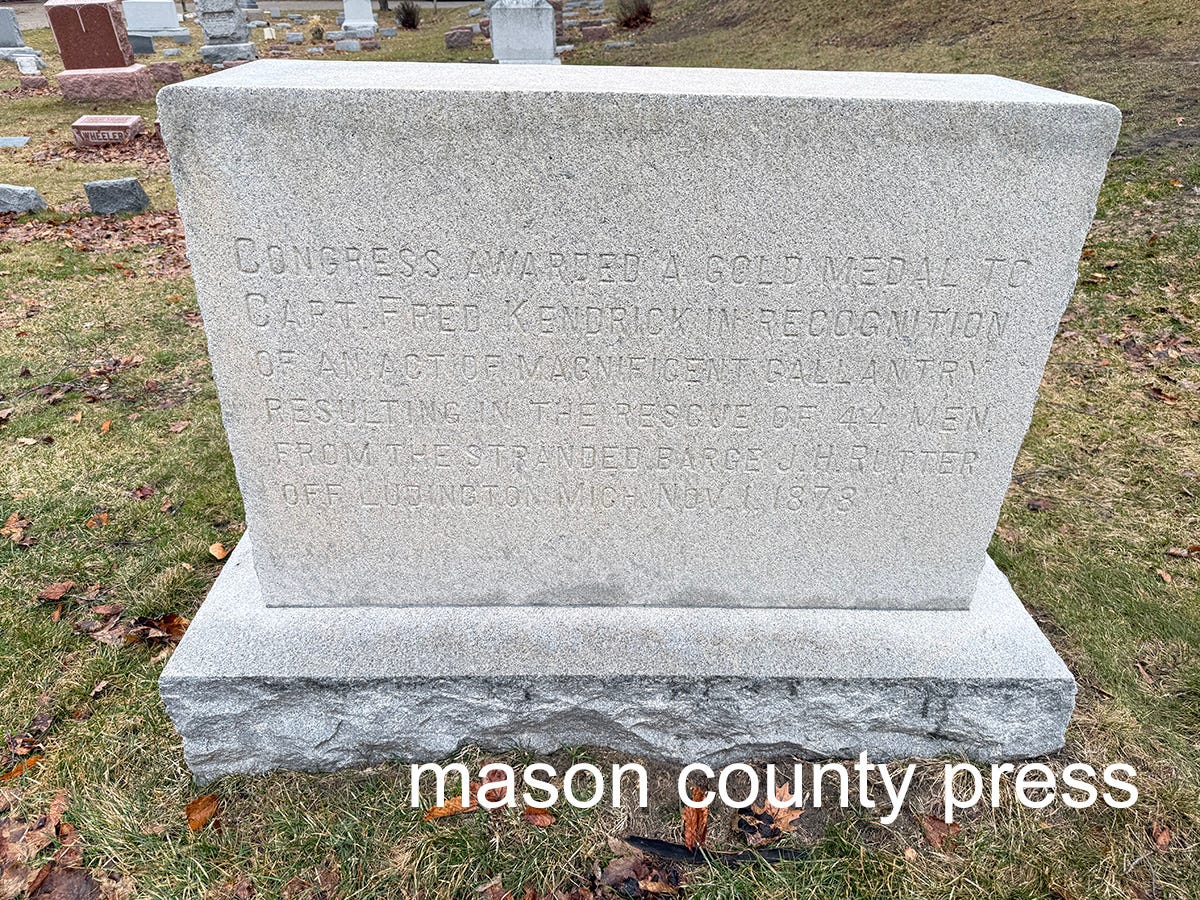
The rescue of the J. H. Rutter joined all of those people in a single day’s work. The Big Sable Point crew had first responded to the distressed schooner. Caswell and the Margaret, together with the De Pere, had helped bring her toward Ludington. Local men volunteered to move her grain and became trapped when the storm returned. Lifesavers struggled through breakers and fired lines until their equipment could do no more. The crew of the Colonel Graham took a small, shallow-draft tug out repeatedly in circumstances that could have destroyed her. Kendrick then made the final decision that brought the remaining men off the wreck.