

By Rob Alway
Masters of the Ludington Steamers — Stories of Ludington’s Cross-Lake Rail Fleet Captains and Other Port Mariners
The Gold Lifesaving Medal
The recognition that followed was national. The United States lifesaving award register records the date of Kendrick’s service as November 1, 1878. His application and supporting affidavits were received April 23, 1879; the register shows an award date of May 13, 1879, and identifies the medal as first class. The gold medal was a federal civilian honor for extraordinary courage in rescuing persons from danger on the water, distinct from the military Medal of Honor. It reflected a judgment that the effort at Ludington, Michigan, had gone far beyond the ordinary call of duty. The original federal lifesaving medal register shows the April 23 application, the May 13 award and the medal order of May 24, 1879; the U.S. Coast Guard Historian’s Office outlines the award’s history.
The older account quoted in the 1981 booklet called the award the highest honor available under the law, yet insisted that the medal could provide only a limited measure of the credit that Kendrick’s deed deserved. The rhetoric is characteristic of nineteenth-century descriptions of gallantry, but the central fact remains compelling: a comparatively small government tug took risks that larger boats could not undertake, and its captain brought all the remaining men off the wreck.
Kendrick was not alone aboard the Graham. Her engineer, James Cummings, had to maintain steam and keep the machinery responsive throughout the struggle. In a propeller tug of that era, loss of power in a breaking sea could be fatal. The engineer’s contribution was remembered in the historical accounts, although those accounts differ on the precise class and date of the medal he received. A 1907 retrospective calls it a second-class medal; later reporting in the local press discusses additional recognition obtained decades after the event. The 1907 Ludington Chronicle retrospective and later local newspaper material in the Rose Hawley Archives differ on the class and date of Cummings’ recognition, leaving that question open.
The wider party also included the Big Sable Point lifesavers, who had first boarded the damaged schooner and then returned through dangerous surf when she grounded; Caswell and the crew of the Margaret; those who had assisted in the original tow aboard the De Pere; and shore volunteers who helped launch boats, carry apparatus, and operate the scow. Later accounts particularly remember local tugmasters and fishermen who placed themselves in danger during the rescue. Kendrick rightly occupies the center of the story because of his final decision and leadership. The rescue, however, belongs as well to Ludington’s entire maritime community.
The Kendrick household and the Conrad connection
Kendrick’s life beyond the rescue can be reconstructed in part from Michigan marriage records, the Tri-Cities Historical Society account, and the obituary of his wife. On December 25, 1880, he married Emma J. Conrad in Amber Township, Mason County, Michigan, a community located east of Ludington. Emma was born May 6, 1860, in Trenton, Michigan, and later attended Ludington High School. The marriage joined a government tug captain to a family connected with the future of the local waterfront. The marriage is recorded in Mason County, Michigan, marriage returns dated Dec. 25, 1880, corroborated by the Tri-Cities Historical Society booklet.
Emma was a sister of James B. Conrad, a marine engineer whose family would remain closely associated with the later Pere Marquette Railway carferries. James’s son, Charles Conrad, became a central figure in the effort to revive Ludington’s cross-lake service after the ferries were laid up in 1990. The precise circumstances of that purchase developed over 1991 and 1992, including a bankruptcy proceeding; the operation resumed in 1992 as Lake Michigan Carferry Service. Through his marriage, Kendrick belonged to the same extended family that helped carry Ludington from the schooner-and-tug era into the final chapter of the railroad carferry era and beyond. The Conrad connection is documented in the original Kendrick research manuscript. The public histories of Lake Michigan Carferry Service and carferries.com describe the 1991–92 acquisition differently but agree that operations resumed in 1992.
Kendrick’s federal career later took him away from Ludington. He served at St. Joseph, Michigan, and then at Grand Haven, Michigan, where he had responsibility for government vessels wintering in the government pond. The Kendrick household was established at 106 Franklin Street in Grand Haven. The foreword to the 1981 memorial booklet states that the couple lived there until the captain’s death on September 1, 1918. Emma remained in Grand Haven, where she became active in civic affairs, particularly projects involving city parks and the reforestation of Duncan Park. She died July 29, 1942, and was buried with her husband in Lake Forest Cemetery. The Tri-Cities Historical Society booklet, Emma Kendrick’s obituary in the Grand Haven Tribune of July 30, 1942, and a Lake Forest Cemetery gravestone photograph support the family chronology.
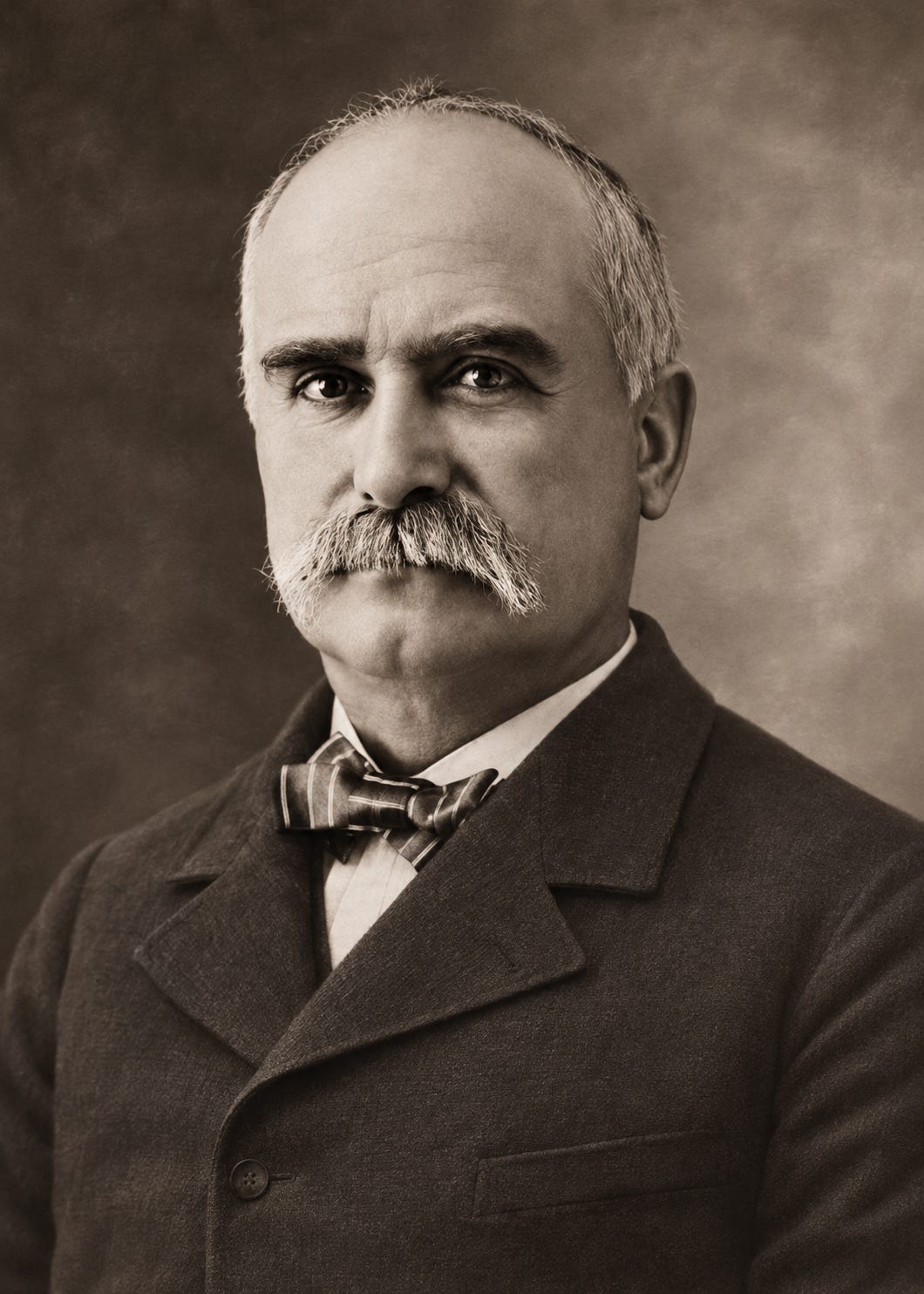
The couple’s family connection was later expressed in a tangible memorial. Charles F. Conrad and his wife, Elsie A. Conrad, gave the former Rock Island Railroad observation car Golden Vista to the city of Grand Haven in memory of their uncle, Frederick Kendrick. When the car was dedicated on September 5, 1981, the Tri-Cities Historical Society reprinted the old account of the Rutter rescue. It included a portrait of Kendrick, illustrations of the lifesaving medal, and a photograph of the stranded schooner. By that means an event from the working harbor of 1878 received renewed attention more than a century later. The dedication and the accompanying booklet are documented in the Tri-Cities Historical Society’s Sept. 5, 1981, foreword and its historical illustrations.
Rescues beyond the Rutter
The booklet records other acts of lifesaving associated with Kendrick. While he was still serving at Ludington, a boy fell into a log boom, and Kendrick pulled him from danger. At Grand Haven he reportedly dived into the water to save two boys who had fallen in and were clinging to submerged timbers. In one case, the child was said to be nearly unconscious when brought to safety. These accounts are brief and lack dates or full names, but they suggest that the Rutter episode was an extraordinary expression of a longer habit of acting when lives were in danger. These smaller rescues are recounted in the Tri-Cities Historical Society booklet, without enough identifying detail to reconstruct their dates.
Another story in the same booklet concerns the November 1883 storm near Saugatuck, Michigan, when the tug Protection, the schooner Arab, and the steamship H. C. Akeley became entangled in a chain of disasters. The booklet says Kendrick and the Graham rendered assistance to the St. Joseph lifesaving crew. The 1981 Tri-Cities Historical Society memorial account credits Kendrick with assistance in 1883 but does not supply a detailed movement log of his tug.
The Protection was towing the damaged schooner Arab after she had stranded near St. Joseph. The schooner had taken aboard pumps to combat serious leakage, but the storm overwhelmed her, and she sank during the crossing. A line fouled the tug’s propeller, disabling her. The steamship H. C. Akeley then came upon the helpless Protection and undertook a tow of her own. The larger steamer was heavily laden with grain and, as the storm intensified, lost her steering and suffered other serious damage. The tug was eventually cut loose. The Akeley foundered in the lake with fatalities among her crew, while the Protection drifted toward Saugatuck and grounded near the harbor. The Michigan Shipwreck Research Association’s account of the H. C. Akeley and contemporary reports from the Chicago Tribune and Inter Ocean, compiled by Chicagology, document the wreck sequence.
The Protection‘s surviving men were helped ashore during a snowstorm by lifesavers and residents. The Gold Lifesaving Medal booklet refers to Dan Miller and his brother, and to aid given by the lighthouse keeper, George Baker, and other local men. A later history of the event published by the United States Lighthouse Society and contemporary newspaper coverage identify the towed schooner as Arab. The 1981 Kendrick booklet calls her Argo and spells the larger steamer’s name Ackley; the contemporary and vessel-registration evidence favors Arab and H. C. Akeley. The United States Lighthouse Society’s history of the Protection wreck and the contemporary reports reproduced by Chicagology support the names Arab and H. C. Akeley over the variant spellings in the 1981 memorial booklet.
The H. C. Akeley, built at Grand Haven in 1881, measured about 230 feet in length. Her wreck was discovered off Saugatuck by the Michigan Shipwreck Research Association in 2001, lying in approximately 275 feet of water. The Protection was subsequently recovered, repaired, and returned to service. The intertwined histories of these vessels illustrate the perilous nature of towing and rescue in a late-season Lake Michigan gale. They also show the limits of historical reconstruction: Kendrick’s participation was remembered in a family or local commemorative account, but no surviving description examined here makes him the principal rescuer in the 1883 incident.
(To be continued…)