


By Rob Alway
Masters of the Ludington Steamers — Stories of Ludington’s Cross-Lake Rail Fleet Captains and Other Port Mariners
The beach becomes a rescue station
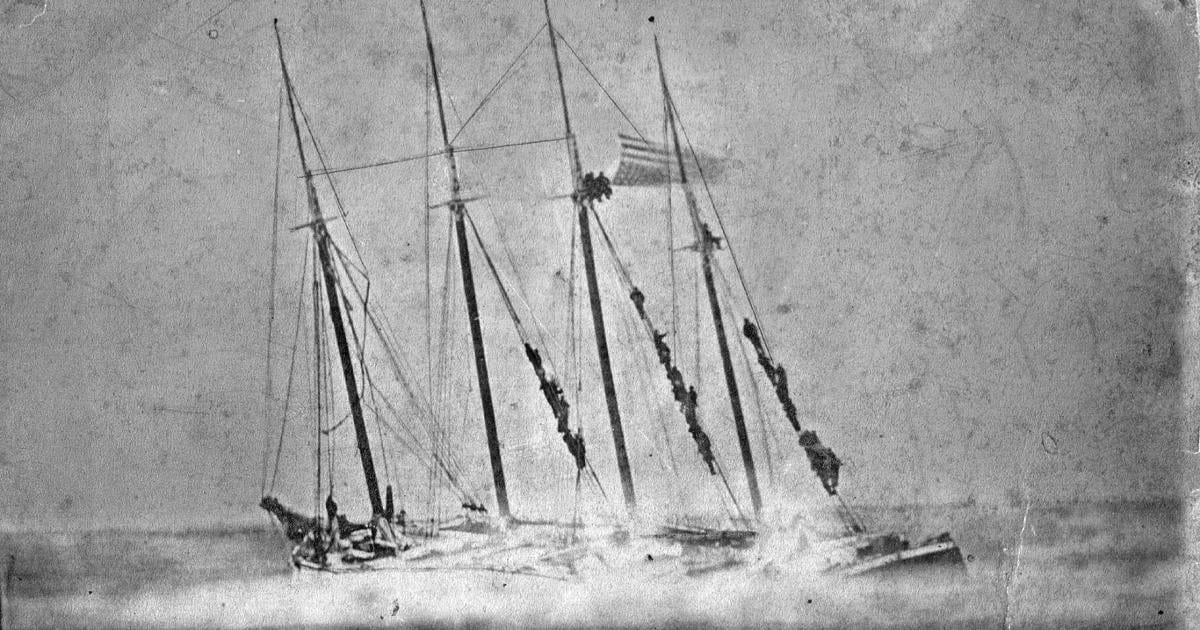
At dawn the plight of the Rutter was plain in Ludington, Michigan. People came from the town and gathered on the beach and piers. Some were relatives and friends of the laborers aboard. The crowd could see what was happening but could do nothing to interrupt the waves rolling across the stranded ship. The regular lifesaving station was miles away at Big Sable Point. Equipment and trained men had to be brought down the shoreline before a formal rescue operation could be attempted.
A local resident named Disciple Abair set out with a team of horses about seven o’clock in the morning to retrieve the lifesavers and their apparatus. The party reportedly reached the disaster scene shortly after nine. The operation required more than bringing an empty boat to the water. A surfboat, beach cart, line-throwing apparatus, ropes, and crews trained to use them all had to be transported over the rough ground and then worked from the exposed shore. The times and the part played by Abair are recounted in the 1951 Ludington Daily News retrospective and the 1907 Ludington Chronicle account.
The lifesavers repeatedly tried to launch their surfboat, but the breakers forced it back. Other attempts relied on a line-throwing gun, the short-barreled apparatus developed to cast a light line over a stranded vessel. Once such a line was secured, heavier equipment could be hauled aboard and the crew brought ashore by breeches buoy. The gold-medal account describes seven unsuccessful shots; later Ludington histories mention nine attempts. The gun, the distance, and the wind were a poor combination. A line that could be thrown across a wreck under favorable conditions was of little use when it fell short or was torn away by the sea. The seven-shot count comes from the account reprinted by the Tri-Cities Historical Society, while the 1951 Ludington Daily News gives a different count; the precise sequence cannot be established with certainty.
Commercial tugmasters also watched the situation. Capt. Amos Breinig and Capt. Louis Sterling Sr. were among those named in the recollections as wishing to help. Their tugs were too deep in the water to cross the harbor bar in that weather. Bringing a large tug out under such conditions might mean grounding her on the sand or smashing her against the piers before she reached the schooner. The rescue required the shallow-draft craft that belonged to the federal harbor operation.
Authorization and the Colonel Graham
The government tug’s availability did not mean that she could simply be commandeered. The documentary accounts state that Kendrick sought and received permission by telegraph to use the Colonel Graham for the rescue. In one later telling, the impatient local captains appear almost ready to take the tug out themselves; in another, Kendrick comes forward as a volunteer once the prospects for the stranded men have become desperate. These recollections are not identical, especially in their treatment of the time lost obtaining authority. Together they establish that permission was a factor, and that Kendrick subsequently accepted the danger when the attempt was made. The 1981 Tri-Cities Historical Society account and the 1951 Ludington Daily News retrospective agree on the need for approval, but present differing details of how Kendrick entered the effort.
The plan was unusual. Kendrick would tow a scow manned by volunteers, with the lifesaving surfboat behind it. The scow, a broad, relatively shallow craft often employed in harbor construction and freight work, could bring men and equipment near the wreck. The surfboat might then break free and attempt the final approach. This arrangement put three very different hulls on one tow in breaking seas: the government steam tug in front, a scow in the middle, and a surfboat astern. None had been designed to run as a convoy through that kind of water.
As the Graham cleared the piers, the line of boats began pitching and yawing in the heavy surf. A contemporary account, preserved in a booklet later republished by the Tri-Cities Historical Society, recalled that the three craft disappeared at times between the waves. For more than an hour Kendrick fought to keep his tug moving toward the stranded ship. Eventually he gained enough position for the surfboat to cast off and push toward the Rutter. The boat reached the wreck and took off eight men, then made her way to shore in water that rose nearly to the gunwales. Kendrick brought his tug and the scow back into the harbor. The tow and first successful surfboat trip appear in the Tri-Cities Historical Society booklet and the Ludington Daily News‘ 1948 retrospective of the rescue.
The recovery of eight men was a significant achievement, but it sharpened the problem. Thirty-six remained. The surfboat attempted to go out again under her own power and was beaten back. Kendrick therefore took her in tow once more. It was not a single reckless dash and a quick success; the attempt was prolonged, and the little harbor tug was repeatedly battered by waves that could throw her off course or extinguish any hope of completing the mission. To the people watching from shore, each return toward the wreck represented both a fresh chance of rescue and the possibility that the rescuers would join the victims.
On the second attempt the surfboat reached a position from which a line could be passed to the men in the rigging and secured. The line was then carried to shore. This offered the possibility of arranging a breeches-buoy rescue: the equipment could be rigged, and the survivors hauled one at a time from the wreck to the beach. Such a method was laborious but usually safer than placing a steamer directly beside a stranded hull in heavy breakers. Its drawback was time. In the late afternoon, with dozens of people still to remove, the operation risked running into darkness, when the changing wind, shifting lines, and exhaustion of those aboard the schooner would only increase the danger. The Tri-Cities Historical Society booklet and the 1948 Ludington Daily News retrospective recount the line carried ashore and the threatened delay.
Alongside the wreck
Kendrick chose not to wait for the breeches buoy to accomplish a slow rescue. He would try to take the Colonel Graham itself alongside the Rutter. The decision exposed his vessel, engineer, deck crew, and any volunteers aboard her to the same forces that had already disabled the schooner. Even if he gained the lee of the wreck, the tug might be thrown against the great wooden hull or carried into the shallows. If she lost power, she might founder. If the men rushed to board at once, they might overturn the balance of the operation.
The tug advanced into the broken water. The account preserved in the Kendrick medal booklet describes her staggering and being thrust aside by the seas, then recovering her heading and working onward. The crowd on the shore could follow the little vessel’s course as she approached the visible masts of the schooner. There was no practical way for those ashore to assist Kendrick now. At the crucial moment his task was one of seamanship: judge the movement of the seas, keep sufficient way upon his vessel, find shelter in the schooner’s lee, and bring the tug near enough to secure a line without being crushed. This description follows the dramatic contemporary account reprinted by the Tri-Cities Historical Society; it records an observer’s impression rather than Kendrick’s private thoughts.
He succeeded. The Colonel Graham gained the lee of the schooner and made fast. The men who had waited all night in the shrouds climbed down. Some were nearly exhausted; all had been chilled and drenched. They were taken aboard the tug in sequence until the remaining thirty-six were safe. Kendrick’s short whistle signaled the achievement to those who could only watch from shore. The crowd answered with cheering. The tug steamed back through the piers and reached the dock before darkness, where the survivors were rushed to dry clothing, warmth, food, and attention. The Tri-Cities Historical Society booklet and the 1907 Ludington Chronicle retrospective describe the final transfer and the jubilant signal.
The day had ended without a single death among the forty-four people rescued from the Rutter. Their survival was not merely fortunate weather. It was the result of the surfmen’s repeated efforts, the courage of the volunteers, the use of a shallow-draft government tug, and Kendrick’s willingness to assume responsibility for a dangerous final maneuver. The city recognized the exceptional character of the feat at once. A public meeting was held at Temperance Hall that evening to honor the rescuers and help care for the men who had been taken from the wreck.
(To be continued...)