


By Rob Alway
Masters of the Ludington Steamers — Stories of Ludington’s Cross-Lake Rail Fleet Captains and Other Port Mariners
The Margaret, Capt. Robert Caswell, and the De Pere
Among the working tugboats at Ludington, Michigan, was the Margaret, a vessel whose name appears in accounts of harbor operations and in an unrelated federal admiralty case from the same shipping season. The tug was ordinarily under Capt. John Crawford Sr., but on the day of the Rutter operation Capt. Robert Caswell was in command. Caswell was a familiar figure on the port’s waterfront, where commercial towing required both seamanship and a detailed understanding of the harbor’s shallows, currents, and approaches. The 1907 Ludington Chronicle retrospective and the original Kendrick manuscript identify Caswell and the Margaret in this operation.
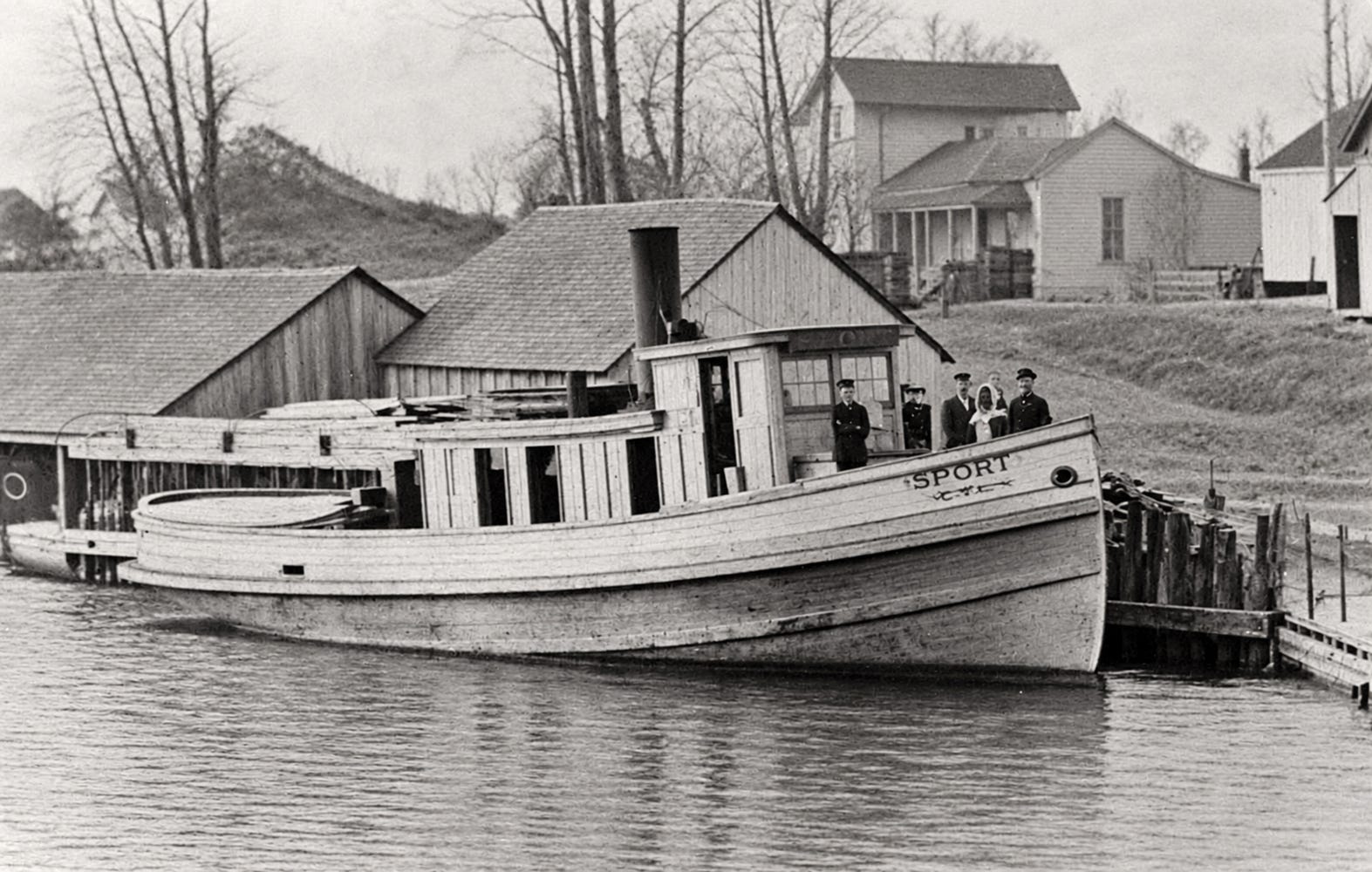
Caswell had been born in Canada in 1834 and became associated with the lumber and marine trades before establishing himself at Ludington. His tug interests, sometimes shared with other businessmen, included the Cyclone, the B. W. Aldrich, and the Sport. The vessels served a practical, profitable, and sometimes dangerous business: towing schooners and barges to and from the mills and docks. Caswell lived on North Ferry Street and remained closely identified with the maritime life of the city until his death in 1889. His experience helps explain why the Margaret was one of the first craft called upon to assist Simpson. The Caswell biographical material comes from the original Kendrick manuscript and maritime files in the Rose Hawley Archives; precise tug ownership shares and registration years would require further examination of enrollment records.
An admiralty decision published in 1880 provides a particularly useful glimpse of the Margaret‘s work. In Stretch v. Tug Margaret, the United States District Court examined an accident on June 20, 1878, in which the tug brought the schooner Mary toward Ludington’s piers. The schooner carried too much sail during the approach, went out of control, and suffered damage. The court declined to hold the tug responsible, emphasizing the continuing duty of the master of a tow to handle his own vessel properly. The case concerned a different incident, but it confirms that the Margaret was regularly negotiating the Ludington harbor entrance months before the Rutter disaster. The published federal decision, Stretch v. Tug Margaret, 2 F. 255, dated April 8, 1880, concerns the Mary accident, not the Rutter.
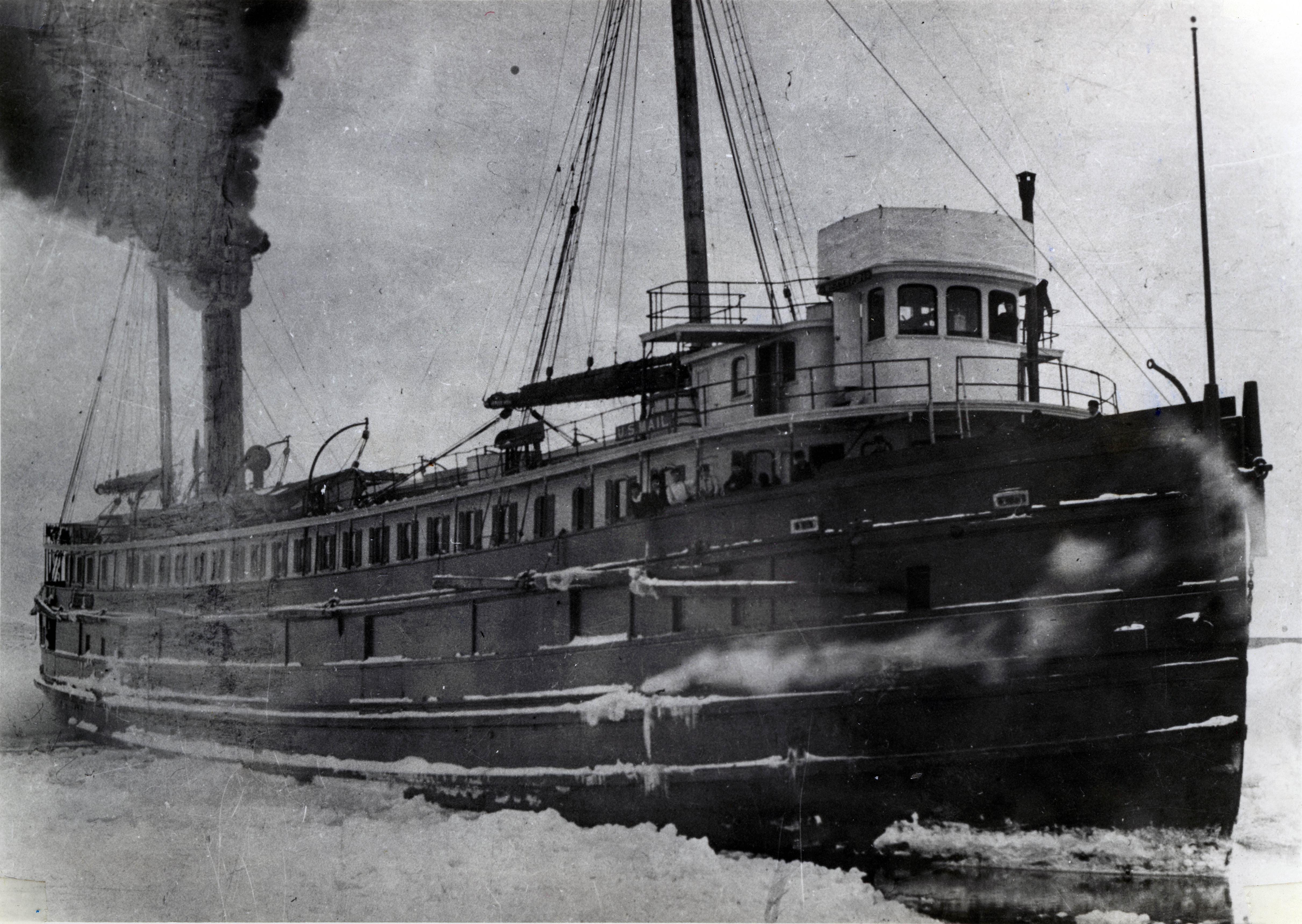
The Margaret reached the disabled Rutter, but Caswell reportedly lacked enough fuel aboard to tow so large a vessel all the way from Big Sable Point to Ludington. A second steamer came to their assistance: the Goodrich Transportation Company’s De Pere. Built by Rand & Burger at Manitowoc, Wisconsin, the wooden passenger-and-freight propeller had been launched on May 13, 1873. She was approximately 165 feet long and 29 feet in beam, much larger than an ordinary harbor tug and powerful enough to undertake the difficult tow. The Goodrich vessel was a passenger steamer rather than a harbor tug; in this emergency her propulsion and size were used for a task far outside an ordinary passenger call. The Wisconsin Marine Historical Society’s account of the De Pere‘s launching at Manitowoc, published May 13, 2025, supplies details of the Goodrich vessel, alongside the Tri-Cities Historical Society rescue account.
The two steam vessels and the lifesavers worked with the Rutter as the tow made the difficult passage toward Ludington. The schooner was without steering and continued to list, yet she eventually reached an anchorage approximately a mile north of the harbor entrance, near the shoreline now occupied by the north end of Stearns Park. Later accounts place the site near the Ludington waterworks and Tinkham Avenue. It was an exposed roadstead, not a protected inner-harbor berth. Simpson had gained the opportunity to correct his cargo, but he had not yet saved the ship. The location is approximate, as described in a 1951 Ludington Daily News retrospective and in the original Kendrick manuscript, which cites another local account from 1954.
The De Pere continued in the Goodrich service for years after the Rutter incident, survived a severe grounding near Two Rivers, Wisconsin, in December 1882, and was later sold to Stephen B. Grummond. Renamed State of Michigan, she passed into other passenger and package-freight service before sinking off White Lake, near Montague, Michigan, on October 18, 1901, after mechanical failure damaged her hull. Her wreck was subsequently located in approximately sixty-five feet of water. Thus one of the steamers that helped save the Rutter would ultimately become a Great Lakes shipwreck herself. The Michigan Shipwreck Research Association’s history of the State of Michigan and the Wisconsin Marine Historical Society’s account of the De Pere support this outline, although they differ on some details of her origins, machinery and ownership changes.
A dollar an hour to save the grain
Simpson now needed laborers. His vessel was carrying tens of thousands of bushels of bulk grain, and the work of shifting it by shovel was strenuous even in a sound ship at a dock. On an unsteady schooner lying offshore, it was hazardous. The captain sent word into Ludington asking for help and offering a dollar an hour. Forty local men, according to the October 30, 1907, account in The Ludington Chronicle, volunteered and were taken out aboard the Margaret. The offer and the reported number of volunteers are described in the Oct. 30, 1907, Ludington Chronicle retrospective and the 1981 Tri-Cities Historical Society booklet.
The retrospective names several of them: Sam Beaton, John Anderson, John Brockhaus, George Orrey, George Tracy, Frank Mero, Thomas Yule, James Clark, Andrew Newberg, George Harbaugh, John Hounsell Sr., and John Hounsell Jr. Many others were identified only as members of the party, their names lost to the published record. They were not professional shipwreck salvors hired for a carefully planned operation. They were local workingmen who saw an opportunity to help a vessel and earn money for what they expected would be a manageable piece of labor. Their names deserve preservation alongside those of the captains, because the human consequences of the storm would fall upon them as heavily as upon the ship’s crew. The names appear in the 1907 Ludington Chronicle anniversary article, with additional recollections printed by the Ludington Daily News in 1951.
There is a discrepancy in the historical counting. The 1907 newspaper account describes forty shore laborers who joined four shipmen in the work, making forty-four people in danger. The older lifesaving account reprinted in 1981 describes thirty-six grain trimmers and later says that eight people were removed in the surfboat and thirty-six delivered in the tug. The distinction may reflect inconsistent counting of workers, sailors, or rescue parties. It cannot be resolved securely from the available sources. What is beyond meaningful dispute is the total rescued from the wreck: forty-four persons, eight in the first boatload and thirty-six when the Colonel Graham reached the vessel directly. The two contemporary and commemorative accounts behind these figures are the 1907 Ludington Chronicle report and the Tri-Cities Historical Society’s 1981 reprint.
For hours the men worked in the hold and between decks, moving grain to counter the list. Their exertions apparently improved the Rutter‘s condition. But the weather that had spared them briefly returned. At about eleven o’clock that night, wind and seas rose again, and the Margaret could no longer lie safely near the big schooner. The two vessels strained against the towline until it parted. Caswell withdrew toward the piers. Before leaving, he and Simpson reportedly agreed that a lantern would be hung in the forward rigging if assistance became urgently necessary. This simple arrangement depended upon the light being visible from the harbor and upon a tug being able to respond. Neither condition would hold. The 1907 Ludington Chronicle and the 1951 Ludington Daily News retrospectives describe the renewed gale and the agreement over the signal lantern.
The night the schooner settled
After the Margaret left, the shore laborers and ship’s crew continued moving grain. In the early hours of November 1, a hatch cover over the after portion of the vessel was washed away. Water poured into the hold. A warning brought Simpson from his cabin, and the captain reportedly found thirteen feet of water below. The vessel’s pumps could not cope with the flooding. With a heavy southwest gale driving the schooner toward shore, the work of saving the cargo was abruptly transformed into an effort to save human lives. The 1907 Ludington Chronicle account and the Tri-Cities Historical Society booklet document the flooding and the shift from salvage to rescue.
Simpson ordered the anchors slipped, allowing the Rutter to settle in shallower water rather than sink where the men might have no refuge at all. According to the 1907 account, Andrew Newberg, John Hounsell, and an unidentified sailor went forward over the slippery deck to free the anchor. Every wave swept over the exposed planking. The vessel, now driven toward the harbor bar, grounded in about eighteen feet of water. The deck became untenable. The men climbed into the rigging and moved as high as they could to escape the seas.
The last usable lantern was hoisted as the agreed signal for assistance. Other lamps aboard had reportedly been broken during the vessel’s earlier rolling. The lantern’s weak flame could not penetrate the storm and darkness to the Margaret near the harbor entrance. All that remained was to wait. Men who had left their homes the previous evening for a dollar an hour now clung to rope and timber, drenched by spray, with the knowledge that the ship was beneath them and the lake might take them before daybreak. The 1907 Ludington Chronicle and 1951 Ludington Daily News accounts describe the failed signal and the men’s night in the rigging.
The Rutter‘s broad hull was largely lost to sight in the waves. Her masts, shrouds, and the dark figures hanging in them were all that the shore would see the next morning. Photographs reproduced in later newspaper accounts show the stranded schooner with men positioned along her rigging, and the American flag inverted as a distress signal. The surviving images give the incident a vividness seldom available for a nineteenth-century rescue. The photograph appeared in the Oct. 30, 1907, Ludington Chronicle; copies and captions are also preserved at the Mason County Historical Society’s Rose Hawley Archives and its Port of Ludington Maritime Museum.
(To be continued…)