

By Rob Alway
Masters of the Ludington Steamers — Stories of Ludington’s Cross-Lake Rail Fleet Captains and Other Port Mariners
On the afternoon of November 1, 1878, the people gathered along the Lake Michigan shoreline at Ludington, Michigan, watched a small steam tug push into seas that had already defeated nearly every attempt to reach a stranded schooner. Beyond the harbor piers, the four masts of the J. H. Rutter rose above a hull almost entirely overwhelmed by breaking water. Men clung to her shrouds. They had been there through the night, wet, cold, and in increasing danger of losing their grip. The schooner lay close enough to be seen from shore but, in the violent surf, impossibly far away.
The tug was the federal harbor boat Colonel Graham. Her master, Capt. Frederick Kendrick, had no assurance that his little vessel could come alongside the wreck or survive the effort. Earlier attempts by the United States Life-Saving Service had succeeded in removing only eight of the forty-four men in peril. Thirty-six remained on the schooner. With the afternoon advancing and the prospect of a long and uncertain rescue by breeches buoy ahead, Kendrick determined to try a more direct approach. His tug worked into the lee of the wreck and made fast. One by one the men came down from the rigging and crossed to safety. A short whistle from the Graham told those watching from the beach that the operation had succeeded. The narrative of the rescue appears in the Tri-Cities Historical Society’s 1981 booklet, Magnificent Gallantry of Local Sailor Saved Many Lives from Wrecked Ship, and in the Oct. 30, 1907, anniversary account in the Ludington Chronicle, preserved in the Mason County Historical Society’s Rose Hawley Archives.
The rescue made Kendrick one of the best-known maritime heroes of early Ludington. In May 1879 the federal government awarded him a first-class Gold Lifesaving Medal for his actions. The honor was unusual, and it was deserved. Yet concentrating only on the final approach of the Colonel Graham understates the larger story. The Rutter had first been met miles north of Ludington by a lifesaving crew. Commercial tugmen and a Goodrich Transportation Company steamer had helped bring her to an exposed anchorage. Local laborers had volunteered to work her dangerously shifted grain. A storm, an inadequate distress light, an impassable harbor bar, and the limits of contemporary rescue technology all shaped what happened next. Kendrick’s courage gave those combined efforts their successful conclusion. The United States Life-Saving Service medal register, preserved in National Archives material, records the service and the May 13, 1879, award.
A government mariner in a growing harbor
Frederick Kendrick was born in England on December 24, 1845. According to records from the Tri-Cities Historical Society in Grand Haven, Michigan, Kendrick entered the service of the United States government in 1873. By 1878 he was captain of the government harbor tug Colonel Graham, working at Ludington during a period when improvements to the channel, piers, and harbor facilities were essential to the city’s growth. The Tri-Cities Historical Society booklet supplies this birth date, although later cemetery compilations give an alternate birth year; the discrepancy has not been conclusively resolved.
Ludington in the 1870s was not yet the railroad carferry port that it would become. The Flint & Pere Marquette Railroad had arrived in December 1874 and cross-lake break-bulk shipping began the following May. Lumbering dominated the waterfront. Sailing schooners carried lumber outward and brought supplies into the port. Commercial steamers linked the settlement with other Great Lakes communities, while tugs moved sailing craft through the narrow channel and around the docks and mill slips of Pere Marquette Lake. The arrival of large schooners was seldom a simple matter of dropping sail and drifting to a berth. A loaded vessel might require a towing hawser, an experienced tug captain, and careful cooperation between tug and tow to negotiate the piers. The presence of federal harbor vessels and dredging equipment was part of the same working landscape.
The Colonel Graham was described consistently as a small, shallow-draft tug, less powerful than the commercial boats ordinarily employed at Ludington. Unlike the larger harbor tugs, she could attempt to cross the sandbar and maneuver close to a wreck in shoal water. In ordinary circumstances the Graham‘s comparatively modest size may have been a limitation. In the storm she possessed an advantage that no amount of commercial towing power could replace. The 1981 Tri-Cities Historical Society account and a Nov. 2, 1951, Ludington Daily News retrospective describe the tug’s role, but her exact dimensions and builder remain unverified.
Kendrick’s government appointment also explains an initially frustrating complication in the rescue. Contemporary and later accounts say that the tug could not be taken from her assigned work without authorization. Kendrick sought permission from his superiors by telegraph before going out. The delay became part of local memory, especially in accounts written many years afterward. It should not be mistaken, however, for evidence that the captain lacked the courage to undertake the mission. Once he had authority to employ the government boat, he carried her into the breakers repeatedly, and finally brought her directly against the stranded ship. The 1948 and 1951 Ludington Daily News retrospectives and the Tri-Cities Historical Society account differ in how they emphasize the wait for permission.
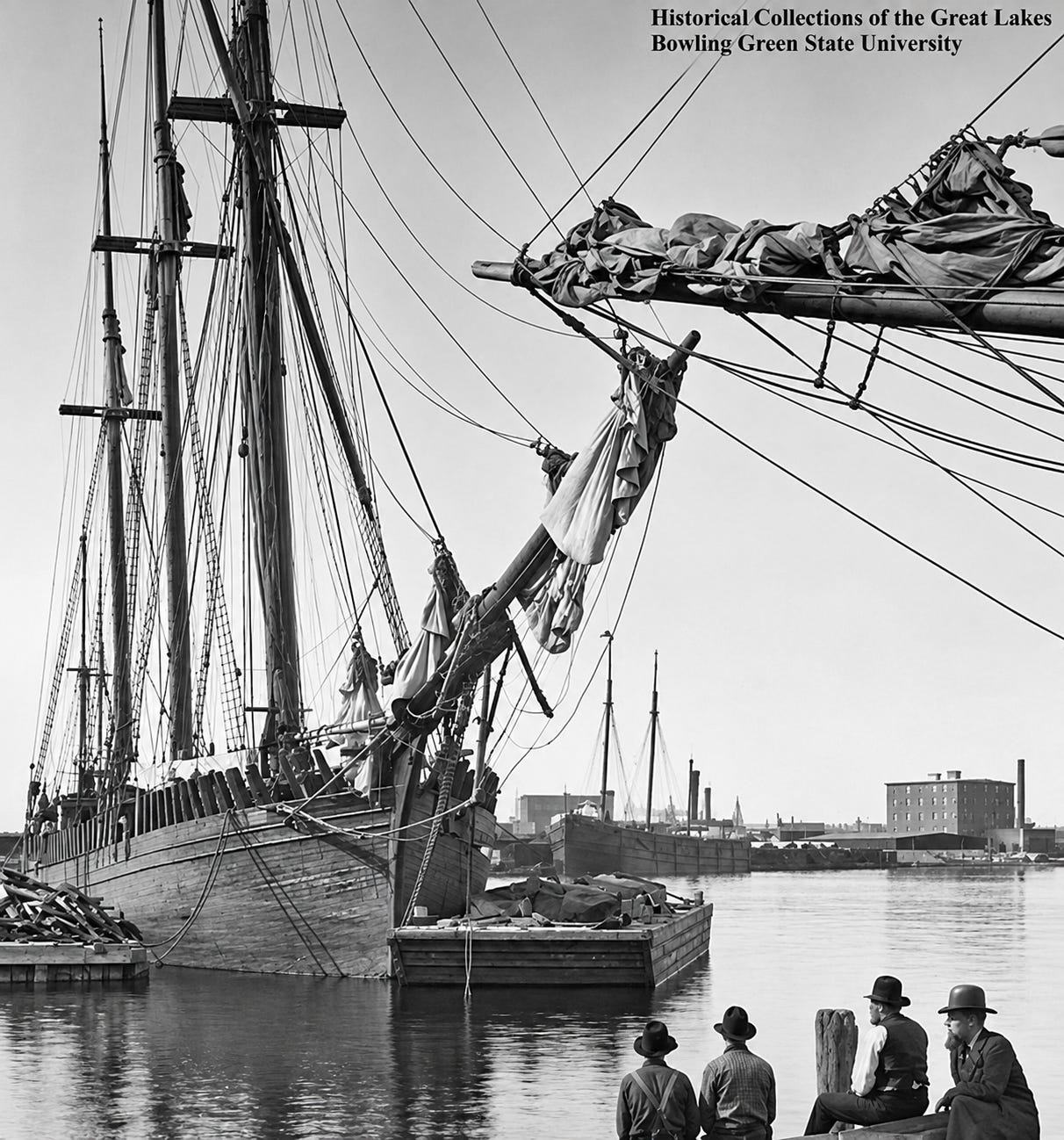
The four-masted J. H. Rutter
The schooner whose loss seemed imminent on November 1 was a major vessel of her day. Built at Marine City, Michigan, by David Lester in 1873 for the Toledo & Saginaw Transportation Company, the wooden J. H. Rutter was enrolled at Port Huron, Michigan, that June with Toledo, Ohio, as her home port. Her original registered dimensions were 212 feet in length, 35 feet in beam, and 14 feet in depth. A rebuilding in 1874 resulted in a re-measurement of 1,224.36 tons, the figure generally associated with the schooner in accounts of the disaster. Those tons represented registered carrying capacity, not the weight of the vessel. The vessel particulars are recorded in Sterling Berry’s Great Lakes Vessel History entry for the Rutter and in the 1907 Ludington Chronicle anniversary account.
The Rutter was a double-decked grain carrier with four masts. Her size, towering rig, and deep holds reflected the effort to move large volumes of bulk cargo economically under sail on the Great Lakes. In late October 1878 she left Chicago, Illinois, carrying grain that contemporary accounts generally describe as approximately 46,000 bushels of corn and 19,000 bushels of rye. Grain had to be loaded, trimmed, and kept from moving in the hold; once its mass shifted and the vessel listed, righting her could require hours of exhausting labor. The 1907 Ludington Chronicle and the Tri-Cities Historical Society booklet differ slightly on the corn cargo, giving about 45,000 or 46,000 bushels, but agree on approximately 19,000 bushels of rye.
Her master was Capt. Jeremiah Simpson, usually called Jerry Simpson. Born in Canada and experienced on the lakes since boyhood, he could scarcely have anticipated that the most widely remembered event of his career at sea would eventually be recounted in the United States Congress. Simpson and his crew encountered severe weather as the schooner proceeded along the Michigan shore. The ship rolled hard, and her grain shifted. Near Big Sable Point, approximately eight miles north of Ludington, the Rutter lost her rudder. The precise physical sequence is not established, but the consequence was unmistakable: an enormous sailing vessel, already listing from a displaced cargo, could no longer answer her helm. The 1907 Ludington Chronicle retrospective, the original Kendrick research manuscript and the Tri-Cities Historical Society booklet provide accounts of the schooner’s early ordeal.
On October 31 she appeared off the Grand Point Au Sable Life-Saving Station with a distress signal displayed. Later accounts record the American flag flown upside down, a recognized signal of emergency. The station stood near the Big Sable Point Lighthouse, which had been established in 1867, a decade before the lifesaving station opened on May 15, 1877. The station was an important outpost on a long and exposed stretch of the Lake Michigan shore. Its boatmen were trained to meet exactly the sort of emergency unfolding off the point, but the Rutter presented an unusual problem: her people were not yet asking simply to be removed; her captain hoped to save the ship. The 1907 Ludington Chronicle account and photographs preserved in the Rose Hawley Archives document the distress signal, including the inverted American flag.
The men from Grand Point Au Sable
The regular keeper of the lifesaving station was Capt. Sandford Washington Morgan, remembered by the nickname “Shanty” Morgan. He had worked on the lakes for many years, and his experience was respected along the coast. The keeper was absent when the Rutter appeared, having gone to Detroit, Michigan, for treatment of his eyes. His son James Morgan was acting in command. Another son, George Morgan, was among those serving at the station, together with Peter Paasch, Wallace Shackleton, Charles Manchester, and two men whose names were not preserved in the detailed 1907 retrospective. The 1907 Ludington Chronicle retrospective and the original Kendrick manuscript name the station crew; secondary histories vary slightly in the keeper’s name and spelling.
The lifesavers launched their surfboat and reached the schooner. They found the Rutter in serious difficulty but not yet beyond recovery. Simpson needed a tow to a safer position where he could find workers to shift the grain and restore an even keel. The surfmen rendered what assistance they could and helped arrange for vessels from Ludington to come out. This was a joint operation between two kinds of mariners whose work often overlapped but whose responsibilities were different. A lifesaving crew could handle a surfboat and beach apparatus; a large, rudderless freighter required the pull of a steam vessel to move any distance down the coast.
The Morgan family’s participation matters because it places the eventual rescue within an organized system of coastal protection that was still developing on Lake Michigan. The Rutter incident did not begin when Kendrick appeared on the beach. It began with an isolated lifesaving station spotting a vessel in distress, taking a boat through heavy seas, boarding a damaged ship, and remaining with her until additional help arrived. The crew later made its way back toward its station, unaware that the schooner would again be in mortal danger before morning.
(To be continued…)