

By Rob Alway
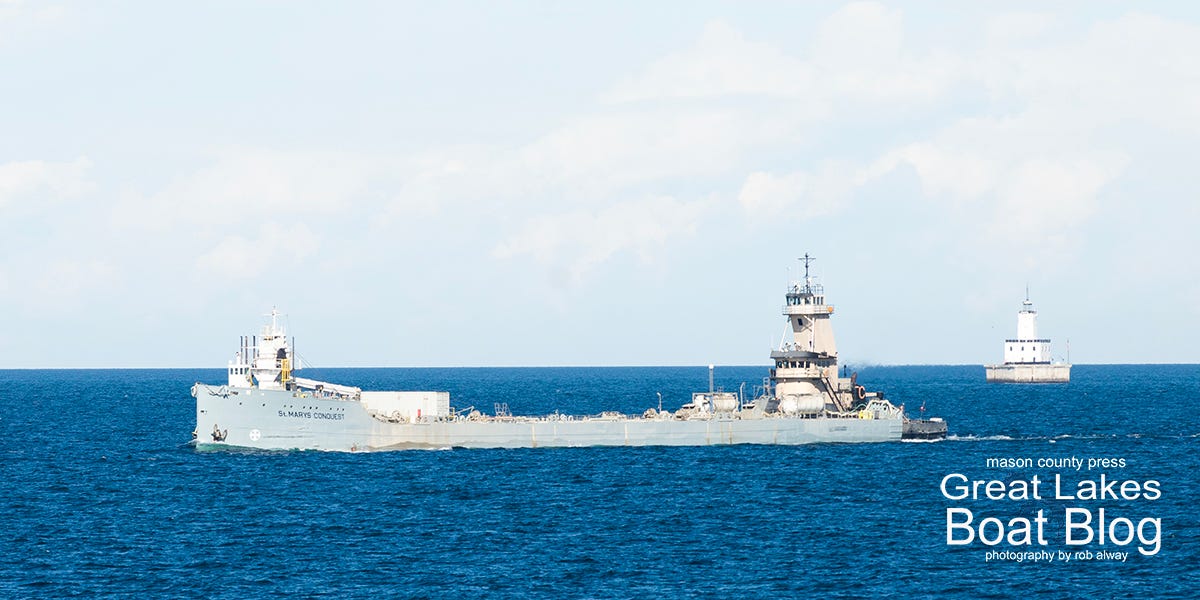
LAKE MICHIGAN — On Wednesday, Oct. 7, 2026, while traveling aboard the steamship Wilfred Sykes, I photographed the articulated tug-barge combination Bradshaw McKee and St. Marys Conquest heading south on Lake Michigan, passing the historic North Manitou Shoal Light Station.
The Wilfred Sykes was northbound toward the Straits of Mackinac, en route to Port Dolomite on northern Lake Huron near Cedarville, Michigan. The Bradshaw McKee was heading toward Milwaukee, Wisconsin, where Automatic Identification System (AIS) records indicate it arrived the following morning.
The encounter brought together three eras of Great Lakes maritime history: a tug built in 1977, a former petroleum tanker dating to 1937 and a lighthouse completed in 1935.
The Bradshaw McKee
The Bradshaw McKee was built in 1977 by Toche Enterprises of Ocean Springs, Mississippi, originally named Lady Elda. Following several ownership and name changes, the tug entered Great Lakes service in 1986 as the Susan W. Hannah, operating for Hannah Marine Corporation.
In 2009, the tug was acquired by Port City Marine Services of Muskegon, Michigan. It was renamed Bradshaw McKee in 2011 and returned to service the following year.
Measuring approximately 121 feet long, the tug is powered by twin diesel engines producing a combined 4,320 horsepower.
It operates as an articulated tug, using a mechanical coupling system that connects it within a specially designed notch in the stern of the barge. Unlike a conventional tug towing a barge by cable, the articulated arrangement permits the vessels to operate as a connected unit while allowing controlled movement between them.
From petroleum tanker to cement barge
The St. Marys Conquest began its career as the steam-powered petroleum tanker Red Crown, built by Manitowoc Shipbuilding Company of Manitowoc, Wisconsin, for Standard Oil Company of Indiana.
Launched Sept. 18, 1937, the vessel entered service Nov. 1 of that year, transporting petroleum products on the Great Lakes.
It was renamed Amoco Indiana in 1962 and continued operating in the petroleum trade until its sale to Cement Transit Company in 1986.
The following year, Bay Shipbuilding Corporation in Sturgeon Bay, Wisconsin, converted the former tanker into a self-unloading cement barge. The conversion included removing its propulsion machinery, rebuilding its cargo spaces and installing equipment for handling powdered cement.
Renamed Medusa Conquest, the barge subsequently operated as Southdown Conquest and Cemex Conquest before receiving the name St. Marys Conquest in 2005.
Today, the approximately 437-foot barge transports bulk cement for St. Marys Cement. Its operating relationship with the Bradshaw McKee dates to 2015, although both vessels have occasionally operated with other partners.
The tug and barge form a combined unit approximately 482 feet long.
A Muskegon maritime connection
The Bradshaw McKee is operated by Port City Marine Services, a Muskegon-based marine transportation company affiliated with Sand Products Corporation. The McKee family’s involvement in Great Lakes shipping dates to the early 1930s, when Sand Products, founded in 1924, expanded from industrial sand mining into marine transportation. Through Wisconsin & Michigan Steamship Co. and other affiliated businesses, the company operated a variety of passenger and freight vessels, including the historic Milwaukee Clipper. Today, Port City Marine Services continues that maritime tradition, specializing in vessel operations and the transportation of dry-bulk cement.
North Manitou Shoal Light Station
Visible behind the tug-barge combination in the photograph is North Manitou Shoal Light Station, commonly called “the Crib.”
Located southeast of North Manitou Island, the light marks a hazardous shallow area along the Manitou Passage, an important commercial navigation route between southern Lake Michigan and the Straits of Mackinac.
Beginning in 1910, the shoal was marked by a succession of lightships stationed at the site. Those vessels were replaced in 1935 by a permanent lighthouse built on a steel and concrete crib foundation anchored to the lake bottom.
For decades, a three-member Coast Guard crew maintained the station, living aboard the isolated structure.
When the lighthouse was automated in 1980, it became the last staffed offshore lighthouse on the Great Lakes to operate without a resident crew.
The structure was listed on the National Register of Historic Places in 2005. In 2016, the nonprofit North Manitou Light Keepers acquired the station and began efforts to preserve and restore the landmark.
The lighthouse remains an active aid to navigation, its flashing red beacon marking the dangerous shoal.
North Manitou Shoal Light Station GPS coordinates:
45°01′15.627″ N, 85°57′25.716″ W
Decimal: 45.021008, -85.957143
Nearly 90 years after the former Red Crown entered service, its surviving hull continues to transport cargo on the Great Lakes. Its passage near North Manitou Shoal Light Station, photographed from the northbound Wilfred Sykes — itself a 77-year-old steamship — offered a glimpse of the remarkable longevity of Great Lakes vessels and the navigational landmarks that continue to guide them.
Help support this Substack page and check out our merchandise store.
This story is copyrighted 2026 by Sable Points Media.