


By Rob Alway
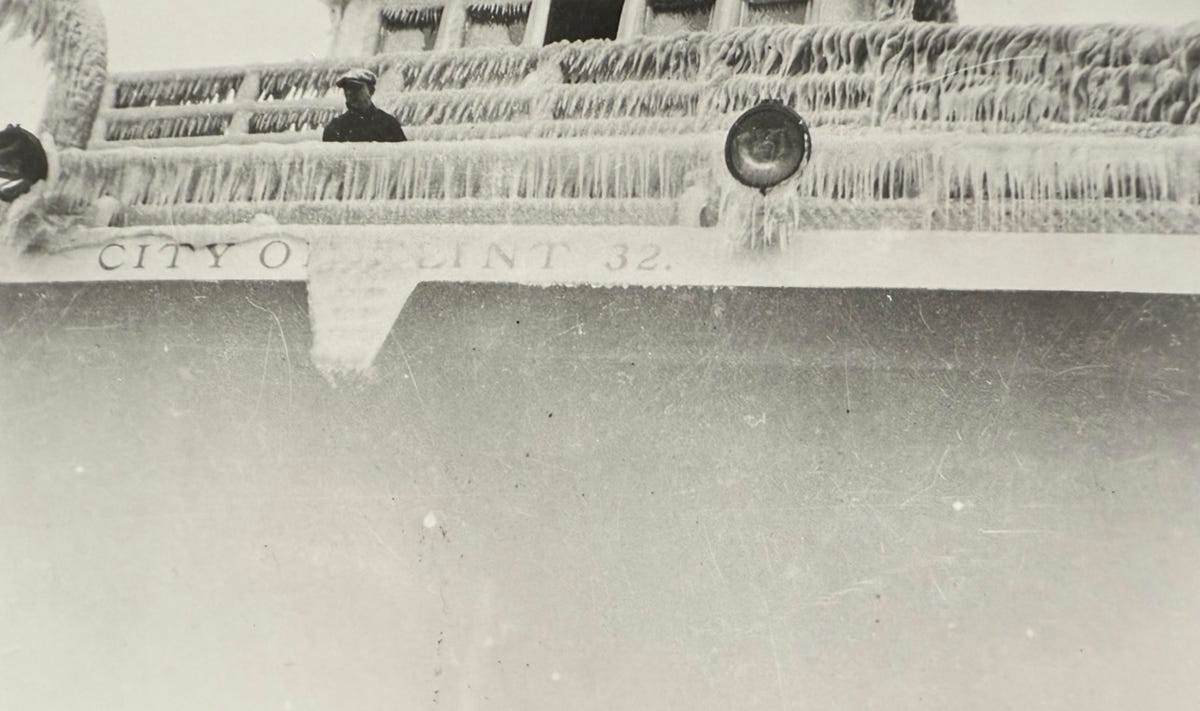
The Armistice Day Storm of Nov. 11, 1940, was still gathering strength when the great Lake Michigan carferries attempted to make their ports. At Ludington, the City of Flint 32 would come within sight of safety but end the night stranded beside the harbor entrance.
City of Flint 32: A carferry on the beach
Built by Manitowoc Shipbuilding Co. in Manitowoc, Wisconsin, at a cost of $1.2 million, City of Flint 32 entered Pere Marquette Railway service in 1930. She was 369 feet long, with a 57.3-foot beam and a 20-foot depth. Her passenger accommodations included 40 staterooms and five parlors. Two steam turbines drove two General Electric 2,300-volt, 118-rpm electric motors, producing a combined 7,200 horsepower.
At approximately 8 p.m. Nov. 11, about 20 minutes after the 348-foot Pere Marquette 21 struggled into Ludington, Michigan harbor, Coast Guard personnel spotted the lights of City of Flint 32 outside the channel. The ferry was two hours overdue. Coast guardsmen stood ready to assist as Capt. Jens Vevang (1880–1956) tried to bring her into port. Capt. Charles Robertson (1880–1944), who ordinarily commanded City of Flint 32, was on shore leave.
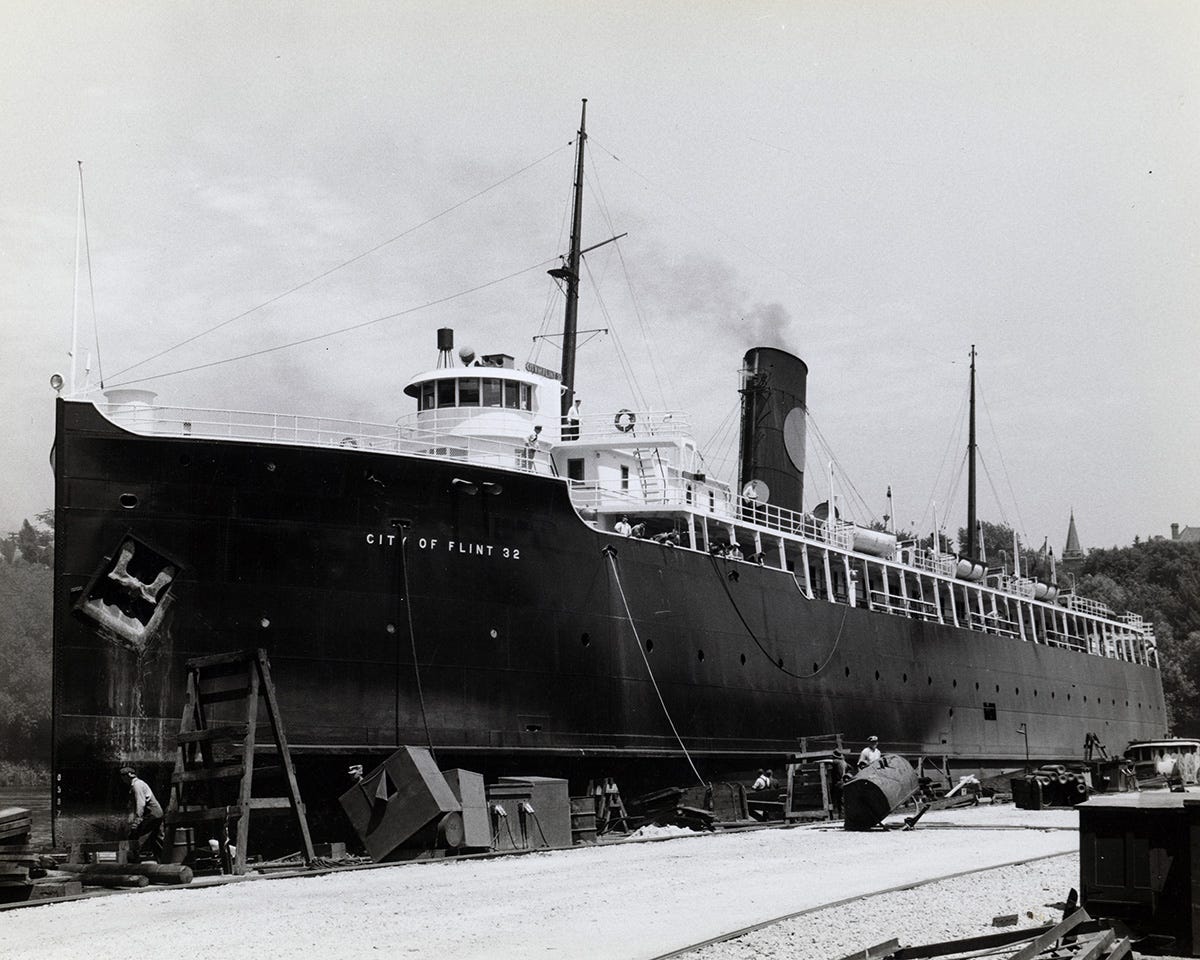
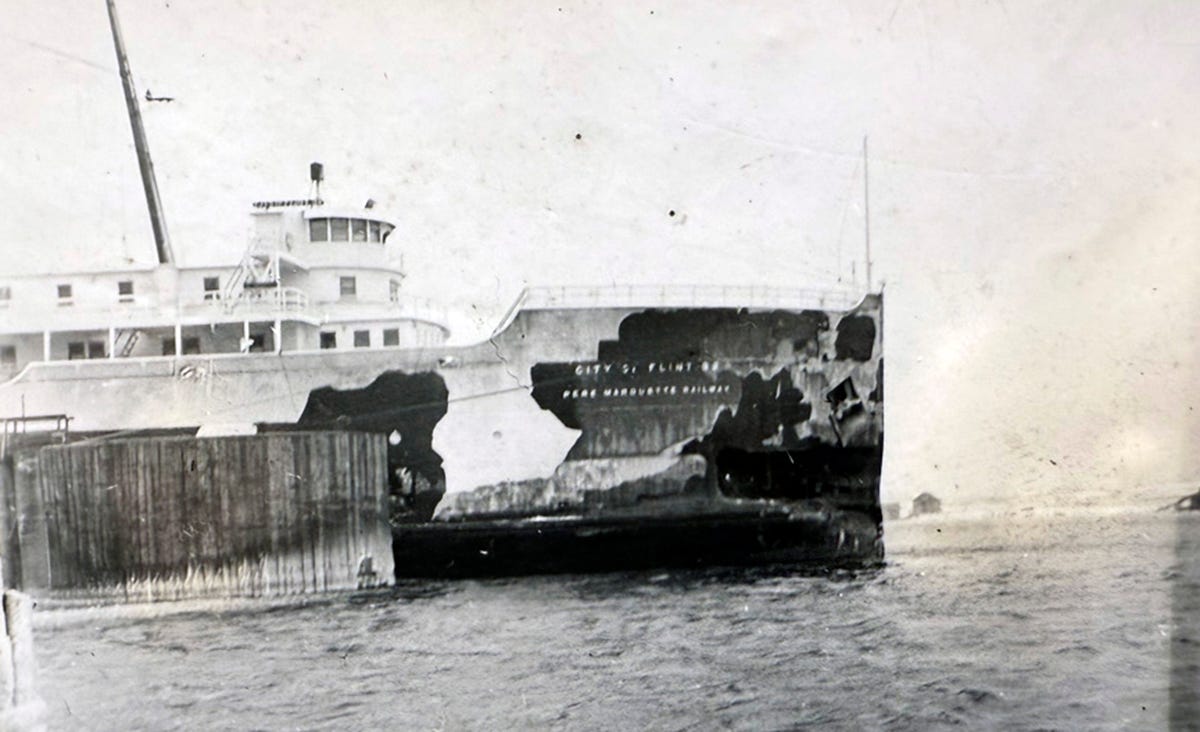
Vevang was unable to counter the storm. The wind pressed the ferry against the north breakwater, spun her around, and pushed her into shallow water on the north side of the harbor entrance. The next day’s Ludington Daily News reported that she had initially lain with her bow pointing toward land and her stern near the turn in the breakwater, then gradually drifted parallel to the beach.
The same account traced the shifting violence of the gale: an early peak around 2 p.m., a brief lull, and renewed fury at 5 p.m. Hurricane-force winds persisted into the night, moderated slightly in the early morning, and returned again. An official gauge at the Pere Marquette marine office recorded a maximum of 75 mph, with winds of 60 to 70 mph lasting several hours. Railroad officials believed winds offshore could have been another 5 to 10 mph stronger.
The storm had not entirely passed on Nov. 12. Winds that morning still approached 50 mph, sometimes slackening only to increase abruptly. Driving snow repeatedly reduced visibility. The grounding was the first of its kind along Ludington’s shoreline since Pere Marquette 19 grounded near Big Sable Point in 1916.
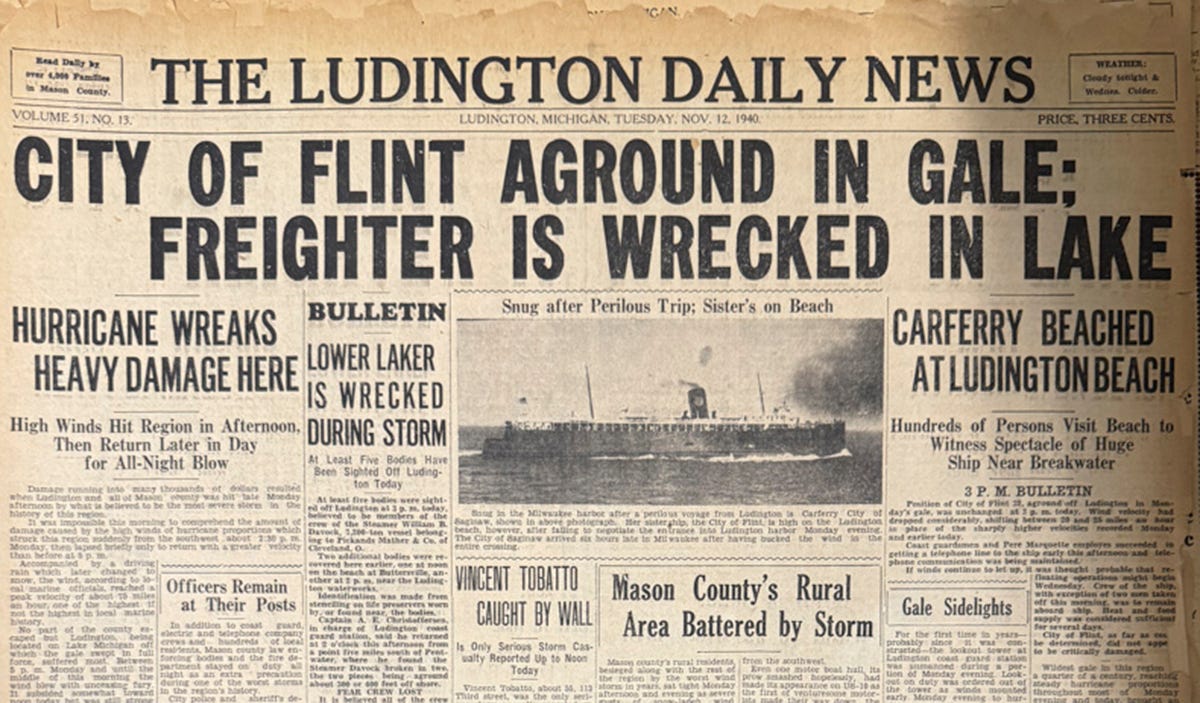
With 45 crew members and four passengers aboard, City of Flint 32 lay approximately 500 feet offshore, west of Court Street and Lakeshore Drive near Stearns Park. Contemporary reports put her stern roughly 60 feet from the north breakwater, her bow facing nearly west, and her hull lying lengthwise in the seas. Pere Marquette officials said refloating would have to wait until the weather moderated, when other carferries could help move her into deeper water.
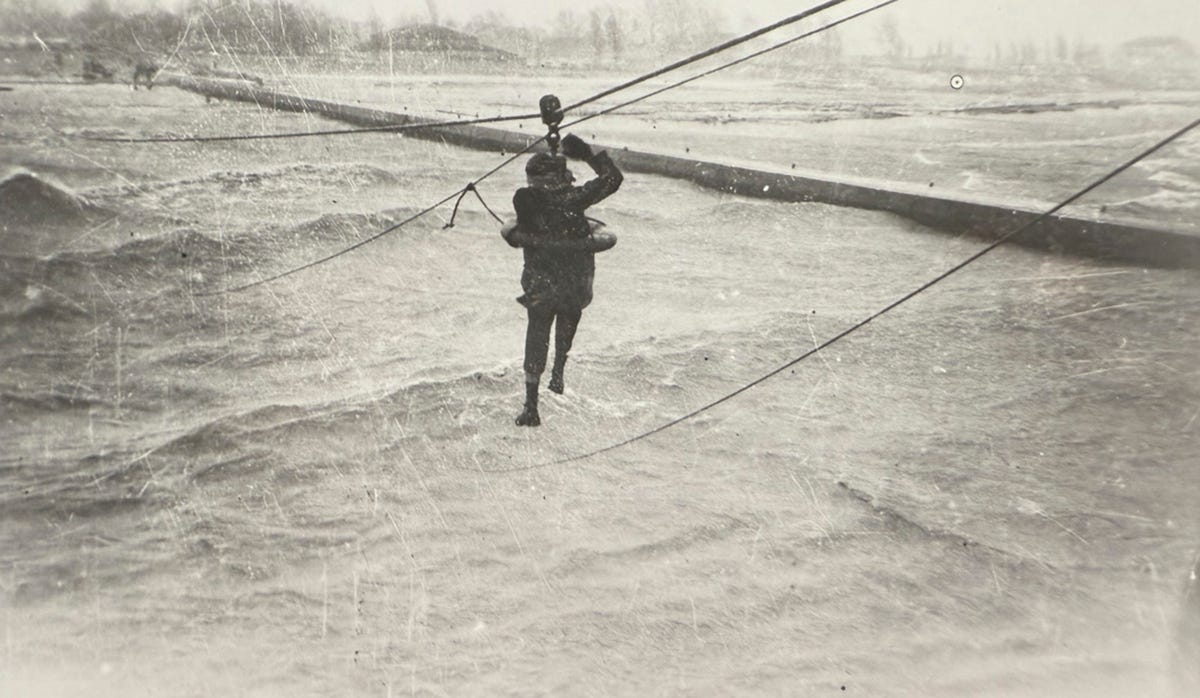
To lessen the violent pounding, Vevang ordered the ballast tanks filled, allowing the ferry to settle lower in the water. Newspaper accounts indicated her engines and other machinery continued to operate. The Coast Guard used a breeches buoy to remove two Ludington crew members, Ernest Delatowski, 27, and Luther Ryder, 19. The device carried people along a line suspended between ship and shore; a Lyle gun could be used to fire the initial line. Railroad officials said they did not regard the stranded ferry as being in immediate danger.
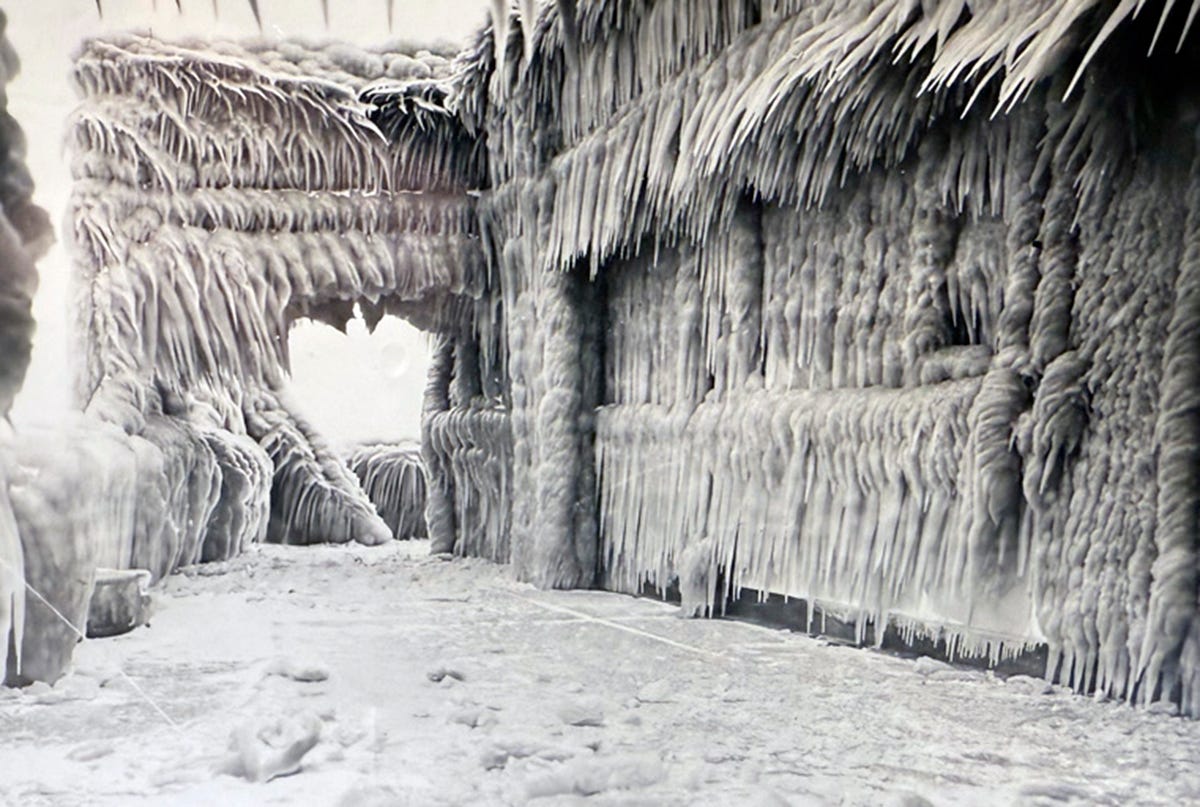
The other Pere Marquette ferries had troubles of their own. Under Capt. Arthur Altschwager, Pere Marquette 21 reached Ludington about 20 minutes before City of Flint 32, but could not reach her customary No. 3 slip. Wind blew her into pilings east of the dock, where emergency lines secured her with crew and passengers still aboard.
Capt. Ed Cronberg’s City of Saginaw 31 had departed Ludington for Milwaukee at 3 p.m., an hour after the first blast of the storm. She did not arrive until about 3 a.m. Nov. 12, taking 12 hours to complete a crossing normally made in six. Pere Marquette 22 remained at Milwaukee, and Pere Marquette 18 (II) remained at Kewaunee, Wisconsin, into the afternoon of Nov. 12. Such delays were unusual for a fleet accustomed to operating in severe weather.
Farther north, Ann Arbor Railroad carferry Ann Arbor No. 6 grounded near South Manitou Island. Having departed Manitowoc on Nov. 11, she had sought refuge near the island but was found aground when her crew attempted to leave. Another Ann Arbor ferry eventually pulled her into deeper water.
Other vessels caught in the gale
The 251-foot oil tanker New Haven Socony, commanded by Capt. Harley O. Norton of Albany, New York, left East Chicago, Indiana, early on Nov. 11. Near Holland, Michigan — described in an Associated Press report as about 25 miles south of Muskegon — waves smashed away her pilothouse, disabling the compass and radio. Debris from the pilothouse and an oar washed ashore, prompting the Coast Guard to fear the vessel was lost. She nevertheless survived with all 16 crew members.
Boatswain Myers later told the Associated Press that the crew had fought the gale without knowing precisely where they were. The radio was dead, the compass had washed away, and even the charts were gone. Norton said waves rose higher than the tanker’s 45-foot mast; he narrowly escaped death when the pilothouse was destroyed.
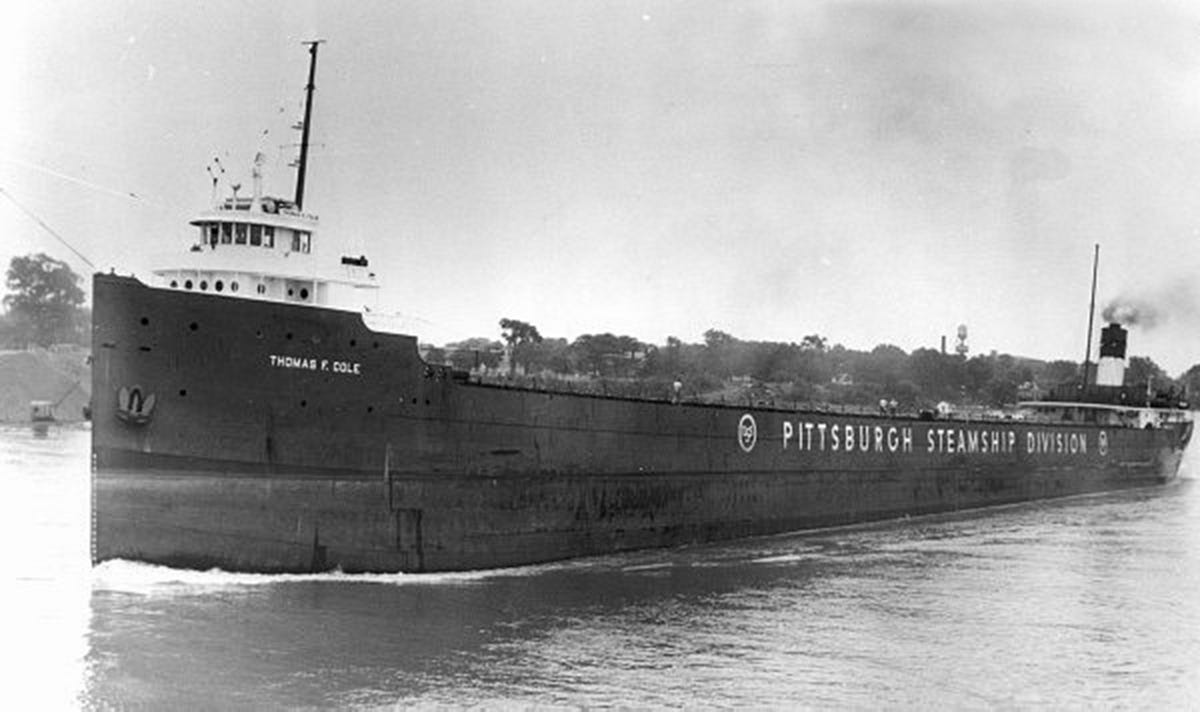
The freighter Thomas F. Cole also survived a harrowing passage. Capt. Robert W. Parsons told the Associated Press that a “miracle,” rather than skillful seamanship, had brought her safely into Milwaukee. Comparing the experience with the storm that sank the carferry Milwaukee with all hands on Oct. 22, 1929, Parsons described the earlier gale as a “summer breeze.” For 36 hours, the large freighter had been swept sideways in the troughs of mountainous seas before she could make headway. Thousands of rivets popped free, and the hull sagged. Water broke through openings 34 feet above the waterline, wrecking interiors; from his pilothouse 55 feet above the water, Parsons sometimes had to look up to see the crests coming toward him.
Off Sac Bay, the Chicago-based Tri-State Steamship Co. gravel carrier Sinaloa grounded on a reef and faced the possibility of breaking apart. Coast guardsmen from Munising rescued all 42 aboard. Eleven crew members were hospitalized, although the Associated Press reported that none appeared to be seriously injured.
The 60-foot fishing tug Drummond, owned by Joseph Kroll of DeTour, Michigan, became fast on a shoal near St. Joseph Island, Ontario. She was freed on Nov. 13 after being held there since Nov. 11. At Saginaw, Michigan, the 170-foot steam yacht Capitola, owned by the Wickes brothers, flooded and sank in the Saginaw River.
The storm grounded Conneaut on the northern shore of the Straits of Mackinac and Arthur Orr at Waugoshance Point. Reports placed Frank J. Peterson at St. Helena Island and, in another account, off Fox Island. Joseph Block was badly battered but reached port. Alfred H. Smith pitched so violently in the Straits of Mackinac that a cargo of sardines and chocolate became mixed together. Automobiles aboard the carferry City of Cheboygan were badly damaged during her struggle in the Straits. Near Fox Island, the fishing tug Dornbos was initially reported lost, although authorities believed she had taken shelter near an island.
Destruction ashore
The hurricane-force winds damaged much more than vessels. The Nov. 12 Ludington Daily News carried the headline “Mason County’s Rural Area Battered by Storm.” Its account described winds sweeping across fields and hills, tearing away buildings, roofs, signs and windows, and damaging vehicles. Broken glass blew into living rooms; longstanding trees bent, groaned and collapsed. Damage, much of it not yet reported, was estimated in the thousands of dollars.
One badly damaged motorboat hull appeared on U.S. 10 amid storm debris. Near Scottville, Michigan, a gust caught a hay-laden truck, turning it partly over into a ditch on the north side of the highway. The newspaper reported numerous power outages. On the Buttersville Peninsula, a cottage was torn from its foundation and reduced, along with its furnishings, to what the newspaper called “kindling wood.”
Next in the series: Two freighters vanish off the west Michigan shore, carrying 57 men to their deaths.
Sources: Ludington Daily News; Associated Press; National Weather Service; historical records cited in the original article.