


By Rob Alway
Eighty-six years after the Armistice Day Storm struck Lake Michigan on Nov. 11, 1940, its human toll remains visible in cemeteries, museums and maritime records. The aftermath brought the refloating of a stranded carferry, the preservation of survivor testimony and a continuing obligation to remember the sailors and fishermen who never came home.
City of Flint 32 is freed
Back at Ludington, the immediate danger for those aboard City of Flint 32 gradually diminished. At 1 p.m. Wednesday, Nov. 13, a Coast Guard surfboat took the four passengers off the ferry. Forty-three of her original 45 crew members remained aboard; the other two had been brought ashore the previous day by breeches buoy.
Refloating work began Nov. 13 with the arrival of the diesel tug Cushing from Chicago, owned by Great Lakes Dock and Dredging Co. The tug and Pere Marquette 21 worked around the stranded ferry, just north of the breakwater, through the night. Hundreds watched from shore. The ship was finally freed by Thursday, Nov. 14, and at 11:20 a.m. Friday, Nov. 15, the tug John H. Cushing took her in tow for Manitowoc.
Repaired and returned to service, City of Flint 32 continued operating through 1967. On Dec. 24, 1969, she departed Ludington under tow. Sold to Norfolk and Western Railway Co., she was converted in 1970 to a river ferry barge and renamed Roanoke.
By Friday, Nov. 15, the remaining Pere Marquette carferries — Pere Marquette 18, Pere Marquette 21, Pere Marquette 22 and City of Saginaw 31 — had resumed operations. The seven Great Lakes Naval Reserve craft also departed Ludington at 9 a.m. Friday, heading for Sturgeon Bay, Wisconsin, for hull repairs after the pounding they had received while anchored during the gale.
How the storm is remembered
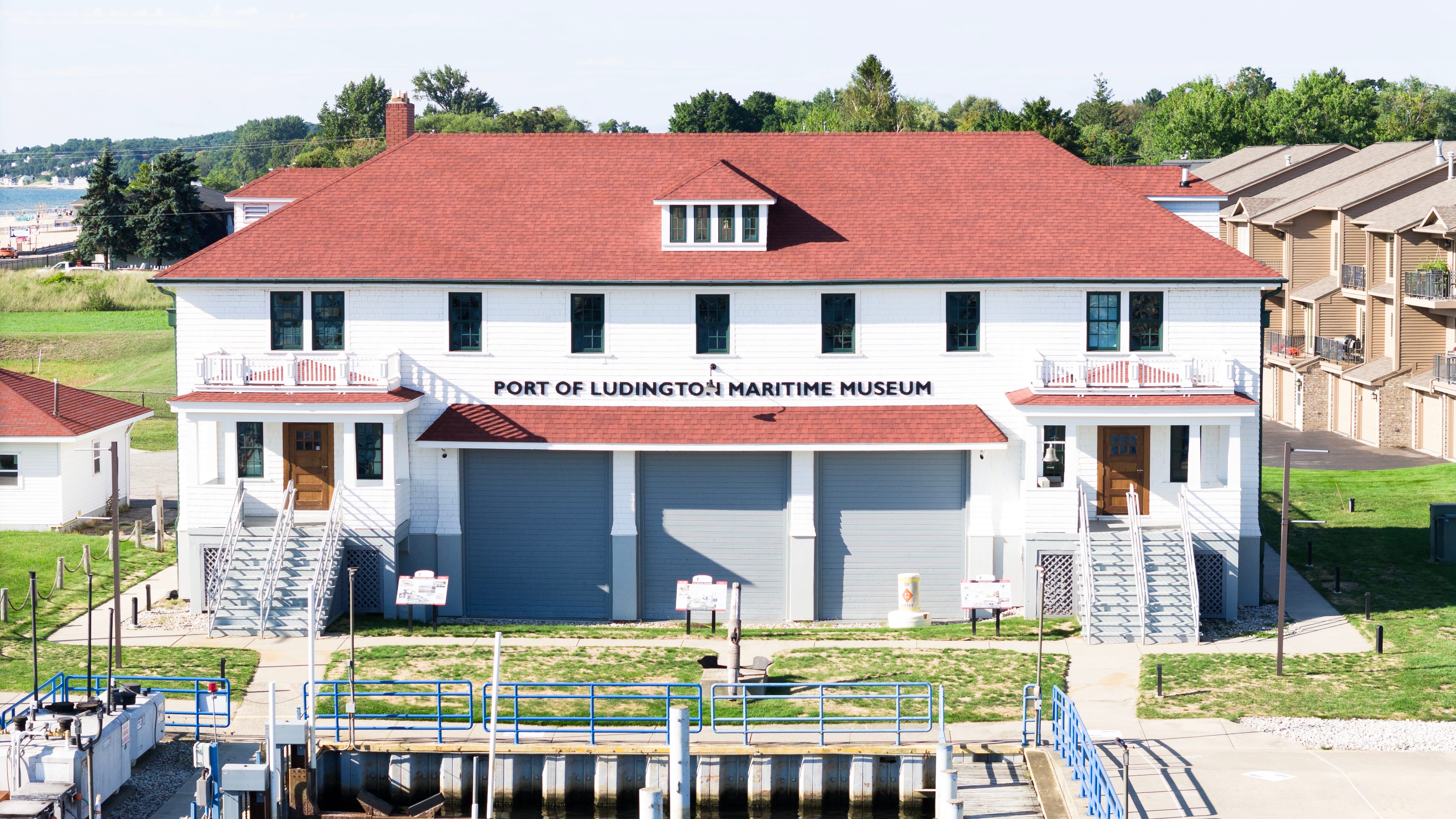
The Armistice Day Storm remains an important part of maritime history in Mason and Oceana counties. The Port of Ludington Maritime Museum, operated by the Mason County Historical Society at 217 S. Lakeshore Drive, Ludington, Michigan, presents an interactive exhibit that traces the event across the Midwest. Photographs, video and a pilothouse simulator allow visitors to explore the storm and try operating a vessel’s wheel. Elsewhere in the museum, a larger, 180-degree simulator recreates the pilothouse of Pere Marquette 22.
Valerie van Heest of Lafferty van Heest and Associates, also associated with MSRA, designed the storm exhibit. It includes renderings of the wrecks based on the association’s 2015 underwater examinations. The museum’s stated seasonal schedule is May through October.
The Mason County Historical Society’s Rose Hawley Archives, 130 E. Ludington Ave., maintains an extensive collection of storm-related documents and photographs. Further information is available at masoncountymihistory.org.
The Pentwater Historical Society and Museum, 85 S. Rutledge St., Pentwater, Michigan, preserves objects recovered from Novadoc, including her wheel, flags, lanterns and bell. The museum also holds a commemorative silver plate presented to Clyde Cross, owner of Three Brothers II, in recognition of the crew’s rescue of 17 Novadoc sailors. Additional documents are held in the society’s archives. Its stated seasonal schedule is June through October; information is available at pentwaterhistoricalsociety.org.
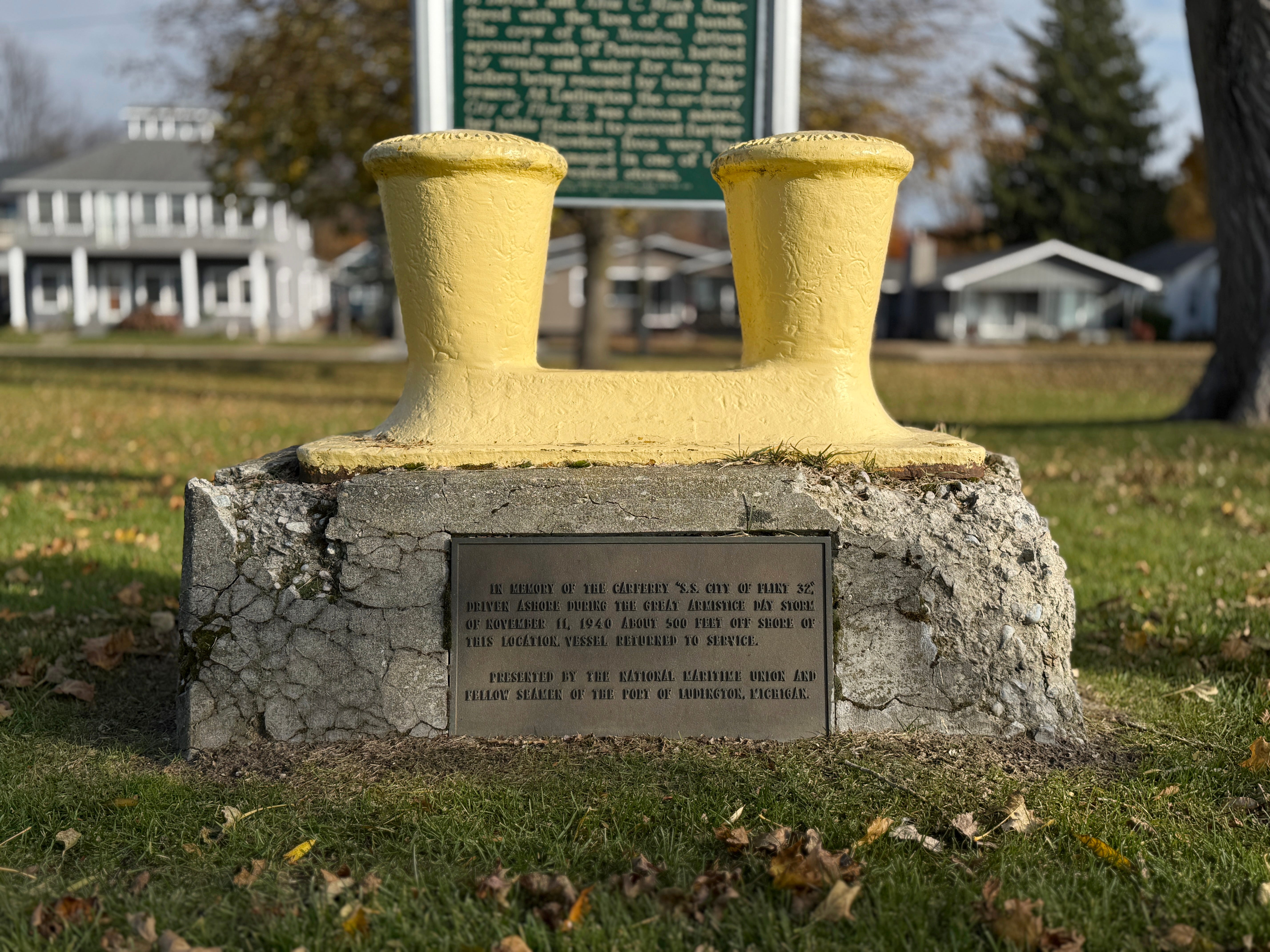
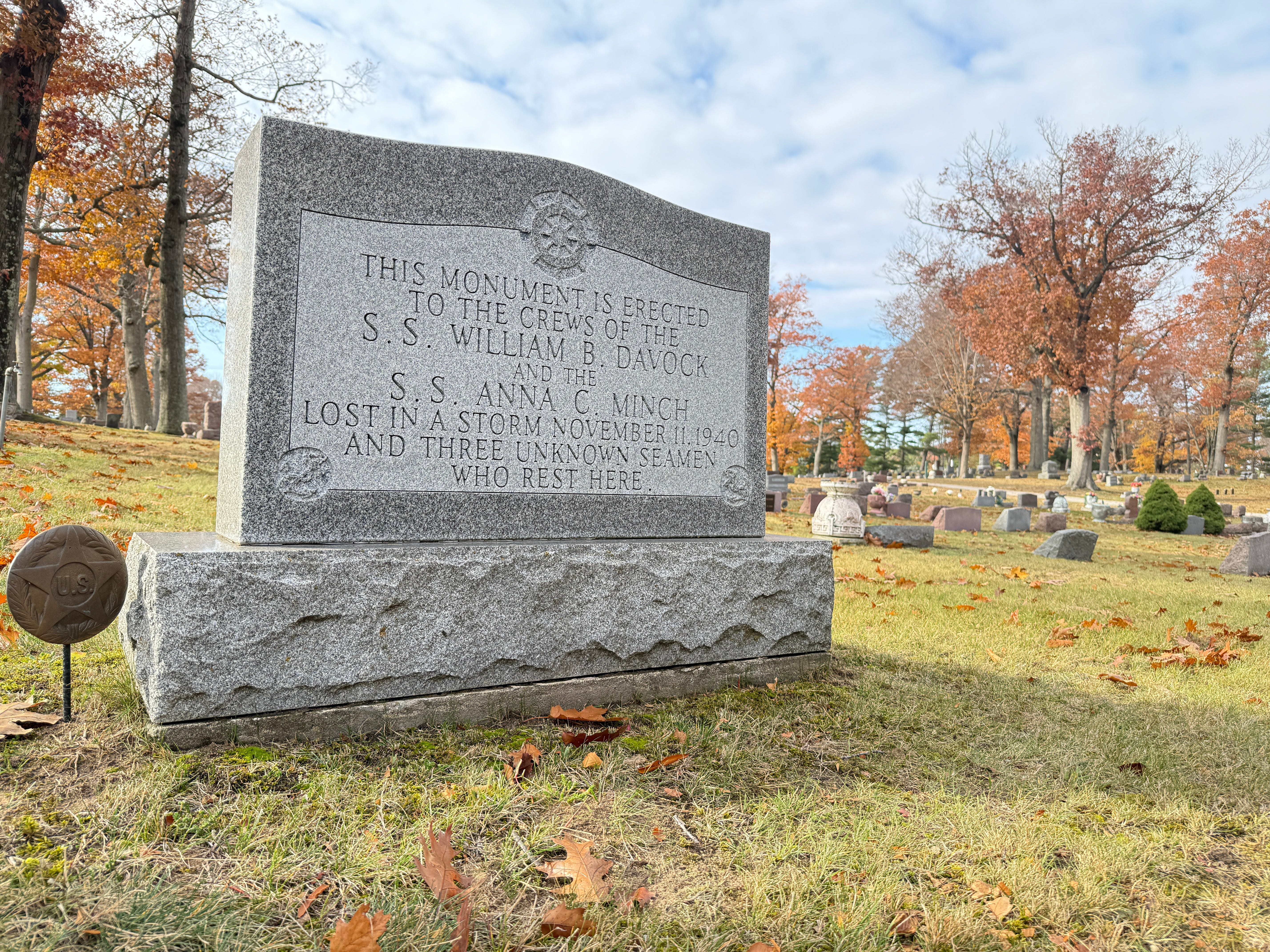
Michigan historical markers memorialize the storm at Pentwater Municipal Marina and at Stearns Park in Ludington. Beside the Ludington marker is a mooring bollard and plaque commemorating City of Flint 32. Lakeview Cemetery in Ludington also has a memorial to the crews of William B. Davock and Anna C. Minch; three unidentified sailors are buried there.
Lake Michigan’s victims
The casualty roll below retains the original article’s available names and shipboard positions while applying corrections supported by historical research. It remains a partial list for Anna C. Minch: 21 names appear in the original roster, though 24 crew members died. The 33-name Davock roster accords with the National Weather Service and the 1941 federal marine investigation, although some later summaries report 32. Names and hometowns that still conflict are identified rather than invented.
William B. Davock
• Charles W. Allen, captain, Detroit
• Charles A. Price, first mate, Highland Park
• John Wiesen, second mate, Ashtabula, Ohio
• Leroy Shurkey, third mate, Columbus, Ohio
• Andrew J. Stiffler, wheelsman, Cleveland, Ohio
• Walter Kiewice, wheelsman, McKean, Pennsylvania
• Frank Stanik, wheelsman, Brooklyn, New York
• James D. Bowman, watchman, Lyndhurst, Ohio
• Lawrence Bleshoy, watchman, Ashtabula, Ohio
• Joseph Rokowski, watchman, Cleveland, Ohio
• Edward E. Becker, deck watchman, St. Clair
• James Gordon, deck watchman, Harrison
• Martin Chambers, deck watchman, Cleveland
• James Saunders, deckhand, Kenmore, New York
• Sterling B. Wood, deckhand, Lorain, Ohio
• Woodring Wilson, deckhand, Ashtabula, Ohio
• John T. Burns, chief engineer, Toledo
• Jere W. Collins, first assistant engineer, Milwaukee, Wisconsin
• Harold F. Mullen, second assistant engineer, Sault Ste. Marie, Michigan
• Arnold J. Johnson, third assistant engineer, South Chicago, Indiana
• Carl J. Sharrow, oiler, Marine City
• Charles W. Findlay, oiler, Ashtabula, Ohio
• Jay E. Weber, oiler, Fair Haven
• Frank H. Parker, fireman, Conway
• Lyle F. Doyle, fireman, Ashland, Wisconsin
• Charles M. Ferguson, fireman, Tipton, Indiana
• Orville J. Shurkey, coal passer, St. Clair
• Godfried J. Lietka, coal passer, Forest Hills
• Homer F. Youkins, coal passer, Marine City
• Lawrence D. Gonyea, steward, Duluth, Minnesota
• Lyle E. Campbell, second cook, Toledo
• John F. Janatis, porter, Ironwood
• Charles J. Flint, porter, Ashtabula, Ohio
Anna C. Minch
• Donald A. Kennedy, captain, Collingwood, Ontario
• Russell Elyea, first mate, Collingwood, Ontario
• Gordon Jeffrey, second mate, Collingwood, Ontario
• Vincent Reive, chief engineer, Lefroy, Ontario
• James Barker, second engineer, Freeman, Ontario
• Howard Kirton, steward, Owen Sound, Ontario
• Mabel Kirton, steward, Owen Sound, Ontario
• William Vollick, wheelsman, Midland, Ontario
• Lawrence Thompson, wheelsman, Midland, Ontario
• George A. Sovey, lookout, Midland, Ontario
• Russell Thompson, deckhand, Midland, Ontario
• Clifford Contois, deckhand, Midland, Ontario
• Robert Vollick, deckhand, Midland, Ontario
• Howard Contois, fireman, Midland, Ontario
• Stanley McNabb, seaman, Midland, Ontario
• James McEachern, seaman, Collingwood, Ontario
• Charles Myers, seaman, Collingwood, Ontario
• Itldon McMath, lookout, Goderich, Ontario
• Dan Rose, fireman, Goderich, Ontario
• Martin Dillon, seaman, Maynooth, Ontario
• Irvin Gallino, seaman, Britt, Ontario
Novadoc
• Joseph Deshaw, steward and cook (also printed DeShaw or DeShane; hometown reported inconsistently as Toronto or Halifax)
• Phillip Falvin, second cook (also printed Flavin or Pfalvin; hometown reported inconsistently as Halifax or Toronto)
Richard H.
• John McKay Jr., captain, South Haven (the earlier roster spelled his name Jack McCay Jr.)
• Stanley White, crewman, South Haven
• John Taylor, crewman, South Haven (some accounts add Jr.)
Indian
• James Madsen, captain, South Haven
• Harold Richter, crewman, South Haven (the earlier roster printed Glenn Richter)
• William “Bill” Bird, crewman, South Haven
• Arthur Reeves, crewman, South Haven
The names recorded above are the lives behind the disaster: masters, engineers, cooks, deckhands and fishermen whose ordinary voyages ended in extraordinary weather. The anniversary is not only a reminder of the force of Lake Michigan, but also a remembrance of the crews who faced it.
Sources: Ludington Daily News; Mason County Historical Society; Pentwater Historical Society; Michigan Shipwreck Research Association; National Weather Service.