


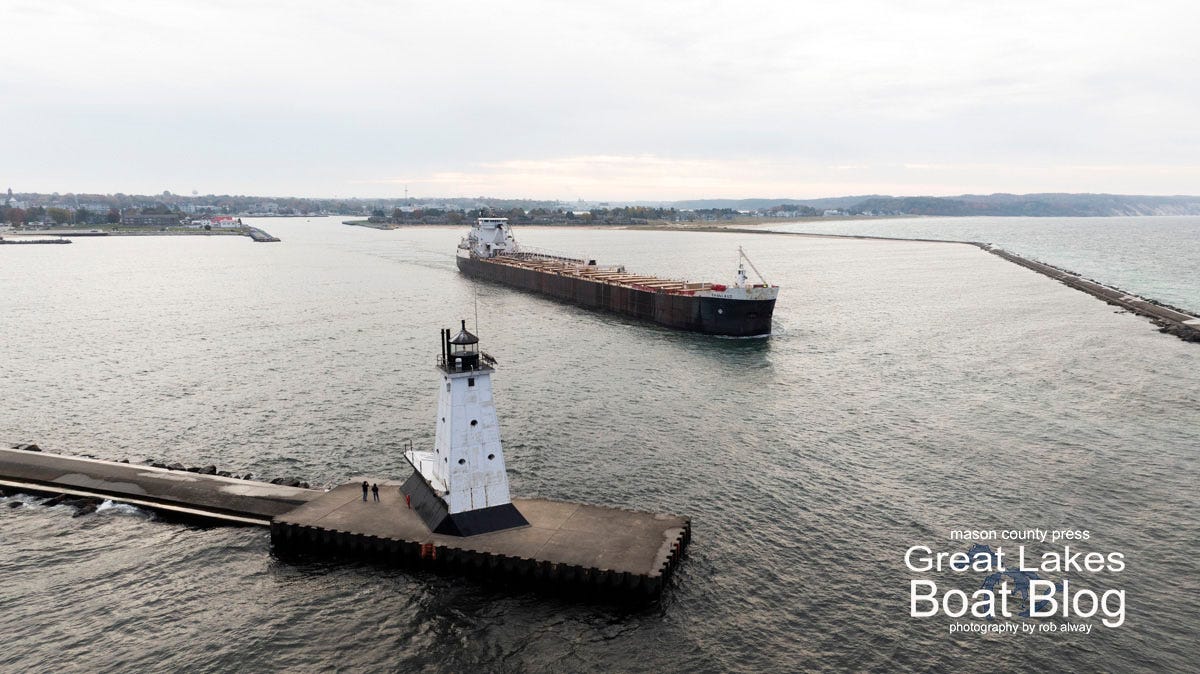
The 1975-built freighter returned to Ludington with a load of stone from Drummond Island before continuing down Lake Michigan.
By Rob Alway
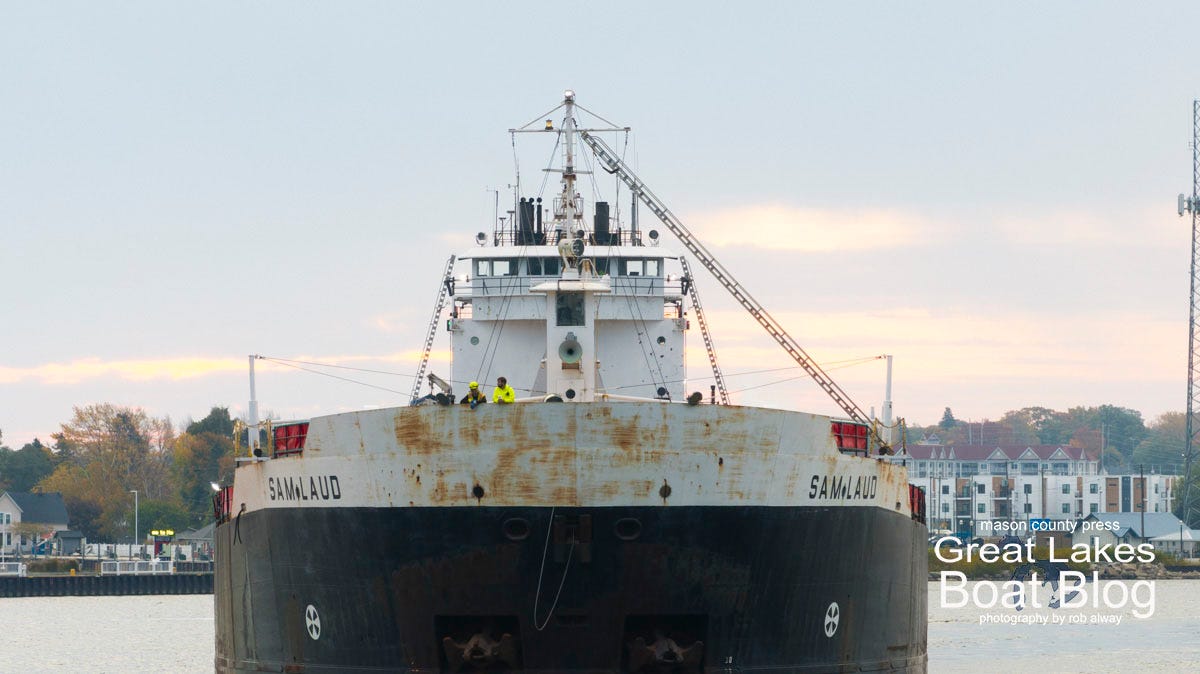
At daybreak Sunday, Oct. 25, the Sam Laud was making her way out of Ludington, Michigan. Her broad black hull and rust-streaked white bow stood against a soft October sky, with two crew members visible near the forecastle. After a brief visit to unload stone, the veteran Great Lakes freighter was headed south again.
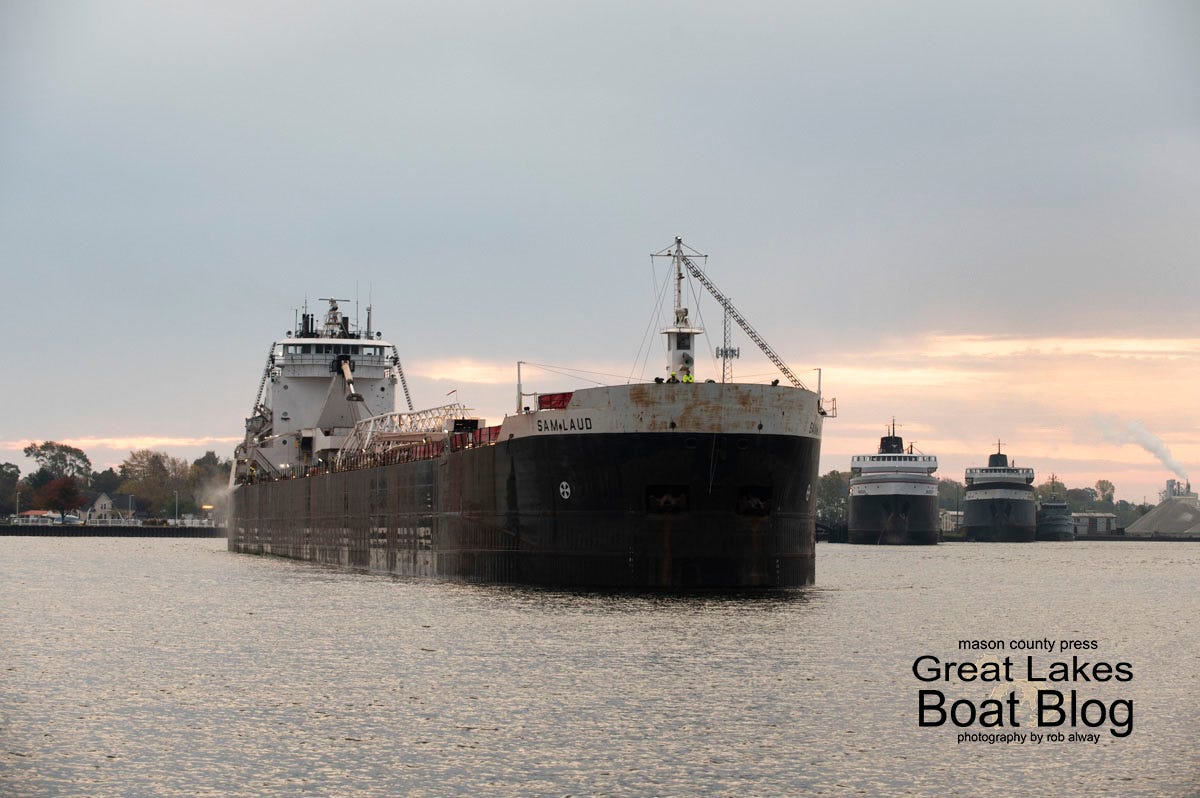
The Sam Laud arrived in Ludington at about 4 a.m. from the Drummond Island Quarry in northern Lake Huron. She discharged a portion of her cargo of stone aggregate at Rieth-Riley Construction’s Great Lakes Materials terminal on Pere Marquette Lake. By about 8:30 a.m., she had departed for St. Joseph, Michigan, where the remainder of her cargo was to be unloaded.
The trip connected two very different places in the Great Lakes economy. Drummond Island, near the eastern tip of Michigan’s Upper Peninsula, is home to an extensive limestone and dolomite operation. Stone quarried there moves by water to ports around the lakes, much of it ultimately used in construction, road building, agriculture and industry. A freighter’s short call in Ludington is part of that much larger network.
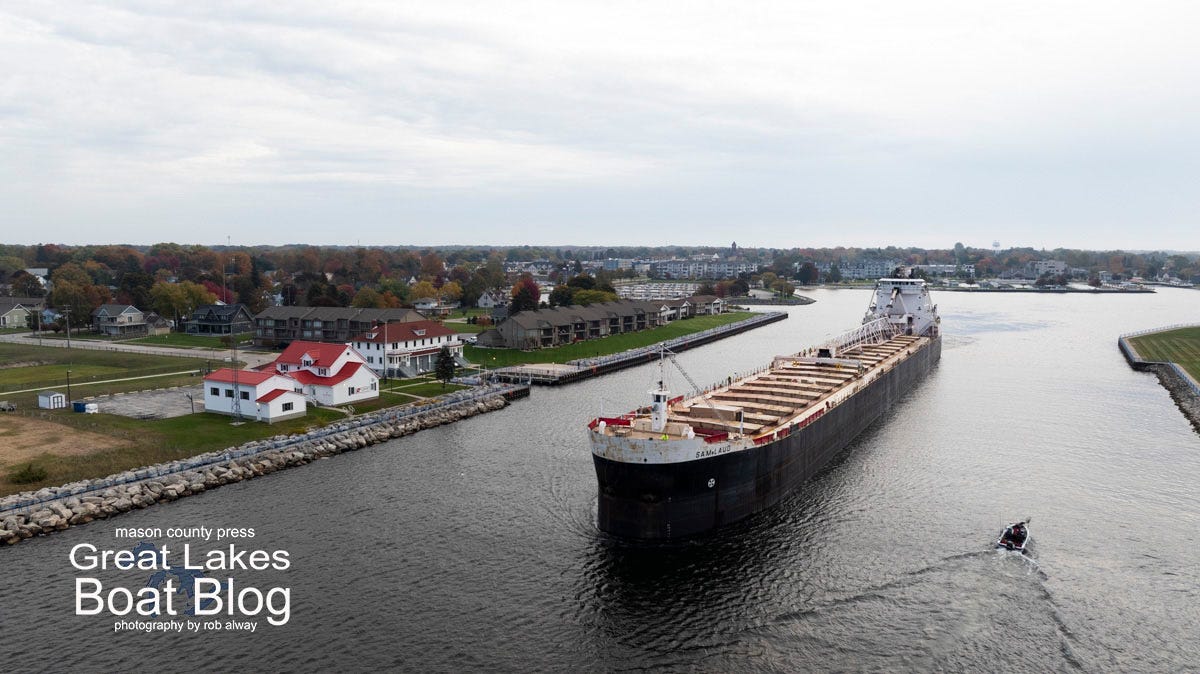
There is also considerable history behind the Sam Laud. Built at Bay Shipbuilding Corp. in Sturgeon Bay, Wisconsin, she was launched Nov. 19, 1974, and entered service the following spring. Her christening took place April 15, 1975, and her maiden voyage began April 29, when she sailed for Escanaba, Michigan, to load iron ore bound for Indiana Harbor, Indiana.
She was built for American Steamship Co. at an approximate cost of $13.3 million. Her name honors Sam Laud, a former president and board chairman of GATX Corp., which had acquired American Steamship in 1973. Laud had begun his GATX career in 1916 as a shop painter and riveter before rising to lead the company. His widow, Edna Laud, christened the vessel.
At 634 feet, 10 inches long and 68 feet wide, the Sam Laud belongs to the group of smaller, versatile self-unloading lake freighters commonly called river-class vessels. While the 1970s also brought the construction of enormous 1,000-footers, American Steamship invested in ships able to reach shallower, narrower and more confined ports. That flexibility remains important to a vessel serving places such as Ludington.
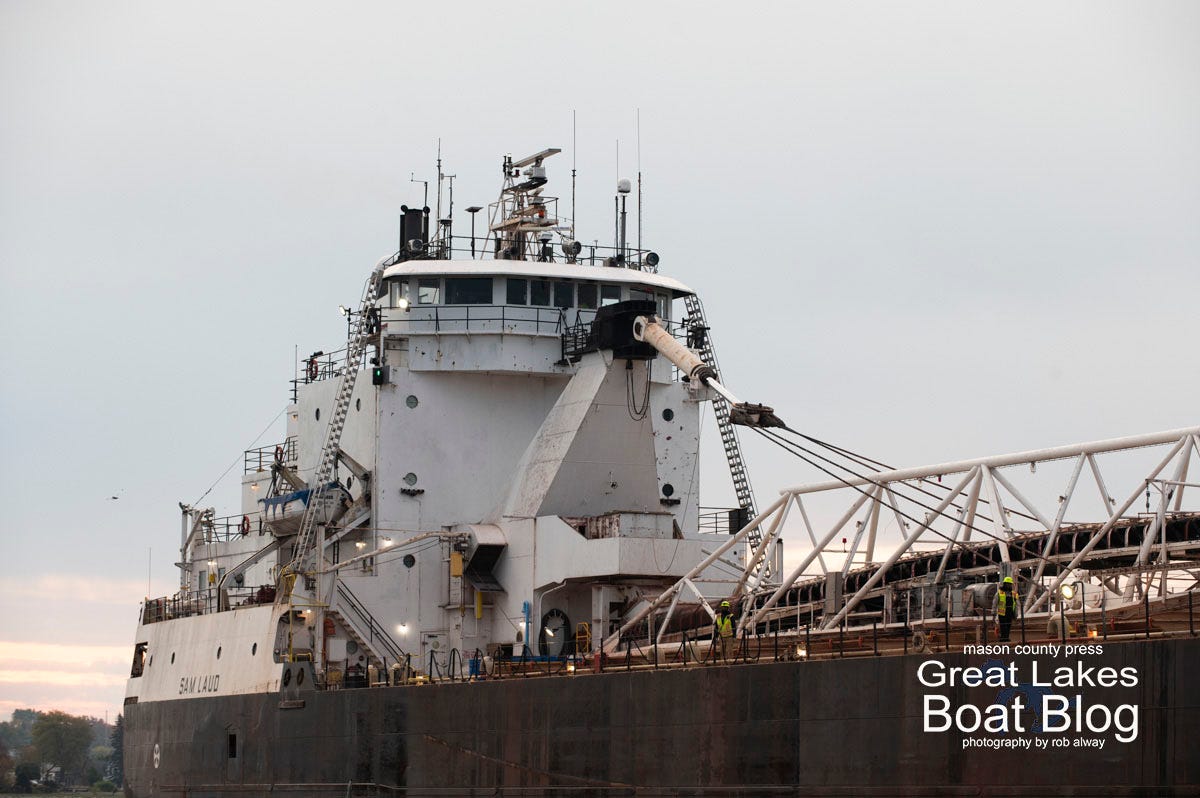
Her five cargo holds are served by 20 hatches. Beneath them, conveyor belts move cargo to a stern elevator and a 250-foot unloading boom, allowing her to discharge bulk material without depending on shoreside unloading machinery. Two diesel engines drive a single propeller, while bow and stern thrusters help her maneuver in tight harbors. Over five decades, her cargoes have included iron ore, coal, limestone, gypsum and other aggregates.
Her long career has not been without difficulties. Just two months after entering service, on June 28, 1975, she grounded on a shoal near Sturgeon Bay while carrying coal to Green Bay, Wisconsin. Some 6,000 tons of coal had to be transferred to the fleetmate Nicolet before she could be freed. Other groundings followed, including incidents at Buffalo, New York, in 1976 and in the St. Marys River in 1981. She remained in service through decades of changes in the lakes trade.
The ship’s ownership and operation have changed as well. Built for American Steamship, she later became part of the Rand Logistics fleet following that company’s 2020 acquisition of American Steamship. She is now operated by Grand River Navigation of Traverse City, Michigan, within Mainstay Maritime, the company formerly known as Rand Logistics. American Steamship remains listed as her registered owner.


This was not the Sam Laud’s first Ludington appearance of 2026. On June 12, she unloaded aggregate at the same terminal after weather on Lake Michigan kept her offshore overnight. On that visit, the rest of her cargo was bound for Manistee, Michigan.
Sunday’s call was quieter: an early arrival, a partial unload and another departure as morning arrived. For those watching from shore, it offered a close look at a working freighter that has spent more than half a century carrying the materials that keep the Great Lakes region moving.
Sources: Boatnerd’s vessel history of the Sam Laud; Know Your Ships; Shipwatcher News Great Lakes Ships, “Sam Laud”; Mainstay Maritime’s corporate history; Carmeuse’s Drummond Dolomite project information; and Mason County Press reporting from June 12, 2026.