


By Rob Alway
Editor’s note: For the past several years, I have made it a personal mission to tell the stories of the Great Lakes maritime industry and, especially, the people who work aboard its vessels. As someone who has spent much of my life watching, photographing and studying these ships, I believe their stories deserve to be told.
Documenting the industry is important for preserving its history, but it is equally important for its future. Great Lakes shipping plays a vital role in our nation’s economy, and its continued success depends on attracting new generations of skilled mariners.
Recently, I spent five days aboard the SS Wilfred Sykes, a 1949 steam-powered freighter operated by Central Marine Logistics. This series explores the ship, the work it performs and, most importantly, the people who keep it sailing.
ABOARD THE SS WILFRED SYKES — Capt. Jason Cracraft first took me to my room, and the accommodations were not exactly what most people would expect to find aboard a Great Lakes freighter built in 1949.
The Sykes was built during an era when company executives and guests sometimes traveled aboard the ships. As a result, the forward accommodations include an entire deck dedicated to guests, with four staterooms capable of sleeping two people each. Each stateroom has its own bathroom, complete with a bathtub and shower.
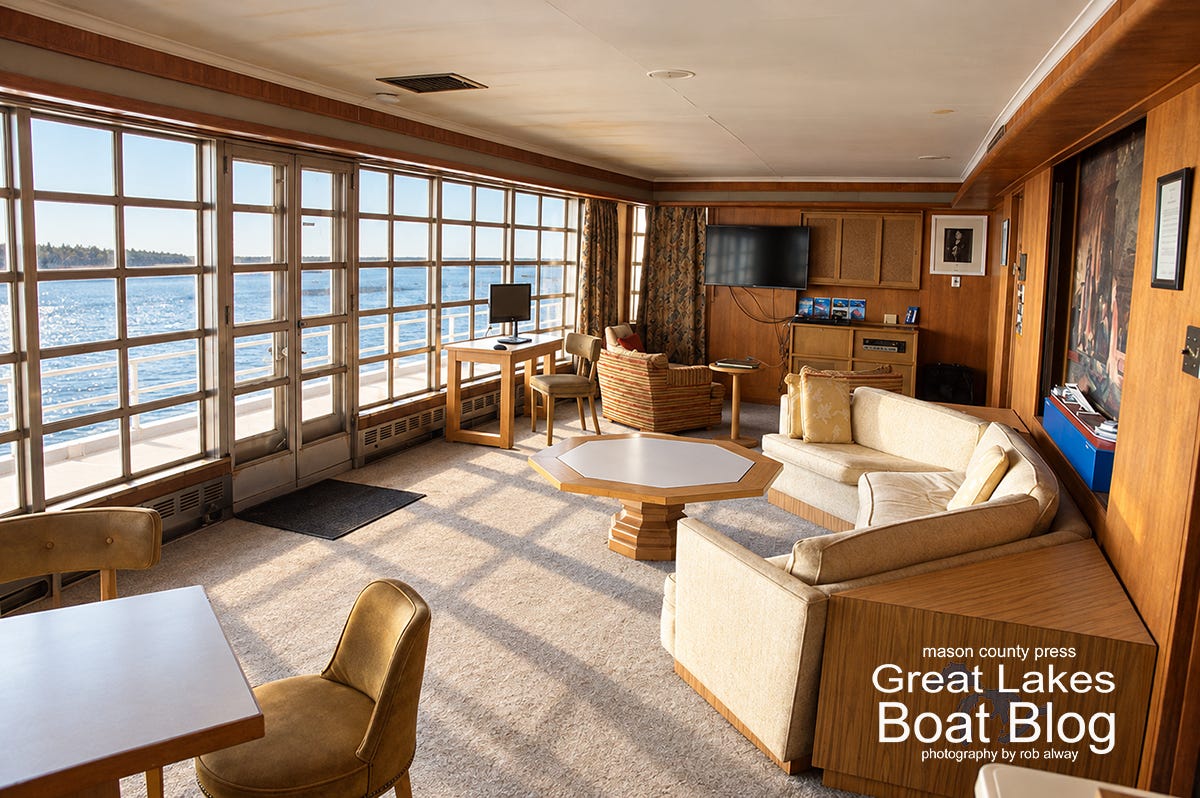
The guest deck also includes a common area with a kitchenette and spacious lounge. An entire wall of windows overlooks the ship’s long cargo deck, providing an expansive view aft. Two of the staterooms have windows overlooking the bow, while the others offer views to port and starboard.
The accommodations feature an eclectic blend of decor spanning the late 1940s through the 1970s, reflecting the vessel’s long history on the Great Lakes. Wood-paneled walls, earth-tone upholstered furniture, wall-to-wall carpeting and a distinctive geometric coffee table give the lounge the appearance of a vintage living room. The combination of mid-century styling and 1970s furnishings creates a comfortable, nostalgic atmosphere, while the expansive windows offer panoramic views of the cargo deck and surrounding water.
Below the guest deck are officers’ quarters and a recreation area. One deck above the guest accommodations are the master’s quarters and office. Above that is the pilothouse.
That arrangement is part of the Sykes‘ classic Great Lakes appearance. The pilothouse and much of the deck officer accommodations are forward while the engine room, stack, galley and additional crew spaces are aft. Later generations of Great Lakes freighters increasingly concentrated their superstructure and accommodations at the stern.
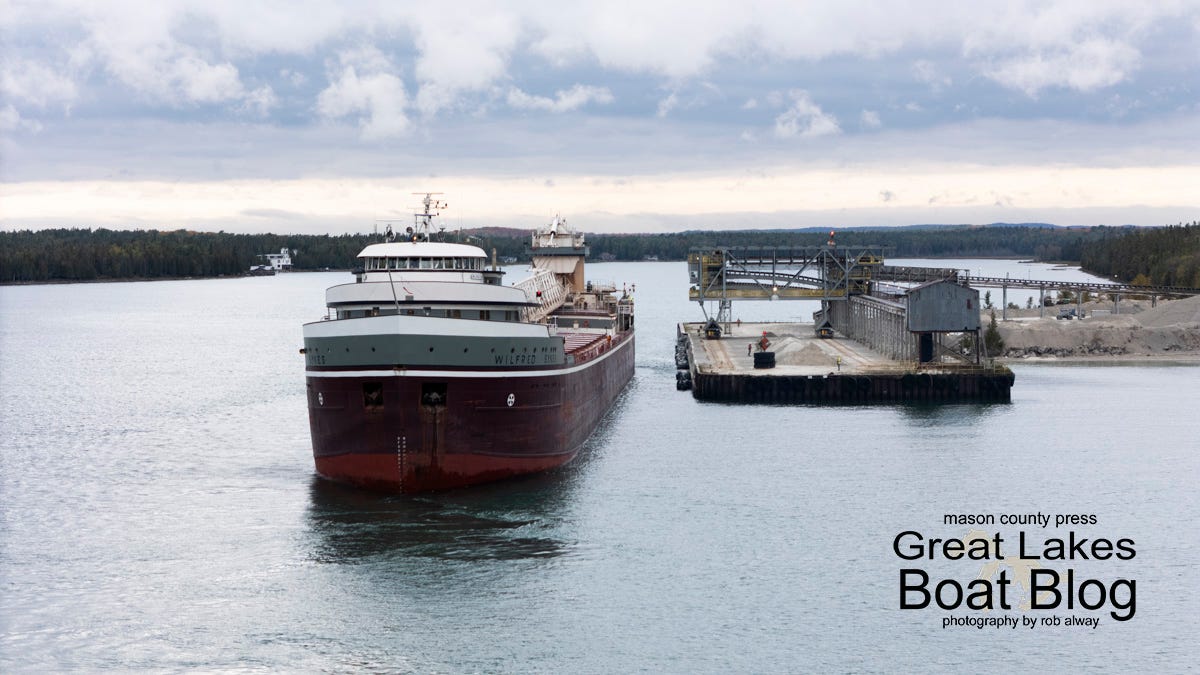
Once I settled in, Cracraft gave me my first tour of the ship.
Meanwhile, loading continued.
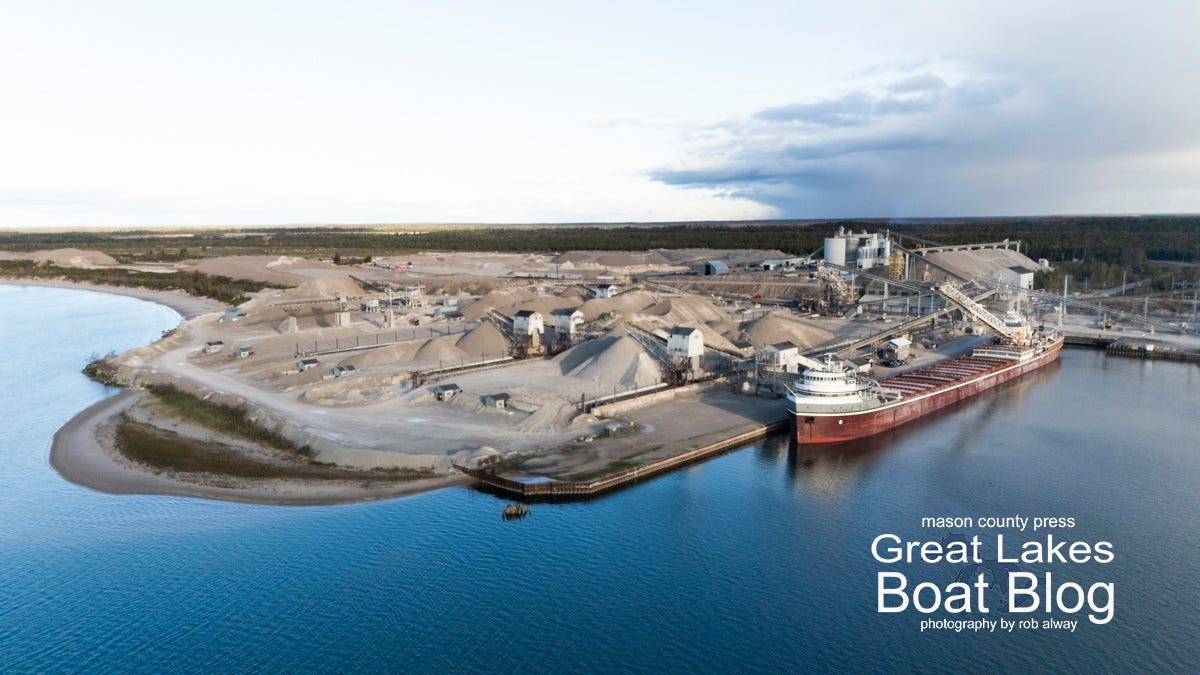
A half-load aboard a vessel the size of the Sykes represents roughly 12,000 tons of stone. Loading a full load at Cedarville, Michigan takes over nine hours under normal circumstances, therefore a half load should have been half that time.
This wasn’t the case on this particular Sunday.
There were multiple equipment breakdowns ashore. At one point an electrician had to be called to the quarry - on a Sunday.
Twice.
The Sykes finally departed Port Dolomite at 5:10 p.m.
That put us beneath the Mackinac Bridge about 7:30 p.m., just after sunset.
For me, passing beneath the Mackinac Bridge was one of the defining moments of the voyage.
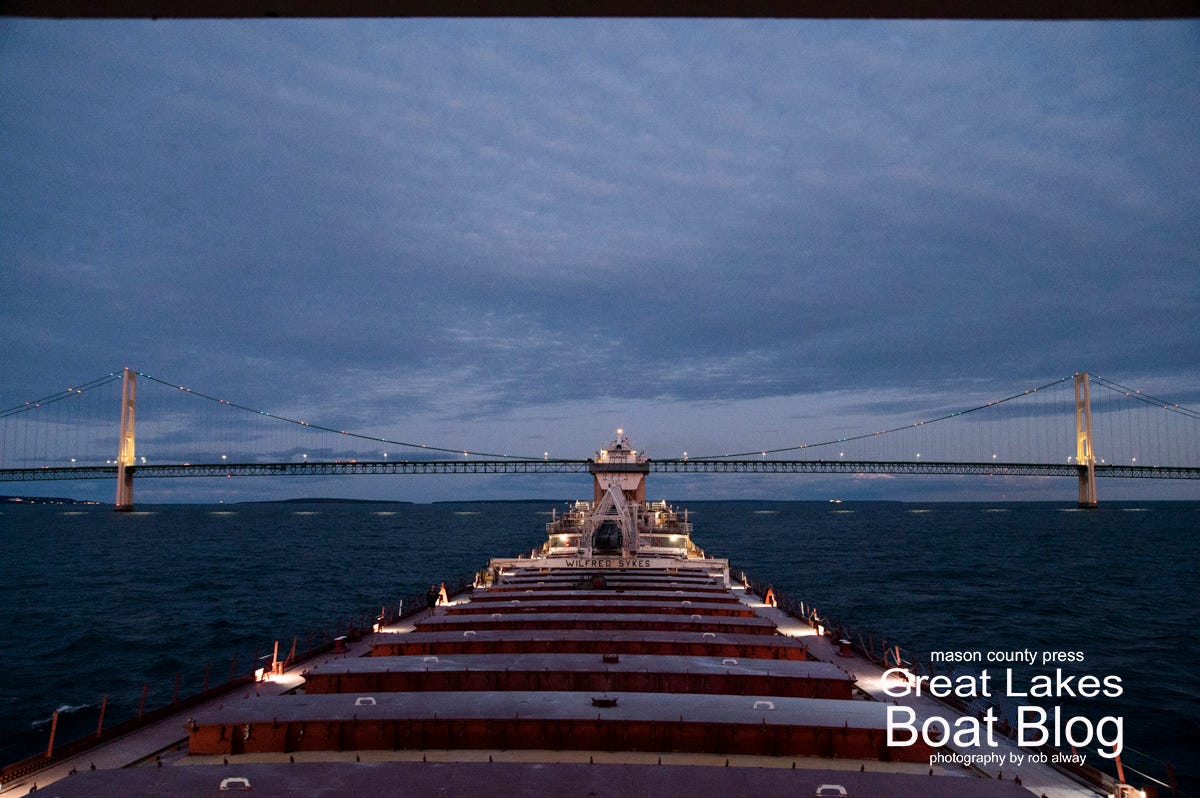
I have crossed the bridge countless times in a vehicle, looking down at the waters of the Straits of Mackinac. But this time, I was looking up, standing aboard a Great Lakes freighter as it passed beneath one of Michigan’s most recognizable landmarks.
For the crew, it was another trip through the Straits.
For me, it was thrilling.
What I appreciated was that the crew understood that. Something that is routine for them can be a once-in- a-lifetime experience for someone else. Nobody diminished the excitement.
And I knew I was going to get to do it again on the return trip.
We actually left Port Dolomite earlier than originally planned and without all of the stone we intended to take.
The loading equipment had broken down again, and the quarry crew estimated it could be another hour or two before repairs were completed.
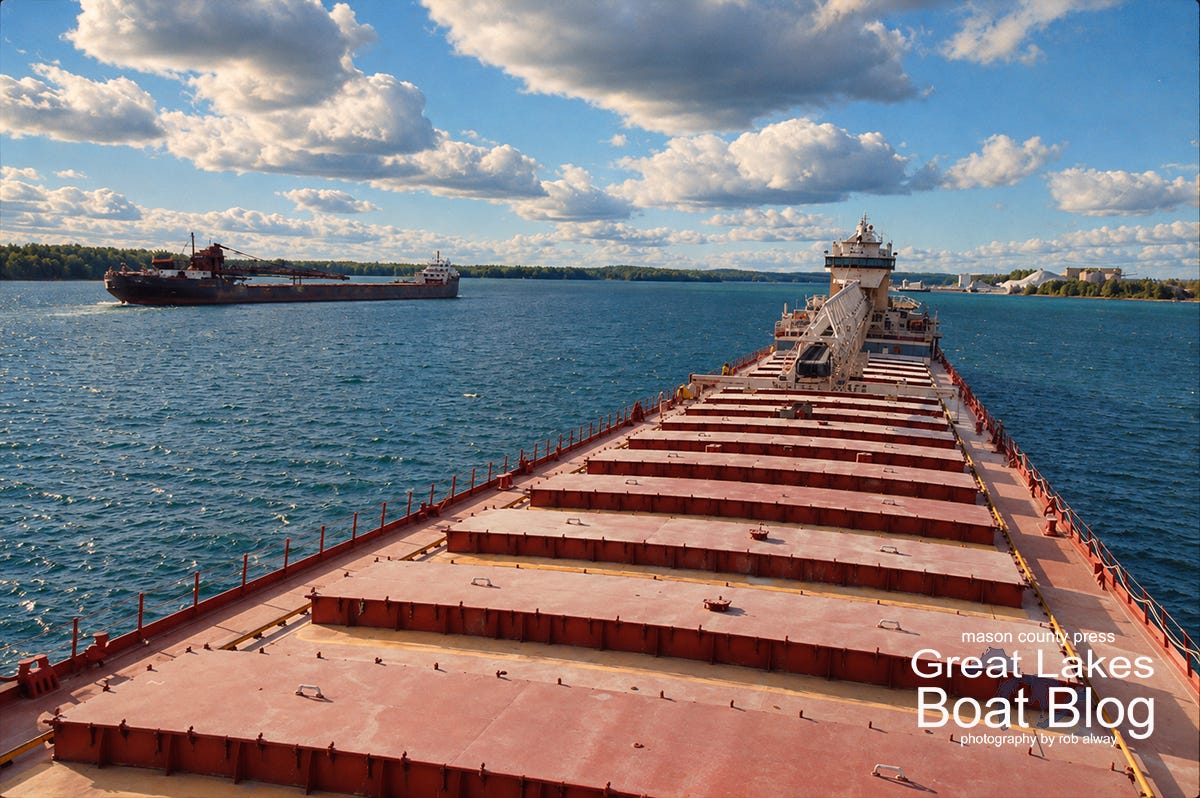
Meanwhile, the M/V Sam Laud was headed toward Port Dolomite from Green Bay, Wisconsin
Cracraft had another calculation to make.
If we waited for the repair and the Sam Laud reached Port Dolomite ahead of our return, the Sykes could face another lengthy delay. We already knew we would probably have to wait at Port Inland for the Saginaw, which had itself been delayed by wind.
The decision was made to leave.
Our run toward Port Inland was a little rough.
The guest accommodations are comfortable, but there is one disadvantage to sleeping in the extreme forward end of a 678-foot ship: You feel the bow move.
I generally do not get seasick, but I had developed a slight headache. I had come prepared with Less Drowsy Dramamine, ginger chews and acupressure wristbands just in case.
Cracraft warned me before I went to sleep that I would probably hear the anchor drop around 3 a.m.
The anchor machinery was almost directly below me.
He was correct.
At about 3 a.m. there was absolutely no question that the Sykes had arrived at Port Inland.
The anchor dropped.
At some point it was adjusted.
Around 6 a.m. it came back up.
I went back to sleep.
By the time I woke about an hour later, we were tied up at Port Inland.
Port Inland has its own industrial landscape. The operation was originally developed by Inland Steel in 1929 and 1930 to provide limestone for its steelmaking operations. The quarry itself is several miles inland. Stone is crushed, sorted and transported toward the lakeshore, where stockpiles feed conveyors leading to the ship-loading dock.
It is a place built around one purpose: moving enormous quantities of stone.
Loading was completed that morning and at 11:30 a.m. we departed Port Inland bound for Burns Harbor, Indiana.
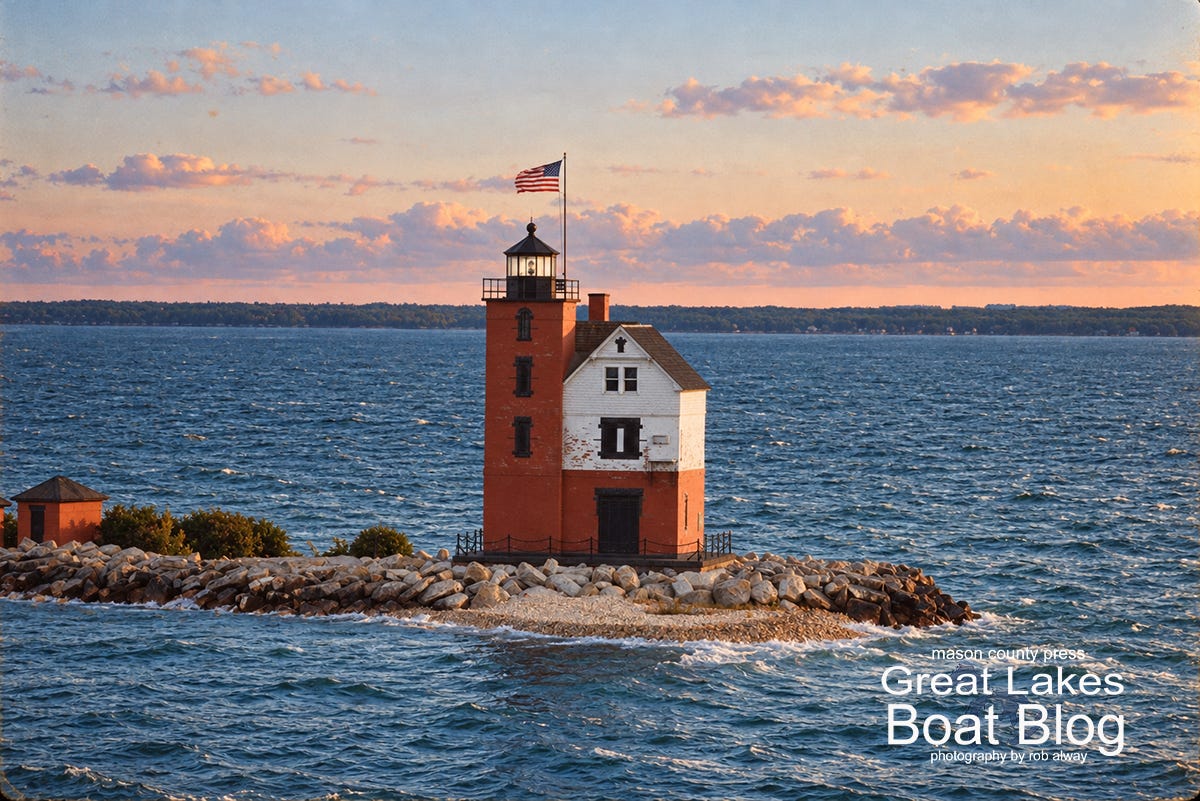
The rest of Monday was one of those days that explains why people are drawn to the Great Lakes.
Lake Michigan was beautiful.
Traveling south, I was able to see the western shores of Beaver Island, the Fox Islands and the Manitou Islands, along with Sleeping Bear Dunes National Lakeshore. By evening, as we passed Manistee, Michigan, the sunset over Lake Michigan was magnificent.
I had hoped there would still be enough daylight to see Big Point Sable.
There wasn’t.
But several miles offshore, the Ludington, Michigan Pumped Storage Plant illuminated the lakeshore. Beyond it, the synchronized red aviation warning lights atop the 56 wind turbines of Consumers Energy’s Lake Winds Energy Park flashed in unison against the darkened sky.
The next morning brought an entirely different experience.
As the Sykes approached Burns Harbor about 7:30 a.m. Tuesday, I made my way down to the engine room.
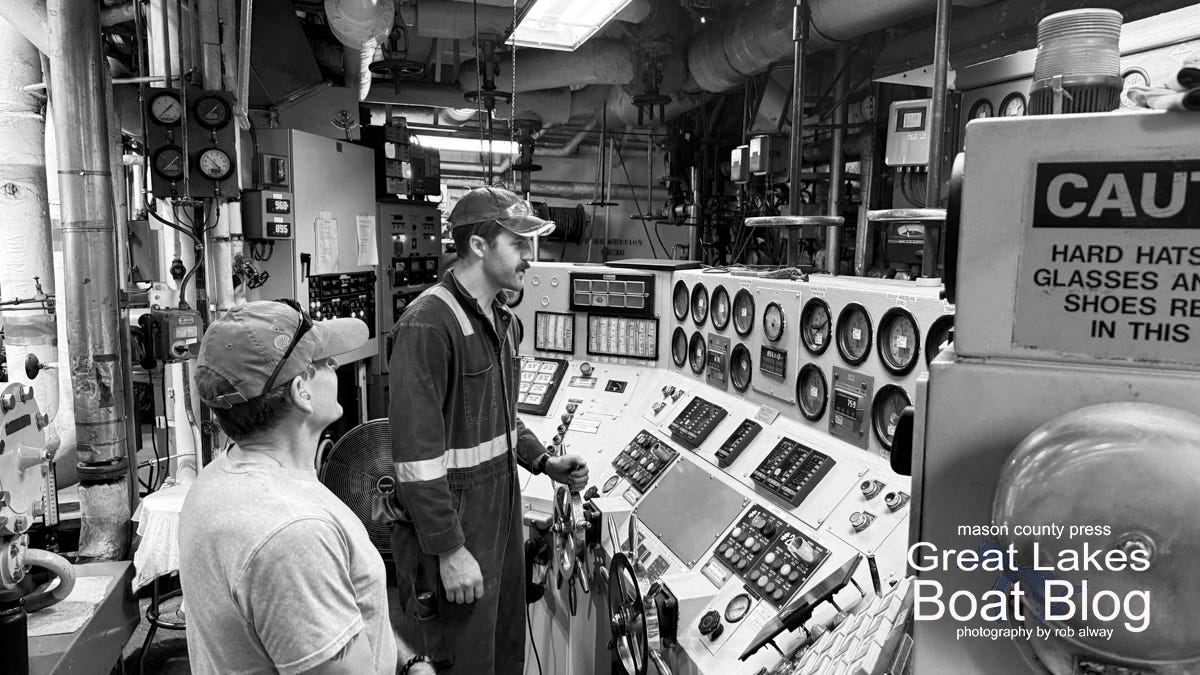
Chief Engineer Mark Nickerson invited me into the engine control area. Under the guidance of Nickerson and Third Assistant Engineer Tyler Gray-Hoehn, I was allowed to work the controls as the Sykes approached the harbor, controlling steam to the turbine and watching the ship’s revolutions per minute.
There are very few places left where a person can stand inside the engine room of a working Great Lakes steam freighter, much less have the opportunity I was given.
The Sykes is one of the survivors of an entirely different technological era.
Burns Harbor was impressive from the deck, but it is even more impressive when you understand what the facility actually is.
Cleveland-Cliffs Burns Harbor is a fully integrated steelmaking complex stretching along the southern shore of Lake Michigan. It operates two blast furnaces and has the capacity to produce nearly 5 million net tons of raw steel annually. The site takes raw materials arriving by ship and rail and turns them into steel products used in automobiles, appliances, construction, pipe and a variety of other products.
Farther west, Cleveland-Cliffs’ Indiana Harbor complex in East Chicago, Indiana is another of North America’s largest integrated steelmaking facilities.
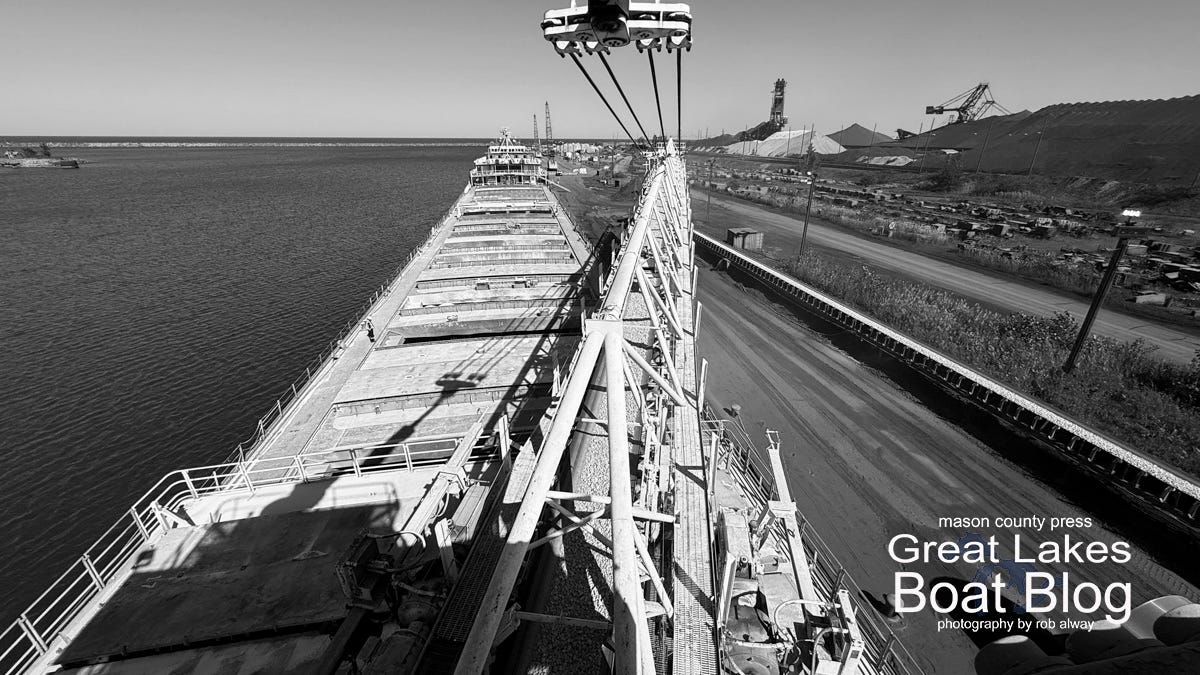
Those mills help explain why ships such as the Sykes exist.
The stone beneath my feet had been blasted out of Upper Peninsula quarries, loaded aboard a vessel built three-quarters of a century ago and carried hundreds of miles to become part of one of the most fundamental industrial processes in the country. Much of the equipment moving the limestone on the land appeared to be much older than the Sykes.
The crew told me I must have been a good luck charm at Burns Harbor.
The unload went almost flawlessly.
Apparently that is not always the case.
We finished unloading and departed about 10 p.m.
Burns Harbor had also given us a final taste of summer. The temperature reached about 75 degrees with sunshine. Even better, the wind blew the right direction, carrying the limestone dust away from the ship instead of over it.
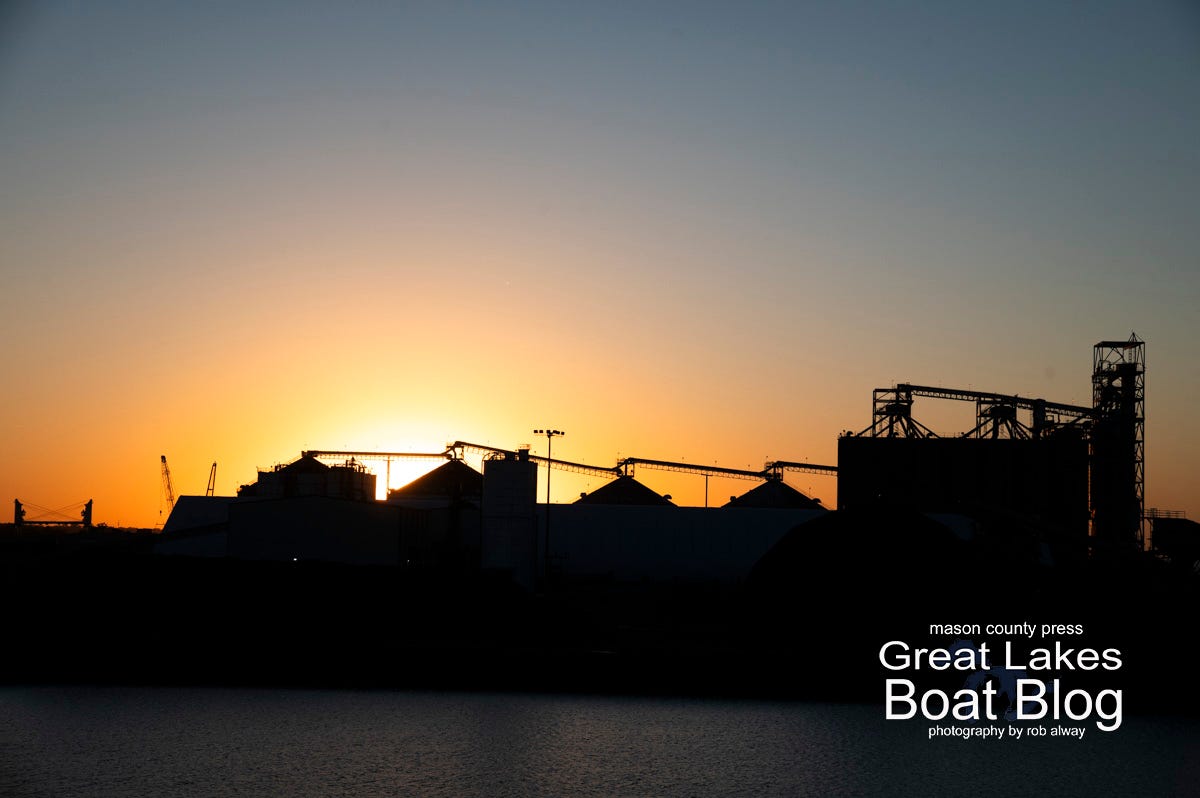
Throughout the day I could see the Chicago skyline about 30 miles across Lake Michigan.
At night, the view became even better.
The lights of the city stretched across the horizon while a seemingly endless procession of airplanes descended toward and climbed away from Chicago.
Eventually the city lights disappeared behind us.
The airplanes faded.
The sky became filled with stars.
The lake was smooth.
Tomorrow: Aboard the Wilfred Sykes: Part 3. A ship is its crew

Help support this Substack page and check out our merchandise store.
This story is copyrighted 2026 by Sable Points Media.