


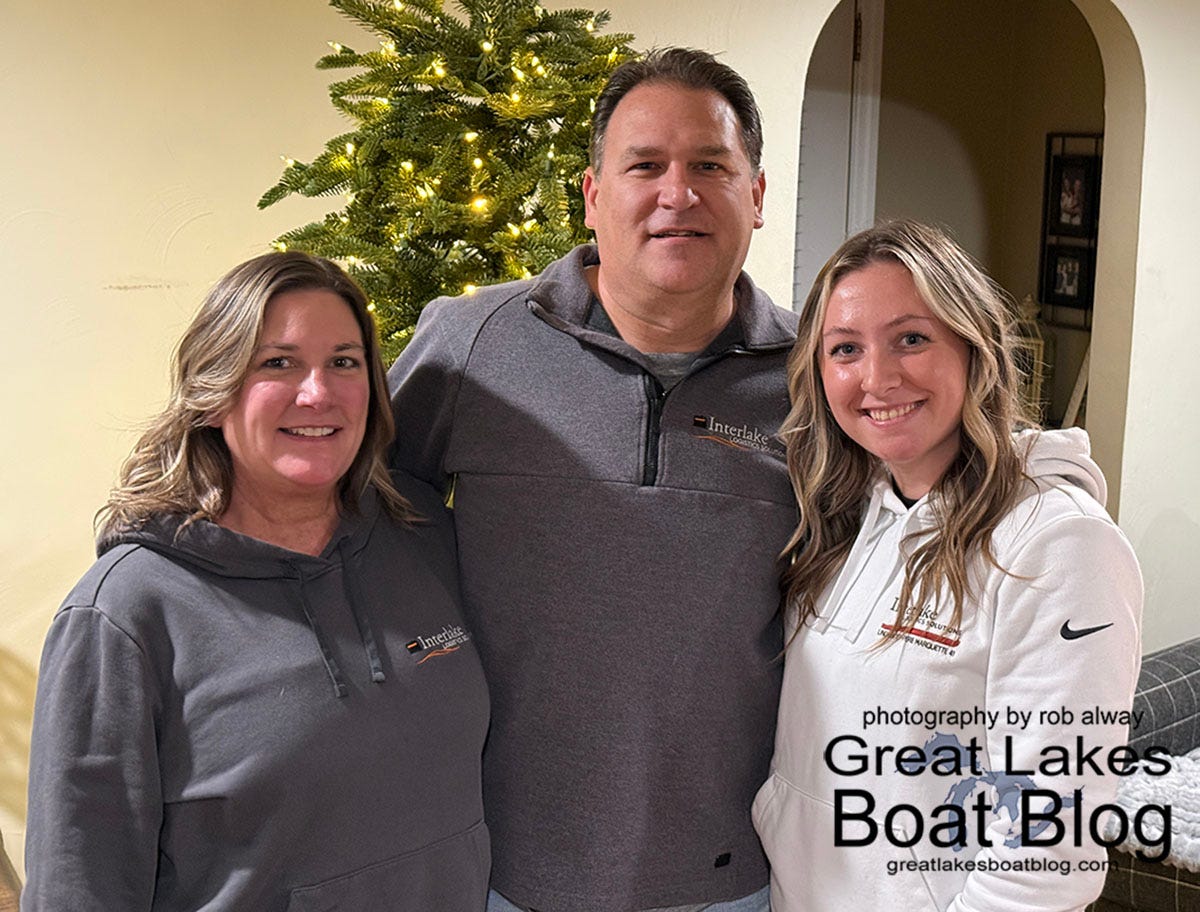
For 17 years, the Jankowski family has navigated the challenges of a maritime career that takes Capt. Brian Jankowski away from home for weeks or even months at a time. His career aboard the tug Undaunted has been a family journey shaped by separation, sacrifice, unexpected homecomings and a shared love of the Great Lakes.
By Rob Alway
When Taylor Bentz was growing up in Ludington, Michigan, she never knew exactly when her stepfather, Brian Jankowski, would be coming home. Sometimes he would be gone for a month. Other times it might be two or three months. And when he finally returned, there was always the uncertainty of when he would have to leave again.
But Taylor, now 23, remembers the surprises.
There was the year Brian unexpectedly flew home for her birthday, bringing her flowers. His visit was brief. He had to turn around and return to work.
There were other times when he would unexpectedly show up at one of her high school soccer games.
Those moments helped make the long absences easier.
“He would always try and find little things to make it easier,” Taylor said. “Like the one year he flew home unexpected for my birthday, brought me flowers, and then he turned around and left. He would show up at my soccer games when I was in high school, just randomly surprising me.”
For the Jankowski family, those unexpected homecomings have been part of life for nearly two decades.
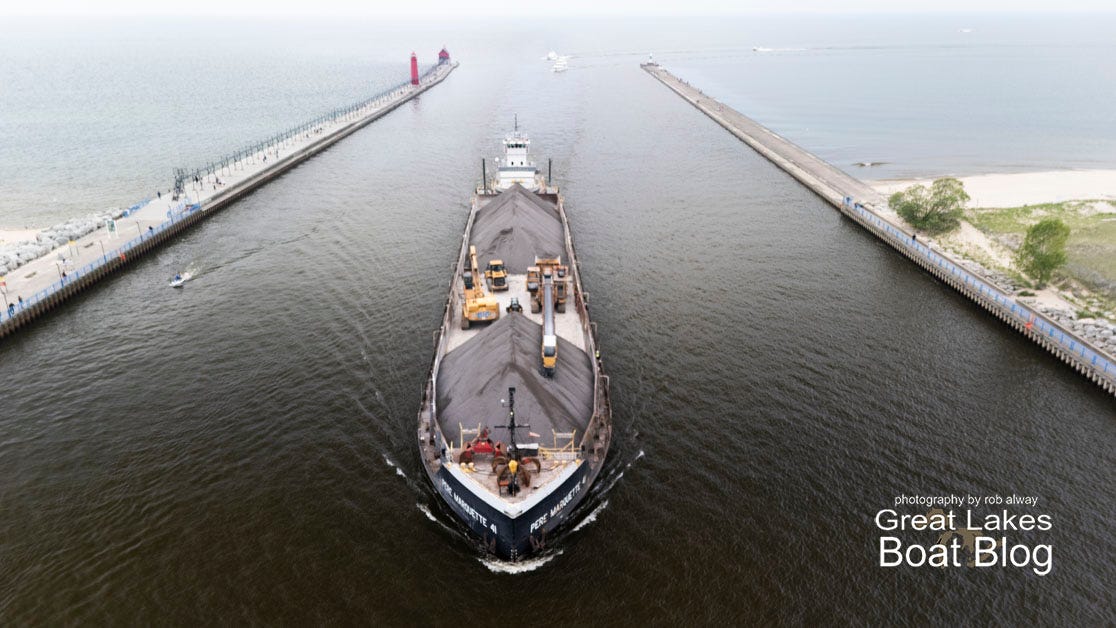
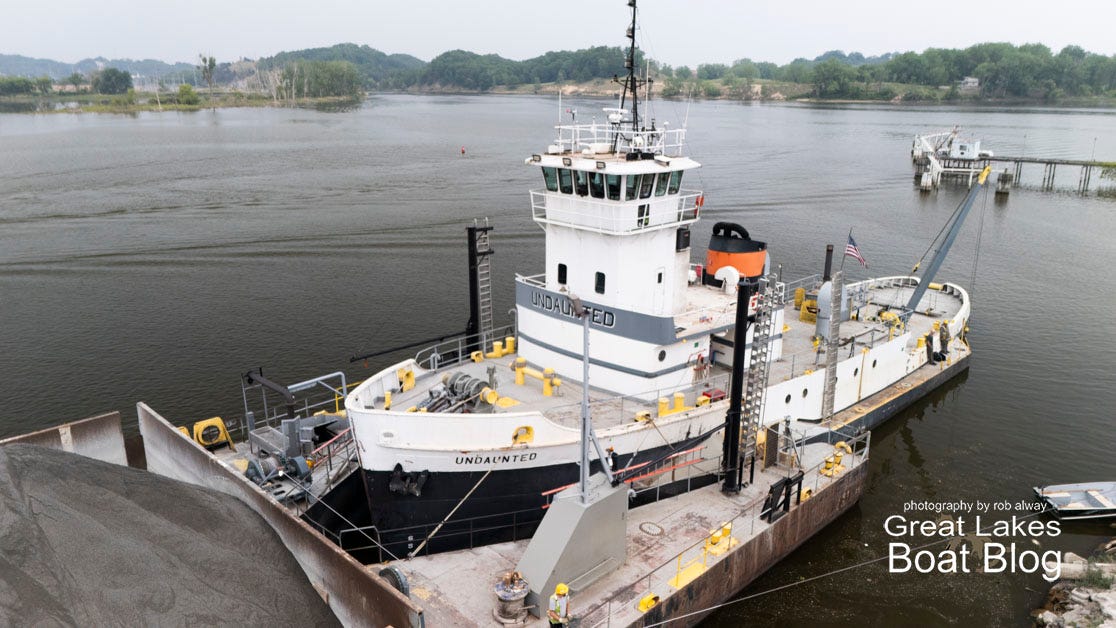
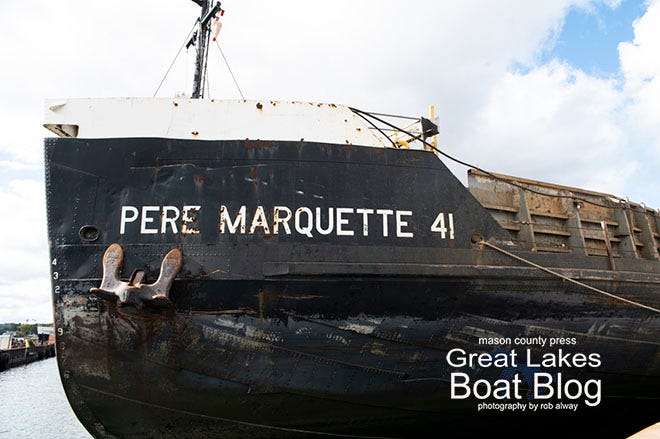
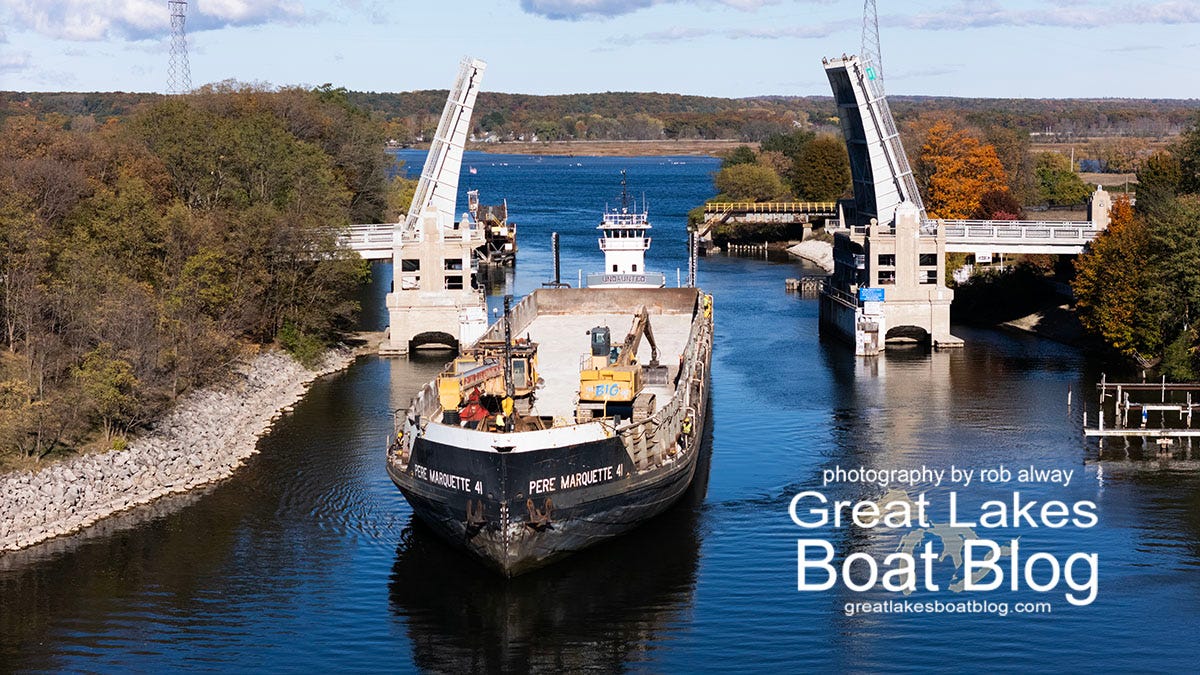
Brian is one of two captains of the articulated tug/barge Undaunted/Pere Marquette 41, a commercial Great Lakes vessel based in Ludington and operated by Interlake Logistics Solutions.
He and his wife, Laurie, have been together for 17 years and live in Ludington, a Lake Michigan port with a long history of commercial shipping and railroad carferry operations.
Brian is completing his 26th shipping season aboard Undaunted, having worked his way from an entry-level deckhand to master of the vessel. He has been a captain for nearly 15 years.
Today, his work schedule is three weeks aboard the tug, followed by three weeks at home. It is a predictable rotation that the family has come to appreciate.
But it was not always that way.
Learning to live with a mariner
Laurie knew Brian was a Great Lakes sailor when they began dating. At the time, he was a mate aboard Undaunted, and being separated for extended periods was already part of their relationship.
When they married, Taylor was 6 years old.
“I married into it,” Laurie said. “I was used to him coming and going while we dated. That’s what we were used to.”
Still, she said, adjusting to the realities of married life and raising a child while Brian was away was difficult.
During much of their marriage, there was no consistent rotation. Brian might be away for a month or two, return for a couple of weeks and then leave again.
There were times when he would tell Laurie he expected to be home soon, only to call a few days later with news that his return had been delayed.
The couple recalled one time when he was aboard the vessel for 12 consecutive weeks.
For Laurie, one of the greatest challenges was not necessarily managing the household alone. It was adjusting to having her husband home after she and Taylor had established their own routines.
“The hardest thing, kind of just with us, was finding the balance when he’d come home from Taylor’s routine while he was gone to him coming back home and figuring out a different routine,” she said.
Brian described the adjustment with a bit of humor.
“Basically, I was captain out on the boat, and I come home and I’m not captain anymore,” he said.
Aboard Undaunted, Brian is responsible for the vessel, her crew and the decisions associated with navigating Great Lakes waters. At home, he is a husband and stepfather returning to a household that has been functioning without him.
Laurie and Taylor had established their own ways of handling daily responsibilities. Brian sometimes had different ideas.
“We have our ways of doing things, and then he comes home,” Laurie said. “Sometimes he thinks it’s better a different way, and sometimes it is better. But we get into our routine and our habits.”
Taylor remembers those adjustments, particularly when she was younger.
School, sports, dinner schedules and household expectations could change when Brian returned.
She jokingly described the difference between her mother’s rules and those of her stepfather.
“There’s mom rules,” Taylor said.
And then, as Brian pointed out, there are “Captain Dad rules.”
Taylor said Laurie generally took a more easygoing approach to household chores and responsibilities. Brian, accustomed to the discipline and expectations of working aboard a commercial vessel, sometimes had different standards.
It took time for everyone to adjust.
“I think we’re in the groove now,” Laurie said. “We’ve got it all figured out, and things are easy. But it was very difficult at first.”
Brian agreed that both had to make adjustments.
For Taylor, one of the hardest parts was getting accustomed to Brian being home, only to have him leave again.
“When I was little, it was definitely hard because he would come home and I wouldn’t really know how long he would be home for,” she said.
As she has gotten older, the separations have become easier to manage. But the memories of those early years remain.
A career that began by accident
Brian never set out to become a Great Lakes captain.
Born in Michigan, he spent five years living in Colorado before returning to Mason County, Michigan, for his senior year of high school. He graduated from Mason County Central High School in 1991.
In his early 20s, he was moving from one job to another, uncertain of what he wanted to do.
“Actually, it was by mistake,” Brian said of how his career began. “I was floating from job to job in my early 20s, and a guy I knew worked out on the boat as the mechanic, and he said, ‘Why don’t you come try it out?’”
The plan was simple: Brian would go aboard for two weeks, experience the work and decide whether it was something he wanted to pursue.
The two weeks turned into five.
Brian discovered that he enjoyed the work and the lifestyle.
He also found that the discipline of working aboard a commercial vessel was good for him at that point in his life.
“It kept me out of trouble,” he said. “I was in my mid-20s. Out on the lake there was zero tolerance. I couldn’t get in trouble out there. I wasn’t spending money out there. It was great.”
His maritime career began with some of the least glamorous work aboard the tug.
He recalled reporting for winter maintenance in February, cleaning rust and debris from the vessel’s bilges with a small hand shovel. He collected the material in buckets and carried it up and out of the vessel.
From there, he learned to operate the machinery and gradually took on greater responsibilities.
He eventually advanced to mate and then captain.
It was a traditional maritime career path known as coming up through the hawsepipe — advancing through practical experience, training and the required credentials rather than attending a maritime academy.
Brian has remained with Undaunted throughout his maritime career.
What was supposed to be temporary employment turned into a lifelong occupation.
“I absolutely love it,” he said. “I wouldn’t do it if I didn’t, because you do give up a lot.”
Laurie said his enthusiasm for sailing becomes particularly apparent near the end of winter.
When Brian has been home for an extended period, she said, he begins getting restless and looking forward to the start of another shipping season.
A demanding job on a smaller vessel
The Undaunted/Pere Marquette 41 is not like a typical Great Lakes freighter.
The 143-foot tug Undaunted pushes the 403-foot barge Pere Marquette 41, which was originally the railroad carferry City of Midland 41.
Together, the articulated tug/barge measures approximately 494 feet long. The tug fits into a notch at the stern of the barge and is mechanically connected to her.
The vessel transports bulk cargo such as limestone and construction aggregate throughout the Great Lakes. Her smaller size allows her to serve ports and handle cargoes that may not be practical for larger freighters.
But for her captain, the frequent trips between ports create a demanding schedule.
Unlike some large freighters that spend extended periods traveling between loading and unloading destinations, the Undaunted/Pere Marquette 41 frequently makes relatively short trips.
Brian said the vessel might visit three different ports in a 24-hour period.
That means three harbor arrivals, three departures and multiple dockings, each requiring careful navigation.
“There is no average day,” Brian said. “As captain, you’re up and down. You get a couple-hour nap here, couple-hour nap there.”
The vessel’s pilothouse operations are also different from those on many larger Great Lakes ships.
Brian said the tug does not carry a wheelsman. The captain or mate personally handles the vessel’s navigation and steering during his watch.
“It’s a one-man pilothouse,” he said.
The crew includes the captain, first mate and second mate, who share the responsibilities of operating the vessel around the clock.
In addition, there is a chief engineer, an engine utility worker, a mechanic, a cook and between three and five deckhands, bringing the typical crew to approximately 10 to 12 people.
The crew’s workload has increased as the operation has become more efficient over the years, with additional deckhands needed to handle the frequent loading and unloading of cargo.
Brian said captains accustomed to much larger Great Lakes vessels have occasionally worked aboard Undaunted and been surprised by the demands of the operation.
Some have told him that the workload was greater than what they experienced aboard a 1,000-foot freighter.
The repeated maneuvering, tight schedules and interrupted sleep create a different kind of maritime work.
And while Brian enjoys navigating rivers and confined waterways, there is one aspect of those trips he does not particularly like: bridges.
It is not necessarily the challenge of handling the vessel through a bridge opening. It is the uncertainty of whether a bridge will open when needed, particularly during the overnight hours.
“You never know if you’re just waking them up,” he said, referring to bridge operators when the vessel arrives at 2 or 3 a.m.
Despite the demanding work, Brian said he enjoys what he does.
Two vessels with historic roots
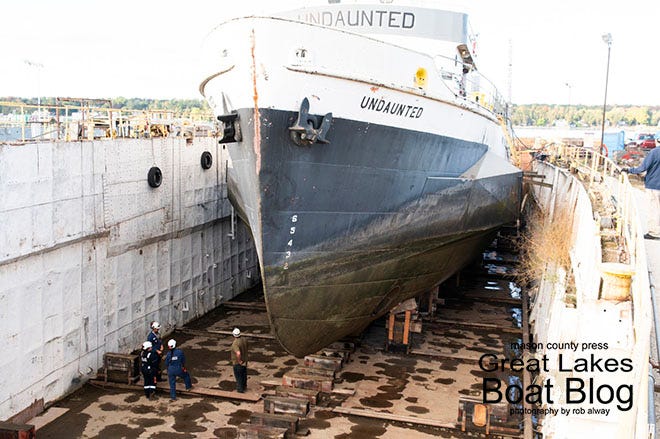
The Undaunted/Pere Marquette 41 is especially significant to Ludington’s maritime history because both vessels have histories extending back to World War II.
Pere Marquette 41 was built in 1941 by Manitowoc Shipbuilding Co. in Manitowoc, Wisconsin, as the Pere Marquette Railway’s railroad carferry City of Midland 41.
She served the Ludington carferry fleet until 1988, when she was removed from active service.
In 1997, she was converted into a self-unloading barge as part of a new shipping operation, Pere Marquette Shipping, designed to transport bulk cargo throughout the Great Lakes. Pere Marquette Shipping was a subsidiary of Lake Michigan Carferry, which operates the historic steam carferry Badger.
Undaunted has an equally notable history.
The tug was originally built for the U.S. Navy during World War II. She entered service in 1944 as ATA-199 and performed towing duties in the Pacific theater.
Following her military career, she served in several other capacities, including as a training vessel for the U.S. Merchant Marine Academy.
In 1998, she was acquired and rebuilt for service with the newly converted Pere Marquette 41.
The operation, along with Lake Michigan Carferry, was acquired by Interlake Maritime Services in 2020 and continues to be based in Ludington.
Brian appreciates the history of the vessels he operates.
“Oh, I love history,” he said. “I love learning about the history of everything.”
He also credits Chuck Leonard, manager of Interlake’s Ludington operations, who has been involved with the tug/barge operation for decades.
Brian said Leonard has worked tirelessly to keep the vessel employed and her crew working.
“The success of this tug/barge is due to him,” Brian said. “He works very hard to keep us busy.
“Chuck is by far the best boss I have ever had.”
Brian also praised Interlake for providing the resources needed to maintain the operation and said the company’s acquisition of the business has been positive.
A family’s view from aboard
For Laurie and Taylor, understanding Brian’s job became easier after they had an opportunity to experience life aboard the vessel themselves.
When Taylor was in third grade, Laurie had recently closed the group daycare business she operated from their home.
The two joined Brian aboard Undaunted for a weekend trip, traveling from Charlevoix, Michigan, to Cedarville, Michigan, and then to Ludington.
The trip included passing beneath the Mackinac Bridge twice, an experience Taylor particularly remembers.
She even had an opportunity to steer the tug.
But the trip was not simply a sightseeing excursion. It provided both Laurie and Taylor with a firsthand understanding of Brian’s working conditions.
Laurie remembered the frequent interruptions to his sleep as the vessel traveled between ports.
“I honestly don’t know how he does it with that sleep,” she said.
She recalled Brian being up and down every three or four hours.
The family also encountered difficult weather, including strong winds, waves and dense fog.
For Laurie, the experience was unsettling. For Brian, handling those conditions was part of his profession and just another day on the job.
The accommodations aboard the tug were another adjustment.
With limited space in Brian’s quarters, Taylor slept on the metal floor. She also experienced some seasickness.
But the trip became a memorable experience.
Taylor later used what she learned to prepare a school project about the history of Pere Marquette 41, including her earlier service as a railroad carferry.
She also spent time helping in the galley.
For Taylor, one of the most lasting impressions was the close relationship between the crew members and their families.
An extended family aboard the tug
The crew of Undaunted has become something of an extended family for Laurie and Taylor.
When the vessel is docked in Ludington or another nearby port, they sometimes visit Brian and share a meal with the crew.
Taylor has particularly fond memories of Don Moss, the vessel’s cook.
She remembers a special drawer filled with candy, a supply of ice cream and the occasional breakfast aboard the tug before school.
But one of Don’s traditions has continued through the years.
“Every year he makes sure that I get a birthday cake made — well, a birthday cookie actually,” Taylor said. “But he gets it sent home one way or another around my birthday.”
It is a small gesture that reflects the relationship the crew members have developed with the family.
Taylor said that whenever she and Laurie visit the vessel, they are welcomed.
“That’s definitely my favorite part,” she said of getting to know the people Brian works with.
Laurie agreed.
“They welcome us,” she said. “They’re just super loving and welcoming.”
The relationship goes both ways.
Each Christmas, Laurie prepares cookies for the crew, something Brian said the sailors look forward to receiving.
Making family time a priority
Laurie has also made changes in her professional life to accommodate Brian’s work schedule.
For several years, she operated a group daycare business from her home, caring for as many as 12 children.
It was work she loved.
But when Brian returned from weeks or months aboard the tug, he often found a house filled with children.
For someone accustomed to living and working in the confined quarters of a commercial vessel, coming home to a busy daycare was not necessarily relaxing.
Laurie eventually closed the business.
She said it was a difficult decision because the children she cared for had become like family.
“It wasn’t just quitting a job,” she said. “It was family. Those kids were like my kids.”
Brian recognizes the sacrifice she made.
“It was a sacrifice she made for me because she loves kids, and she loved her daycare,” he said.
The change also allowed Laurie to become more involved in Taylor’s school activities and sports.
Today, Laurie works part time at the Purple Monkey in downtown Ludington.
Her work schedule provides flexibility around Brian’s rotations. She generally works more hours when he is sailing and fewer when he is home.
That allows the couple to spend more time together during his three-week breaks.
Laurie said it is a lifestyle they have worked hard to establish.
Staying connected across the lakes
Communication has improved dramatically since Brian began sailing more than two decades ago.
When he first entered the maritime industry, cellphones offered limited coverage, particularly when a vessel was far offshore.
He remembered a time when crew members would line up at payphones on the docks to call their families.
As cellular service improved, sailors could often maintain contact while traveling near shore.
Brian said he sometimes preferred remaining within cellular range for safety reasons because of the vessel’s relatively slow speed, although the tug also carried a satellite phone.
Today, satellite internet provides a much more reliable connection.
Brian and Laurie typically communicate through FaceTime twice a day, once in the morning and again at night.
“We can call home anytime,” Brian said. “So it definitely helps.”
Technology has also allowed Brian and Taylor to maintain their relationship as she has grown older.
Instead of relying entirely on telephone conversations, the two now often exchange videos through TikTok.
Taylor said that has become one of their ways of staying in touch during his absences.
The ability to communicate frequently does not replace having Brian home, but it makes the separation easier.
Technology has also changed how Laurie feels about Brian’s safety.
When they first married, Brian was a mate. Laurie said she often worried about the weather and the decisions being made aboard the vessel.
Now that Brian is captain, she has greater confidence because she knows how he approaches those decisions.
“Now that he’s captain, I know he’s very safe,” she said. “I know he’s not going to take the boat out when he shouldn’t be.”
Brian said marine weather forecasting has improved considerably during his career.
When he began sailing, crews relied on weather reports delivered through fax machines and other limited sources.
Today, mariners have access to multiple forecasting websites and other information that helps them monitor developing conditions.
That has made it easier to avoid dangerous weather.
“We can see weather coming well in advance,” Brian said.
The challenges of a maritime career
For all the benefits Brian has found in sailing, he acknowledges that maritime employment is not for everyone.
Long hours, physically demanding work, rough weather and extended absences from family can be difficult for someone entering the industry.
Brian said Undaunted has seen new employees discover that the lifestyle is not what they expected.
Some leave after realizing the work and conditions are not a good fit.
“It is definitely not for everyone,” he said. “You have to have some kind of passion to go in and do what we do.”
The vessel’s frequent short voyages and busy loading and unloading schedule also mean there is little resemblance to the leisurely travel that people sometimes associate with life on the water.
Even a visit to Ludington, the vessel’s home port, can be demanding.
For Laurie, seeing the tug arrive in Ludington provides an opportunity to visit Brian without traveling far.
For Brian, it can mean one of the busiest stops of the voyage.
Supplies must be loaded, equipment needs attention, and family members may be coming aboard.
And while all of that is happening, the crew is still responsible for the vessel’s cargo operations.
Brian said he actually prefers ports where the vessel can arrive, complete her work and depart with fewer complications.
Ludington, despite being home, is not necessarily his favorite port.
But it remains one of Laurie’s favorites because it brings Brian close to home, even if only briefly.
Finding a balance between two worlds
After 26 seasons, Brian knows the demands of his profession better than most.
He has spent nearly his entire adult career aboard the same tug, advancing from shoveling rust out of the bilges to commanding a vessel that carries cargo throughout the Great Lakes.
He has navigated rivers and harbors, worked through difficult weather, dealt with changing schedules and spent countless nights away from his family.
At home, Laurie and Taylor have experienced that career from a different perspective.
They have learned to manage the household, adjust routines and accept that the person they love may be hundreds of miles away when something important happens.
The more predictable three-weeks-on, three-weeks-off rotation has made those challenges easier.
But the family knows that a maritime career still requires sacrifices.
For Laurie, it has meant adjusting her work and family life around Brian’s schedule.
For Taylor, it has meant growing up with a stepfather whose job could take him away for months at a time.
And for Brian, it has meant recognizing that the authority he carries aboard Undaunted does not necessarily follow him through the front door of his Ludington home.
The family has learned to find humor in those differences.
More importantly, they have learned to make the most of their time together.
It's great learning about those who pass us by when I've been out on White Shoal Lighthouse.