


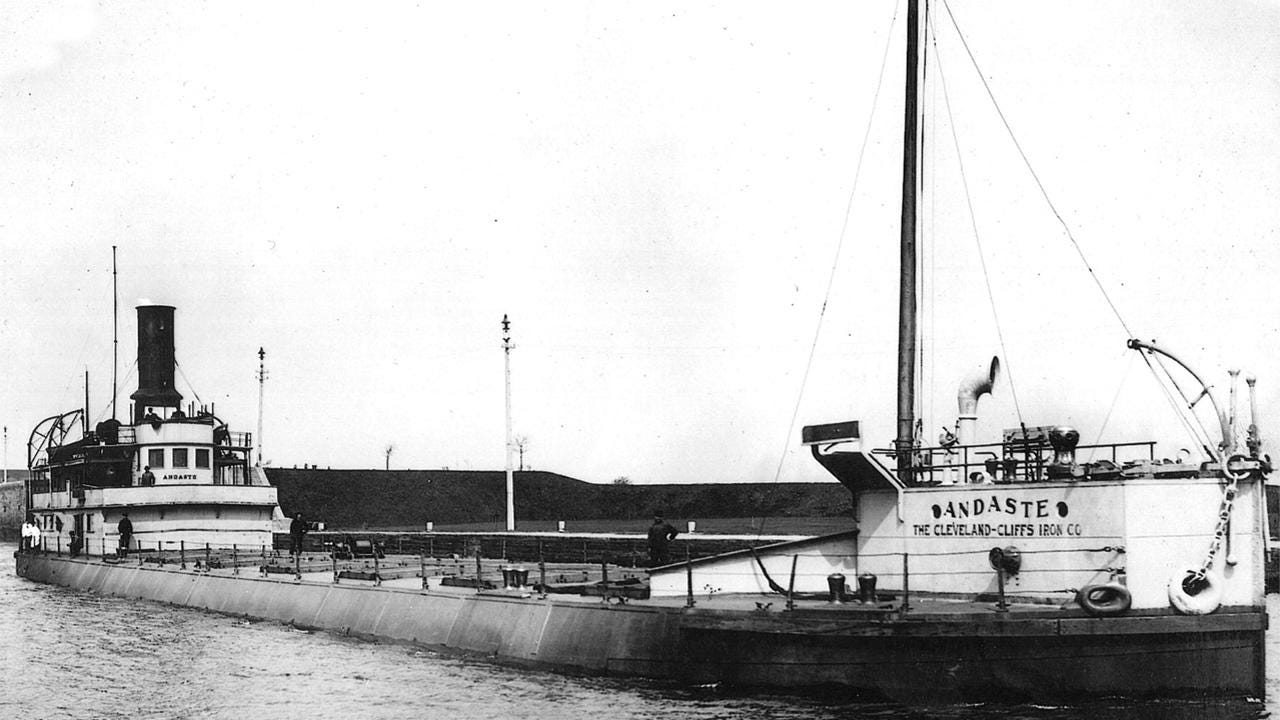
Part 1: SS Andaste
By Rob Alway
The final four months of 1929 were especially deadly for shipping on Lake Michigan. At least four shipwrecks resulted in the deaths of more than 100 people. This series examines those disasters and compares the circumstances that contributed to the complete loss of some crews while others survived.
The vessels lost included the SS Andaste (Sept. 9), SS Milwaukee (Oct. 22), SS Wisconsin (Oct. 29) and SS Senator (Oct. 31). Two of those wrecks claimed everyone aboard. Neither the Andaste nor the Milwaukee, the two vessels lost with all hands, carried wireless radio equipment.
Of those four wrecks, two resulted in the loss of everyone aboard. Neither of those ships, the Andaste and the Milwaukee, was equipped with wireless radio.
This is the second of a four part series. Part 1 told the story of the sinking of the SS Milwaukee carferry. Part 3 will look at the sinking of the SS Wisconsin and Part 4 will examine the sinking of the SS Senator.
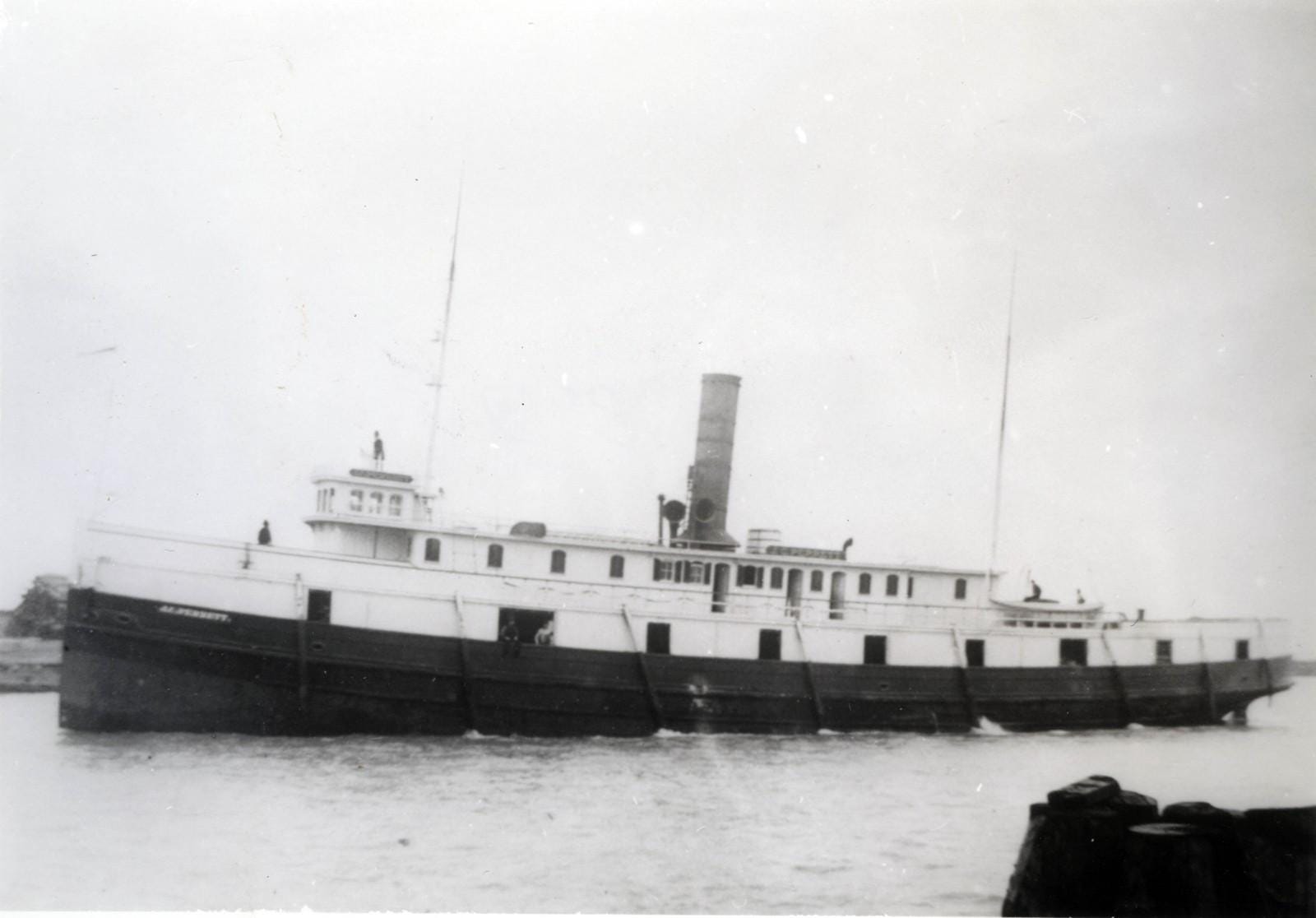
The history of the Andaste
The Andaste was a Monitor-class freighter constructed by Cleveland Shipbuilding Co. at Lorain, Ohio. She was launched March 31, 1892, for the Lake Superior Iron Company. Following that company’s bankruptcy in 1898, ownership passed to the Cleveland-Cliffs Iron Company.
As built, she measured 266.9 feet in length, with a beam of 38.1 feet and a depth of 17.9 feet. Her design included a cutaway stern, seven deck hatches and no interior bulkheads between the forward collision bulkhead and the engine bulkhead aft. She had a fully loaded capacity of 2,800 short tons.
Cleveland Shipbuilding Co. was established in 1888. In 1900, it became the American Ship Building Company after acquiring Superior Shipbuilding of Superior, Wisconsin; Toledo Shipbuilding of Toledo, Ohio; and West Bay Shipbuilding of West Bay City, Michigan.
According to historical records, the Andaste was among the earliest vessels built by the company.
Her name was a French designation for the Susquehannock people. Her sister ship, SS Choctaw, also constructed in 1892, was named for the Choctaw people. The Choctaw sank in Lake Huron on July 11, 1915, although all 22 members of her crew survived.
The two vessels featured an unusual hull design. They were straight-back steel freighters that resembled the more familiar whaleback vessels, but with straight sides and conventional bows.
Above the waterline, the hull sides angled inward, a design known as tumble-home. Vessels of this type were sometimes described as semi-whalebacks. Like traditional whalebacks, they could take substantial water across their decks during storms and gales.
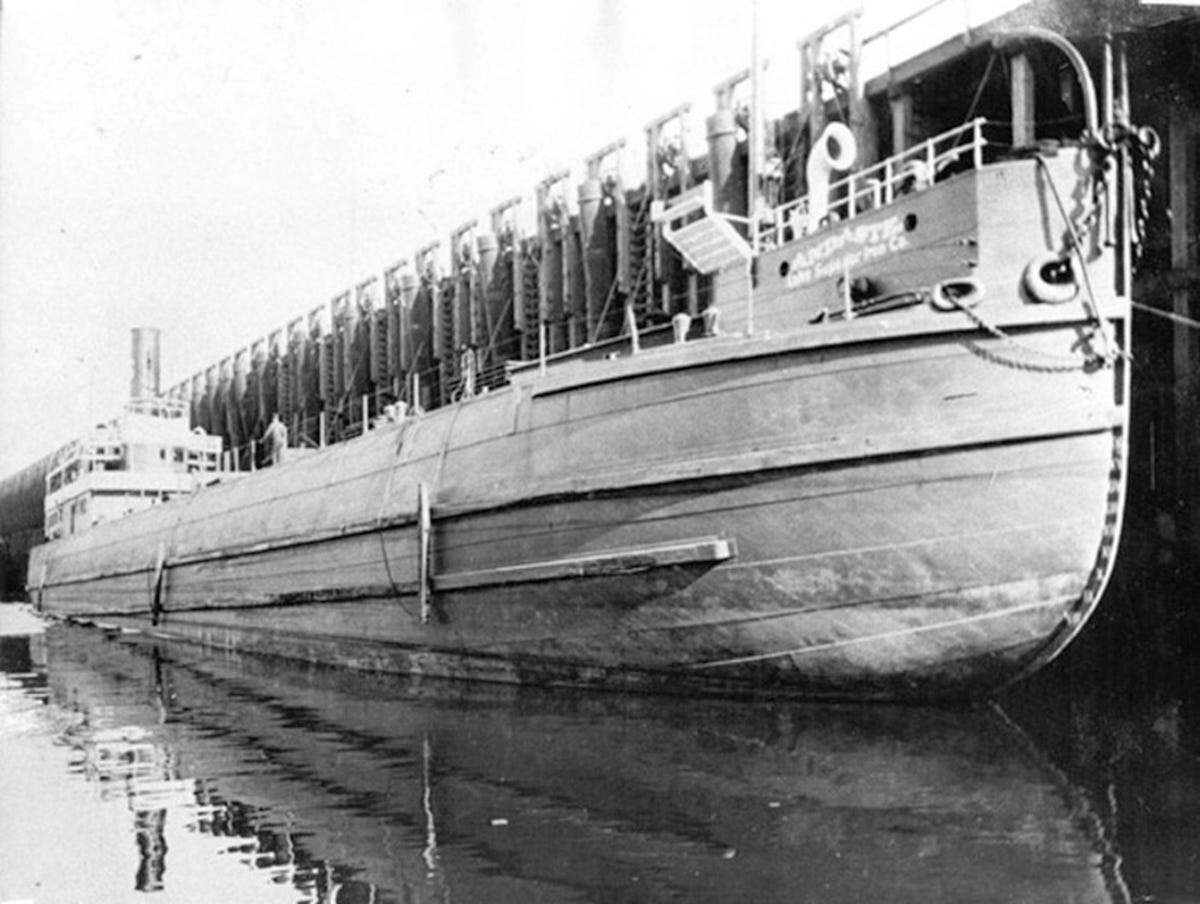
During the winter of 1920-1921, Great Lakes Engineering Works at Ecorse, Michigan, shortened the Andaste from approximately 266 feet to 246 feet. The modification allowed her to navigate the Welland Canal and St. Lawrence River.
Great Lakes Engineering Works operated from 1902 until 1960. Within three years of its founding, the company was responsible for building half the tonnage of new vessels constructed on the Great Lakes. Among its best-known achievements were construction of the SS Edmund Fitzgerald and development of the first self-unloading freighter, SS Wyandotte. The company was dissolved in 1961, when its assets were sold to Great Lakes Steel Corp.
In 1898, both the Andaste and Choctaw were transferred from Lake Superior Iron Company to Cleveland-Cliffs. They transported coal, iron ore and grain between Lake Superior and the lower Great Lakes.
Conversion to a self-unloader
In 1925, the Andaste was acquired by the Cliffs-L.D. Smith Steamship Company and underwent another major modification at Sturgeon Bay, Wisconsin.
The work converted her for transporting crushed stone and aggregate. A self-unloading crane was installed on her hull and frame, along with Leatham Smith tunnel scrapers intended to speed unloading and allow partial discharge at ports previously inaccessible to conventional bulk carriers.
Leatham Smith operated a quarry in Sturgeon Bay. In 1920, he patented a tunnel scraper unloading system to make transporting quarry stone to Chicago more efficient.
The equipment reduced the time needed to unload a large vessel from two or three days to a matter of hours. Because the scraper machinery occupied less space than earlier unloading equipment, it also increased available cargo capacity.
Smith’s operations eventually developed into L.D. Smith Shipbuilding at Sturgeon Bay, where 85 vessels were built. In 1944, the company became Christy Corporation, which later constructed the Chesapeake & Ohio Railway car ferries SS Spartan and SS Badger.
The original shipyard property is now occupied by Fincantieri Bay Shipbuilding Co.
Although the self-unloading conversion provided economic advantages, the additional topside machinery apparently affected the metacentric stability of some vessels equipped with the system.
Metacentric stability is a measure of a floating vessel’s initial resistance to heeling and her ability to return toward an upright position. Four vessels that underwent similar modifications were lost within a relatively short period.
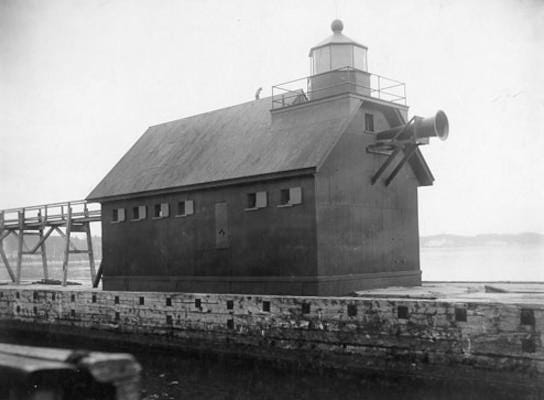
The final voyage
On Sept. 9, 1929, the Andaste was loading approximately 2,000 tons of aggregate from a glacial deposit of sand and gravel near the confluence of the Bass River and Grand River, about 12 miles southeast of Grand Haven.
The location, within Robinson and Allendale townships, is now part of the 1,665-acre Bass River State Recreation Area, owned by the State of Michigan and managed by the Michigan Department of Natural Resources.
Commanding the Andaste was Capt. Albert L. Anderson (1866-1929) of Sturgeon Bay, Wisconsin.
Anderson had spent 40 years sailing the Great Lakes, including 30 years as a licensed captain.
He was born Oct. 28, 1866, and grew up in Sturgeon Bay, where he graduated from high school. At age 32, he married Georgiana Remellard, according to an obituary published Sept. 20, 1929, in the Green Bay Press-Gazette.
The couple had a daughter, Madonna, and two sons, Merle and John, all of whom were living in Sturgeon Bay when their father died. Another son, Clifford, appears in an Ancestry.com family tree and may have died during infancy.
Anderson is buried at Bayside Cemetery in Sturgeon Bay.
Late on the evening of Sept. 9, the Andaste departed the loading site and traveled down the Grand River toward Lake Michigan, bound for Chicago.
The U.S. Coast Guard recorded her passing through the Grand Haven pierheads at 9:03 p.m. It would be the last confirmed sighting of the freighter.
About an hour after she left Grand Haven, strong winds developed across the lake.
Gale warnings had been issued, but the Andaste, which was not equipped with wireless radio, had no way to receive them.
The storm intensified through the night. By 1 a.m. Sept. 10, winds had reached 60 mph.
The Andaste never arrived in Chicago.
Search and recovery
Search efforts for the missing freighter began Sept. 11.
On Sept. 12, floating wreckage was discovered southwest of Holland. Among the debris were a cabin door and hatch strongbacks, which a former member of the Andaste‘s crew identified as belonging to the vessel.
Hatch strongbacks are structural supports used with hatch covers to keep them secured and watertight. They help prevent hatch covers from bending or collapsing under the force of heavy seas.
By Sept. 13, the Associated Press was reporting that the wreckage had been positively identified as belonging to the Andaste.
Eventually, the bodies of 16 of the 25 men aboard were recovered. Eleven of those men were wearing life jackets.
Among the missing was Earl Zietlow, a 14-year-old steward’s assistant who was making his first voyage.
During the search for bodies along Ottawa County beaches, searchers discovered a splintered piece of wood floating in the water.
Written on the wood in pencil was a desperate message:
“Worst storm I have ever been in. Can’t stay up much longer. Hope to God we are saved. A.L.A.”
The initials were those of Capt. Albert L. Anderson.
The investigation
A coroner’s jury was assembled to examine the circumstances surrounding the Andaste‘s loss.
A coroner’s jury consisted of citizens appointed to investigate accidental or suspicious deaths and, when necessary, establish the identity of the deceased.
The jury investigating the Andaste was made up of Holland businessmen who had an interest in improving safety on Lake Michigan.
One of the principal questions concerned the vessel’s condition and stability before she foundered.
The recovery of several bodies wearing life jackets led some investigators to suspect that the Andaste had become trapped in the troughs of the storm’s waves.
A vessel with compromised metacentric stability may be unable to recover after being struck broadside by a breaking wave. Once partially flooded, the vessel can roll into the trough between waves and fail to rise with the following crests.
Investigators questioned whether the heavy self-unloading equipment mounted above the Andaste‘s hull had reduced her stability.
Great Lakes mariners were already familiar with other casualties involving vessels modified with similar equipment.
The aggregate freighter Clifton, which was structurally similar but not identical to the Andaste, had received comparable topside unloading machinery. She disappeared with her entire crew on Lake Huron in September 1924.
Another vessel, the Hennepin, underwent a similar conversion before sinking west of South Haven on Aug. 18, 1927.
The condition of one recovered crewman raised additional questions about the Andaste‘s final moments.
First Mate Charles Brown was found wearing tall rubber boots.
Some interpreted the boots as evidence that the vessel’s aggregate cargo may have shifted in the storm. Under that theory, Brown might have prepared to enter the flooded hold and shovel gravel uphill in an attempt to correct the shifting load.
However, investigators had no means of determining whether that scenario had actually occurred.
The coroner’s jury ultimately made three recommendations:
1. Require wireless radio equipment aboard all large commercial vessels operating on the Great Lakes.
2. Establish five central marine reporting offices, one for each Great Lake, to receive and document reports of missing vessels.
3. Maintain adequate search-and-rescue facilities on all five Great Lakes to allow immediate responses to maritime emergencies.
The importance of wireless radio
Of the four major Lake Michigan shipwrecks examined in this series, three occurred in heavy seas. The fourth, the sinking of the Senator, resulted from a collision attributed to fog.
The Andaste and Milwaukee were both lost in storms and neither vessel carried wireless radio.
The Wisconsin, however, was equipped with radio communication equipment. Her crew was able to transmit a request for assistance, which ultimately resulted in lives being saved.
No one survived the sinking of either the Andaste or the Milwaukee.
Wireless communications had entered maritime service in 1899, when the first ship-to-shore wireless message was transmitted to a station in the United States.
The use of wireless telegraphy expanded rapidly, including the first transatlantic wireless message in 1901.
The potential value of radio communications had already been demonstrated on Lake Michigan nearly two decades before the Andaste disaster.
On Sept. 10, 1910, the Pere Marquette Railway car ferry SS Pere Marquette 18 sank in Lake Michigan.
Her captain was able to request help through wireless communication. The distress call brought assistance from her sister ship, SS Pere Marquette 17, and contributed to the rescue of many of those aboard.
The Pere Marquette Railway had established a policy of equipping its car ferry fleet with wireless radio equipment in 1909.
Stephen F. Sczepanek, purser and wireless operator aboard the Pere Marquette 18, is credited with transmitting the first CQD distress call on the Great Lakes.
CQD was an early wireless distress signal used before SOS became the international standard.
Sczepanek’s actions, credited with saving numerous lives, occurred two years before the sinking of RMS Titanic in the North Atlantic.
An undiscovered wreck
Despite the recovery of wreckage, the investigation into her loss and more than nine decades of interest in Great Lakes shipwrecks, the final resting place of the SS Andaste remains unknown.
As of October 2026, her wreck has not been located.
Next: Part 2. The sinking of the Milwaukee was the Great Lakes’ deadliest car ferry disaster

Help support this Substack page and check out our merchandise store.
This story is copyrighted 2026 by Sable Points Media.